Next
to Caruso John McCormack was for a number of years the best-selling
recording artist. During WW1 he even surpassed the Neapolitan
tenor for a period. In many ways the two singers were each other’s
opposites: Caruso came from Italy, McCormack from Ireland. Both
reaped their fruits mainly in the US. Caruso was, from the outset,
a lirico-spinto whose voice grew darker and more dramatic during
his last decade. McCormack was a lyrical tenor and remained
in this Fach. Caruso was first and foremost an opera
singer, the leading tenor at the Metropolitan for most of his
life. McCormack appeared for some limited time on the stage
but most of his career he was a concert singer, mainly of popular
songs and sentimental ballads, a field that allowed him to become
the highest paid singer of his time. That both singers had superb
voices and musicianship goes without saying but I don’t think
that it is irrelevant to say that John McCormack’s voice was
the most beautiful.
McCormack
did record some opera – on this disc we have four distinguished
examples of his art in that field. On previous and forthcoming
volumes there is more to savour, not least his Mozart singing,
where few tenors have been more stylish. It is however the lighter
fare that dominates his recorded output, Many of the songs can
hardly be regarded as masterpieces. But his innate musicality
and the beauty of his voice do much to ennoble even the slightest
ditties and make them sound better than they are; it would be
a mistake to turn up one’s nose at this singer on that ground.
Schubert’s
Ständchen from Schwanengesang is an established
masterwork and few have sung it more beautifully, more naturally.
He pours out golden tone and phrases so musically – no detailed
pointing of words but his diction is so clear that the message
comes over regardless. Ave Maria is an adaptation of
the famous orchestral Intermezzo from Cavalleria rusticana
and the final pianissimo is a marvel. In both these songs Fritz
Kreisler assists with meltingly beautiful playing.
McCormack’s
soft singing is admirable throughout. Normally he never goes
beyond the limitations of his voice, even though in Because
(tr. 9) the final note is slightly strained. Mary of Argyle
is one of the very best songs here, sung with conviction, diction
exemplary as always and the rolling Rs so distinct.
The
light operas of the Victorian era are rarely heard today, which
is a pity, since there is a lot to admire there. It is good
to be reminded of this music in two excerpts here. When other
lips and other hearts from Balfe’s The Bohemian Girl
was also included in a recital disc with Jerry Hadley some years
ago. He sang it with elegance and lightness almost in the McCormack
class but the older mastersinger has even more melting tone.
In the duet from Benedict’s The Lily of Killarney McCormack
is sympathetically partnered by Reinald Werrenrath’s warm and
noble baritone.
There
is a grim reminder of the Great War that started during the
period when these sides were recorded. It’s a long way to
Tipperary became, as John Scarry puts it in his informative
notes, ‘one of the classic anthems of World War I’. This recording
was made just months after hostilities began, which explains
the martial drums in the refrain. In this number, as well as
in the beautifully sung Stephen Foster song and Denza’s Funiculì
funicula, he is backed by a male ‘chorus’. Denza’s lively
song, written to commemorate the first funicular railway at
Mount Vesuvius in 1880, is a welcome contrast to the predominantly
slow and sentimental songs that constitute the core of this
disc.
For
those who feel the sugar-content too high to be healthy, the
four operatic numbers are still possible to digest without contracting
diabetes. John McCormack abandoned the operatic stage since
he regarded himself as a lousy actor. This may be true but he
definitely had the measure of many of the great operatic roles.
As the Count of Mantua in Rigoletto he is ideal
and considering the age of the recording the four voices are
surprisingly well separated. In the Traviata duet he
is a warm Alfredo with his favourite soprano Lucrezia Bori a
frail Violetta. They also sing together in the Bohème duet,
a perfectly matched couple and McCormack takes the lower option
at the end of the duet, according to Puccini’s wishes. The role
of Radamès in Aida would never have been within his reach
in the theatre but in the studio the final duet is well executed.
His Aida, Lucy Isabelle Marsh, also a lyrical voice,
makes a fine impression.
The
recorded sound is good and Ward Marston has retained some of
the surface noise to ensure that the singers are not robbed
of important overtones, making their voices dull.
Complete
editions are mainly directed towards inveterate collectors.
More general listeners, who are not too keen on an overdose
of sentimental songs, are perhaps better advised to seek out
a disc with “The Best of John McCormack”. On the other hand,
to get an all-embracing portrait of the singer and perhaps better
understand the magic that endeared him to the masses, a disc
of this kind is valuable – and there is no need to listen to
it in one sitting.
Göran
Forsling
























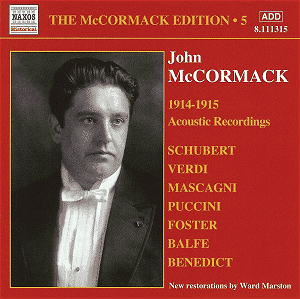
 John McCormack
(tenor)
John McCormack
(tenor)