Editorial Board
MusicWeb International
Founding Editor Rob Barnett Editor in Chief
John Quinn Contributing Editor Ralph Moore Webmaster
David Barker Postmaster
Jonathan Woolf MusicWeb Founder Len Mullenger
Karl Amadeus
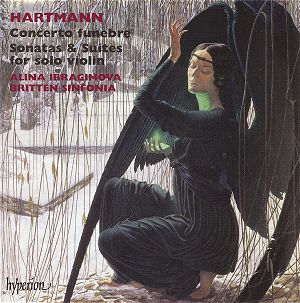
HARTMANN (1905-1963) Concerto funebre for violin and string orchestra
(1939 revised 1959) [21:48]
Suite No.1 for solo violin (1927) [19:54]
Suite No.2 for solo violin (1927) [9:34]
Sonata No.1 for solo violin (1927) [14:58]
Sonata No.2 for solo violin (1927) [14:14] Alina Ibragimova
(violin)
Britten Sinfonia
rec. Henry Wood Hall, London, November 2006 (Concerto funebre);
January 2007 (sonatas and suites) HYPERION
CDA67547 [80:48]
Many recordings of the Concerto funebre have coupled
it with other large-scale orchestral works by Hartmann or
have taken the opportunity to programme it with violin concertos
by other composers – a course taken for example by Zehetmair
and Holliger where they also presented the Berg and Janáček
concertos. This one is different. Its focus is unremittingly
and uniquely on Hartmann’s violin works.
This is also the debut disc of Alina Ibragimova and whilst
she doesn’t enter into quite a hornet’s nest of alternative
recordings of the concerto it’s very much the case that the
Hartmann admirer has a variety of recordings and approaches
from which to select - from the Gertler/Ančerl [Supraphon
SU36722 - see review] to this latest entrant. Ibragimova’s
approach perhaps most approximates that of Isabelle Faust
[ECM 4657792] though
the newcomer certainly tends to a greater sense of tonal
reserve. As a performance it’s removed profoundly from both
Zehetmair’s gritty determinism [Apex 0927408122] and
Gertler’s romanticised expression, so too
from Čenĕk Pavlík’s sympathetic though less secure
intensity [Panton 0529].
A number of key areas will determine your allegiance, or
allegiances, as this work - like all great works - will bear
a range of approaches. Firstly there’s the matter of the
soloist’s tonal and architectural priorities. Ibragimova
is an imaginative and subtle player. The opening statements
are measured and withdrawn but she can sculpt with incision
and drama when required as she does in the Adagio. Her attacks
in the third movement Allegro are resinous and dynamic and
in the finale, taken at a perfect tempo, she allies herself
to the approach of Faust and to a lesser extent Zehetmair
in her tonal responses. Faust’s tonal resources are more
variegated than Ibragimova’s. Nobody has since replicated
the approach of Gertler whose unbridled and vibrato rich,
close-to-the-microphone approach is very much at one extreme – an
exceptionally moving, totally committed and unashamed performance
led by Ančerl who is almost overwhelming in his concord
with his soloist.
There’s next the question of the orchestral sound-world.
The Britten Sinfonia is led by Jacqueline Shave but there’s
no conductor so this must have been a recording of consensus.
One notices that the orchestral climaxes in the Adagio are
more atmospheric and “present” in the ECM recording if a
little plusher as well. By contrast the Hyperion recording
is a little more swimmy and so the third movement orchestral
chords and lower string counter-themes don’t register as
viscerally – they’re somewhat cushioned and the effect is
rather more relaxed, the character of the music muted a little.
Nevertheless this is a most impressive reading
all round, entirely cogent architecturally and technically
highly accomplished. My own preference remains Faust on ECM
for her greater sense of emotive engagement, one that never
spills over into excessive effusiveness. Zehetmair’s tempo
relationships are highly personal – he takes the Adagio very
fast – and his implacable approach is one of strong contrasts
not all of them, to my ear, convincing. Čeněk
Pavlík, with Milos Konvalinka, is worthy and often
impressive but not quite on top of the writing. There are
a number of
other performances I’ve not had time to mention or have not
heard. My own preference however is for Isabelle Faust on
ECM and for the older Elmanesque approach of Gertler. One
should note that a performance by Wolfgang Schneiderhan with the Bavarian Radio Symphony Orchestra and Rafael
Kubelik has just been issued on Orfeo C718071B.
Desirability is increased by the coupling. Others
have essayed the sonatas and suites, Ingolf Turban on Claves
509518 most obviously (without coupling) since his were premiere
recordings, but Ibragimova has their full measure. She’s
rather freer than he was a decade ago, fine player though
he is. These are early works, written in 1927 when Hartmann
was twenty-two and they owe much to Hindemith and to neo-classicism.
She deals dashingly with the timbral contrasts and double
stops of the Fugue of the First Suite. Some rough-hewn folk
fiddling is called for, as well as some stratospherically
high writing. The finale is a tense Chaconne. The Second
Suite is considerably more compact with a hymnal or folk
song lilt to its opening and a sort of baroque cakewalk for
the “Jazz Tempo” finale – though I ought to add that for
all his relative youth this is subtly done and not garish,
as in the manner of quite a few of his contemporaries whose
enthusiasm for American jazz outstripped their capacity to
absorb it intelligently.
The First Sonata is a powerful and expressive
work that calls for plenty of roughened tone – “ugly” in
the composer’s word. Its heartbeat is a long and intense
lied exploiting registral extremes, sometimes austere, and
very Hindemith-like. The Second Sonata has a few hints that
Hartmann knew some Bartók – the demands are incessant, powerful
and often unremitting and the folkloric hues are part of
a strongly outlined tapestry. The longest single movement
of the suites and sonatas comes here - a slow movement of
high seriousness and accomplishment.
The sonatas and suites are difficult, sometimes
ungrateful sounding works to play but Ibragimova proves a
confident and assured guide. Together with the concerto and
with fine notes this is an impressive addition to the Hartmann
discography.
Jonathan Woolf
Please support our advertisers below by clicking on the logos for further information.

























 Alina Ibragimova
(violin)
Alina Ibragimova
(violin)