Editorial Board
MusicWeb International
Founding Editor Rob Barnett Editor in Chief
John Quinn Contributing Editor Ralph Moore Webmaster
David Barker Postmaster
Jonathan Woolf MusicWeb Founder Len Mullenger
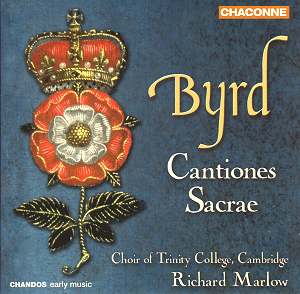
William BYRD (1539/40-1623) Cantiones
Sacrae
Haec dies, no 21 (1591) [2:09]
Miserere mei, Deus, no. 13 (1591) [3:44]
Laetentur coeli, no. 16 (1589) [3:09]
Salve, Regina, no. 4 (1591) [8:27]
Laudibus in sanctis, no. 1 (1591) [5:18]
Ne irascaris, Domine, no. 12 (1589) [9:34]
In resurrectione tua, no. 10 (1589) [1:37]
Domine, non sum dignus, no. 15 (1591) [3:33]
Vigilate, no. 9 (1589) [4:18]
Domine, secundum multitudinem dolorum meum, no. 15 (1589)
[3:29]
Domine, salva nos, no. 20 (1591) [4:18]
Cantate Domino, no. 18 (1591) [2:08]
Quis est homo, no. 2 (1591) [5:58]
O quam gloriosum est regnum, no. 13 (1589) [4:28] Choir of Trinity
College, Cambridge/Richard Marlow
rec. Chapel of Trinity College, Cambridge, 8-10 July 2001. DDD CHANDOS CHACONNE CHAN0733 [62:57]
This
CD offers a selection from Byrd’s Sacred Songs, six
motets from the sixteen published in 1589, eight from the
21 published in 1591. In the heading these are identified
after their titles by their numbering in the original and
modern editions.
Trinity
College Choir is one of mixed voices and there’s contemporary
evidence that Byrd’s Latin music was sung by such a combination.
However, the Sacred Songs were published for domestic
use in Catholic households, so it’s likely that usually smaller
forces, even just one voice per part, performed them than
the thirty singers pictured in this CD booklet photo.
The
most memorable motet of the 1589 selection is Ne irascaris,
Domine. This begins as a soft, contrite plea, ‘Be not
angry any more, O Lord’, smoothly sung and phrased. Soon
comes ‘Ecce, respice’ (tr. 10 1:52), an intent, aching call
to attention which grows more urgent in this performance.
It is then expanded to ‘populus tuus omnes nos’(2:52) with
a feeling of pride and solidarity in this mantra like affirmation ‘we
are all your people’ as the counterpoint grows in texture
and sonority. The second part, ‘Civitas sancti tui’ (tr.
11) begins recalling the beauty of ‘the city of your holy
place’ before the plain reporting of present reality, ‘facta
est deserta’ (0:44), ‘is become a wilderness’. Now comes
the human reaction, a lament ‘Sion deserta facta est’ (1:46)
given out in homophony in turn by the upper four voice parts,
then the lower four, an octave lower. Marlow presents this
too with consistent smoothness. The desolation is all in
Byrd’s scoring. ‘Jerusalem’ (2:21) is now specified in polyphony
as a happy memory but the firm statement ‘desolata est’ (2:55)
through repetition contains the starkness of gradual, painful
acceptance, heartrending beauty of tone notwithstanding.
I
compared this recording with the 1999 recording by The Cardinall’s
Musick/Andrew Carwood (ASV Gaudeamus CDGAU309). Carwood
uses only one
voice per part which brings about a more personal, etched
expressiveness and greater clarity of contrapuntal articulation.
But there’s also a sufficiently ample sonority owing to the
airy acoustic of Arundel Castle’s Fitzalan Chapel whereas
that of Trinity College Chapel is smooth but more neutral.
Carwood projects the piece more urgently, with a timing of
8:36 against Marlow’s 9:34. In the first part Carwood’s ‘populus
tuus’ has a more downcast yearning pleading about it where
Marlow shows more assurance. In the second part Carwood finds
a relentless flow but a lighter, lilting recall of ‘Jerusalem’ before
the overwhelming sadness and weariness of the repetitions
of ‘desolata est’. Carwood achieves expressiveness through
pace and clarity of melodic line and contrapuntal exchange
rather than the dynamic contrasts that Marlow adds. Marlow
opts for a more prayerful, mystical opening of weary contemplation,
a dramatic crescendo for the second soprano ‘Ecce’ (tr. 10
2:20), a cowed, sotto voce ‘Sion deserta est’, a soft
focus ‘Jerusalem’ at first and a variation of dynamic for ‘desolata
est’ with sensitive tapering down (tr. 11 3:27) and then
increase in anguish (4:03) before final softening.
But
there are three motets of jubilation. In resurrectione
tua (tr. 12) is notable for its Alleluias, a creamy first
phase at 0:30 and extended series from 1:01, light and flexible
from Marlow but with a positive culmination. Carwood here
is more gutsy in rhythm but Marlow reveals more the grand
architectural span. O quam gloriosum est regnum is
Byrd’s vision of a choir of saints. Marlow takes it more
pacily than Carwood, 4:28 against 5:00. This makes the opening
a gleeful, beaming assurance. Thereafter you soak in the
2 soprano lines exchanging descants. Marlow gives you horizontal
smoothness, Carwood’s lustier rejoicing emphasises vertical
clarity. Laetentur coeli is also treated more pacily
by Marlow, 3:09 against Carwood’s 3:42, creating a more athletic
opening, snappy exultation (tr. 3 0:16) contrasted with smooth
jubilation (0:28) and reflection on hope for the poor (1:00).
The second part (tr. 4), at first confined to the upper 3
voices, is more pearly and rarefied. Marlow emphasises Byrd’s
fluency. The outcome is both admirable and somewhat distancing.
Carwood’s account blossoms more via more cutting edge, its
close a serene blessing on the poor.
Domine,
secundum multitudinem dolorum meum (tr.
15) is dramatically presented by Marlow as a changing focus:
the laboured falling ‘dolorum’ (0:37), upward and uplifting ‘consolationes’ (1:46),
light and dancing ‘laetificaverunt’ (2:32). Carwood concentrates
more plainly on the intertwining imitation which achieves
the illusion of a crowd of witnesses. To Vigilate (tr.
14) Marlow brings a light opening, rejoicing in feathery
counterpoint, gradually more admonitory as the voice parts
increase. He consistently dramatizes by contrasts of dynamic,
like the lusty first tenor entry on ‘sero’ (0:42) and soprano
cry ‘vigilate’ (1:51). Carwood’s single voices create a
more graphic picture of a cock crowing, the sudden arrival
of the master and a coda of more sinewy strength where
Marlow (3:28) relies on grand formality, but the student
choir here more vividly conveys the slinking syncopated
falling scale of ‘dormientes’ (2:33) showing the servants
fast asleep, born perhaps from experience of lectures?
Turning
to the 1591 collection, Laudibus in sanctis stands
out. Marlow’s performance is sonorous and suave by turns
as he weaves a continual tapestry of dynamic contrasts, eg.
the loud-soft-loud tiering of ‘laeta chorea’ (tr. 9 0:22)
and the bite, clarity and variation of the ‘cymbala’ entries
from 0:47. But his Halleujah chorus is largely soft as is
the focus of the assured coda. Carwood’s performance, this
time on Hyperion (CDA67568) has more zest and sinew about
it while his
slightly slower tempo, 5:44 against Marlow’s 5:18, points
the cross rhythms more.
Marlow’s recording of Quis est homo was
the first ever, though Carwood’s was released first. Marlow’s
faster tempo, 5:58 against Carwood’s 6:19, emphasises an
atmosphere of serenity and positive ideas fluently promoted.
For me Carwood’s less smoothly tapered, more directly and
intently expressive manner better matches the didactic text.
With Salve, Regina it’s Marlow’s slower tempo, 8:27
against Carwood’s 7:07, that I find more effective. The rising
scales of ‘salve’ (tr. 5 0:44) have a touch of effortful
yearning, explained by key motifs that Marlow allows to emerge
from the gently sorrowing texture, ‘in hac lacrimarum valle’, ‘in
this vale of tears’ (2:12), the address ‘advocata nostra’, ‘our
advocate’ (2:52) and longing in the closing cry, ‘ad nos
converte’, ‘turn to us’ (3:50) where Carwood’s is more of
a despairing demand. Marlow’s second part (tr. 6) opens with
a serene vision of Jesus and from 1:30 offers an extended,
adoring appeal to Mary, beautifully focused, his finest performance.
The
other five items on this CD, Carwood has yet to record, but
four appear on the 1591 selection from New College Oxford
Choir/Edward Higginbottom (CRD 3439) from 1986. Marlow’s Haec
dies has eagerness and spring about its opening, a joyous ‘exultemus’ (tr.
1 0:38), frolicking ‘et laetemur’ (0:42) and supple Alleluias
from 1:02 capable of both reflection and affirmation. The
slower Higginbottom, 2:32 against Marlow’s 2:09, has clearer
yet stiffer entries and a slow motion feel. In total contrast
Marlow’s Miserere mei, Deus is contrite pleading,
the gentle lingering of the elaboration in the soprano at ‘misericordium tuam’ (tr.
2 1:15) giving the impression of infinite mercy. The incisiveness
of Higginbottom’s entries takes away something of the humility
of the pleas and while the even tone of the sorrowful avowing
of his close has dignity it isn’t as moving as Marlow’s more
romantic dynamic contrast, a climax at ‘dele iniquitatem
meam’ (2:47), falling away softly, ashamed, from 3:01. Domine,
non sum dignus receives a much more measured performance
from Marlow at 3:33 than Higginbottom’s 2:33. For Marlow
this is a careful appeal of six voice parts unfolding elaborately
with a soft, cajoling ‘sed tantum dic verbam’, ‘but say the
word only’ (tr. 13 1:56), for the first time excitement at ‘et
sanabitur’, ‘shall be healed’ (2:20), a motif whose note
values are then doubled in length (2:52) to emphasise the
power of faith. Higginbottom’s nervous energy lacks the breadth
and underlying faith that illuminates Marlow’s performance.
It’s a similar story with Domine, salva nos where
Marlow’s more generously phrased performance, 4:18 against
Higginbottom’s 3:18, creates humble pockets of folk imploring
to be saved and a poignant picture (tr. 16 1:21) of drowning
otherwise in repeated descending motifs. Higginbottom is
contrapuntally lucid but emotively too disciplined.
Cantate
Domino (tr. 17) is made a virtuoso
display piece by Marlow perhaps overmuch, with a striking
peal at 0:19 after a light opening and almost brutal very
loud repeats of the soft phrases from 0:56. I can live
more readily with the slightly slower, 2:23 against Marlow’s
2:08, 1993 Worcester Cathedral Choir/Donald Hunt (Griffin
GCCD4053) which is lively and clear enough rhythmically
and contrapuntally without Marlow’s touches of frenzy.
If
you like Byrd motets well upholstered and tightly shaped,
generous in dynamic contrasts, this CD will do nicely. If
you prefer more rhythmic vibrancy and individual voice part
expressiveness, go for Carwood.
Michael
Greenhalgh
Please support our advertisers below by clicking on the logos for further information.

























 Choir of Trinity
College, Cambridge/Richard Marlow
Choir of Trinity
College, Cambridge/Richard Marlow