Editorial Board
MusicWeb International
Founding Editor Rob Barnett Editor in Chief
John Quinn Contributing Editor Ralph Moore Webmaster
David Barker Postmaster
Jonathan Woolf MusicWeb Founder Len Mullenger
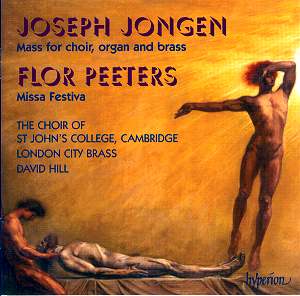
Joseph Jongen (1873-1953) Messe en l’honneur du Saint-Sacrement Op.130 (1945-1948)
[34:06] Deus Abraham Motet pour une messe de marriage W150
(1909) [3:21] Pie JesuNo.1of Deux Motets W71 (1895)
[2:49] Quid sum miser?No.1 of Trois Motets W99
(1899) [4:43] Flor Peeters (1903-1986) Missa Festiva Op.62 for choir and organ (1947) [27:31] Thomas Gould
(violin); Paul Provost (organ)
London City Brass
The Choir of St John’s College, Cambridge/David Hill
rec. St John’s College Chapel, Cambridge, 10-12 July 2006 HYPERION
CDA67603 [72:50]
Like
his fellow countryman Hercule Poirot, Joseph Jongen is often
thought of as a Frenchman, however he was a Belgian. Jongen
was born in Liège on 14 December 1873 and lived and worked
in that country until his death in 1953.
He
is probably best known to most music-lovers as an organ composer.
Yet a brief look at his catalogue reveals a huge variety
of works – most of which await discovery by the majority
of listeners. Jongen wrote some 240 works; although
a strong critical mind has caused nearly half of them to
be withdrawn by the composer. Interestingly there are a considerable
number of orchestral works that include a Piano Concerto and
a number of impressionistic tone poems.
I
am not sure how Madame Valentine Jongen né Ziane, must have
felt on hearing the Deus Abraham sung at her/their
Nuptial Mass. Jongen had met her at the Libre esthétique
in Brussels: she was a pianist. He proposed and the couple
were married in 1909. Joseph put together this short ‘motet’ for
solo tenor, violin and organ. Certainly she would realise
what her husband expected – ‘Your wife is like a fruitful
vine on the walls of your house, your children are the buds
of olives on your table.’ Not an unpleasant piece, but schmaltzy:
especially with the un–liturgical violin obbligato. But perhaps
the occasion demanded it?
Classic
FM listeners will know at least two examples of Pie Jesu – the
one from Fauré, and the other from the Andrew Lloyd-Webber
confection. Jongen’s version will never reach the Top Hundred
Classics – but it certainly deserves to be heard. It is a
particularly beautiful and meditative setting, as the words
require. On this disc, it is excerpted from the composer’s Requiem
Mass of 1895.
With
the Quid sum Miser? we are back to the fiddle accompanying
the bass soloist. This just does not ‘do’ for me. Of course
there is a strong tradition of all kinds of musical instruments
being used in church. Think of the ‘musician’s gallery’ that
Thomas Hardy recalled. And some churches even use electric
guitars! But the solo violin to my ear is the least liturgical
of instruments. If anything, it makes the music seem almost
operatic. The words of the motet begin – “What then shall
I say, wretch that I am …” Not perhaps the most flamboyant
of texts. Again this is not a bad piece – just one that does
not quite deliver the theological meaning in the best musical
manner.
The Mass
in honour of the Holy Sacrament was written in thanksgiving
for the release of his nephew from a German concentration
camp and also in memory of the composer’s brother Alphonse,
who died after a complex operation.
I
am not convinced by the use of the brass band in this work.
It is fair to say that it adds a considerable strength to
the music – yet somehow set against Jongen’s the superb part-writing,
it often overpowers and acts as a distraction. It is as if
Walton were to add brass flourishes to Vaughan Williams Mass
in G minor: it is difficult to decide if it helps or
hinders the music. To be fair, there are many gorgeous moments
when the brass points up the text – either from the gentle
side or from the brash facet of its tone.
I
believe that if an orchestral arrangement of the Mass was
made – akin to that of the great Duruflé Requiem it
would be impressive: the balance between brass, choir, organ
and liturgical needs does not seem quite right.
Furthermore
this is not a liturgical mass – I cannot imagine the music
being sung in church, even for a special occasion. It is
quite definitely a concert work. Of course there is no problem
with that – there are many masses that are manifestly unsuitable
for Sunday by Sunday use.
It
is difficult to know whether this is a great work. Brass
notwithstanding, there is a good balance of the parts, the
part writing is effective, the sound is impressive and often
moving. In fact there are some truly gorgeous passages in
this work However I cannot imagine it ever becoming popular
like the Fauré or the Duruflé Requiems. It will remain, like
the rest of Jongen’s music very much the preserve of a few
cognoscenti.
The
Flor Peeter’s Missa Festiva is quite a different work
to Jongen’s even although they were composed around the same
time. For one thing, Peeters uses only the organ to support
the choir. For another, he is more influenced by plainsong
and folk music than is apparent in Jongen. The sound-world
is much less romantic, more Spartan and perhaps even more
bitter-sweet than that of Jongen. We hear plainsong and even ‘organum’ on
a number of occasions during this work which adds considerably
to its almost timeless impact on the listener.
However,
the Missa Festiva is well balanced and surprisingly
restrained for a work that was manifestly written for a ‘Festival’ occasion.
There are many lovely moments that both impress and move.
Peeters
is noted for his organ music – although there are a considerable
number of vocal works in his catalogue. He spent much of
his student years studying Gregorian chant. In addition he
was enthusiastic about the Flemish School of Polyphony that
included such great composers as Dufay, Ockeghem and Josquin.
There are also nods to neo-classicism and twentieth century
techniques such as polyrhythm and polytonality. Peeters was
an eclectic composer who was firmly rooted in his country’s
musical tradition.
The
programme note suggests that Peeters’ “great talent nowhere
approached the compositional genius of Jongen”. However listening
to these two masses ‘back to back’ reveals a well written
and finely balanced work that is wholly consistent with itself. The Missa
Festiva is a fine work that, in my opinion has the aesthetic
edge over the ‘greater’ Mass by Jongen. The listener must
decide for himself or herself.
The
music sounds great in this recording – the ‘cathedral’ effect
is impressive. The performance of this music is first class,
notwithstanding the fact that I do not have another recording
to compare them with.
This
is a worthy CD that all lovers of ‘ecclesiastical’ music
will want in their collection. In spite of my reservations
about the shorter Jongen pieces this release presents two
fine works by two great, but relatively unknown Belgian composers.
John
France
Please support our advertisers below by clicking on the logos for further information.

























 Thomas Gould
(violin); Paul Provost (organ)
Thomas Gould
(violin); Paul Provost (organ)