These
are simply marvellous accounts of two of Dvořák's most
popular symphonies. Mark Obert-Thorn is both Producer and Audio
Restoration Engineer and has done a simply wonderful job of
transferring the HMV DBs. Thinness of string sound is kept to
a minimum.
I
heard a performance of the Seventh here in London with the LPO
and Marin Alsop which bordered
on the lacklustre. Nothing of the sort could be levelled at
Talich and his forces. The pacing of the first movement is excellently
judged, bringing with it just the right amount of drama. Interestingly
shades of Elgar make themselves known; and yet when it comes
to the second movement it is straight, and unmistakably, to
the Bohemian forests. Listen out for the astonishingly lonely
oboe solo around 8:19. There is a real Czech energy to the Scherzo before the finale squeezes itself onto the scene. Whereas
in Alsop's hands this seemed a movement full of longueurs, with
Talich the tension never flags for a second, and the coda positively
blazes.
The
Eighth's opening glows in a way few others do, no matter what
the recording date. The glow seems both internal and external
in a movement that oozes easy melody. Woodwind sing of the Czech
countryside, and yet Talich still manages to conjure up near-Wagnerian
drama from his heavy brass.
Indeed,
this is a reading of No. 8 that reaches to the extremes. From
the drama of the Allegro con brio, Talich
brings forth hushed pianissimi in the Adagio
that are nothing short
of miraculous. The third movement is perhaps a touch slower
than usual, yet Talich makes its easy-going nature feel just
right. The call-to-arms that heralds the finale ushers in a
drama of almost operatic proportions. starting from a cello
tune moulded with what can only be described as paternal care
by Talich. Only one quibble – the famous horn trills, surely
Mahlerian in nature, are all but inaudible. But surely this
is cancelled out by the judicious use of string portamento,
a lost tradition nowadays that one finds here in its most natural
and unaffected form. It is true that some might find this Eighth
a little 'pushed', a little relentless but personally I find
it part of Talich's search for musical truth to highlight the
grit at the heart of this sunniest of Dvořák's symphonies.
The
learned and erudite booklet notes are by Tully Potter. It is
difficult to find fault with an issue as consistent as this
one, so it is just left for me to give my unqualified recommendation.
Colin
Clarke
























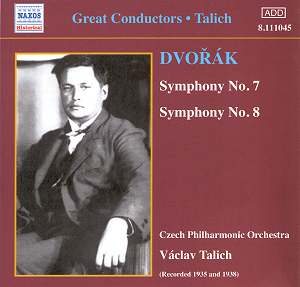

 Czech Philharmonic
Orchestra/Václav Talich
Czech Philharmonic
Orchestra/Václav Talich