Editorial Board
MusicWeb International
Founding Editor Rob Barnett Editor in Chief
John Quinn Contributing Editor Ralph Moore Webmaster
David Barker Postmaster
Jonathan Woolf MusicWeb Founder Len Mullenger
Johann Sebastian
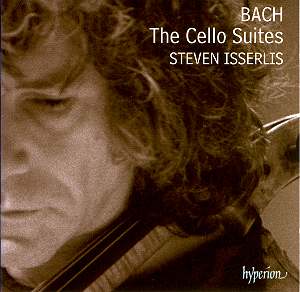
BACH (1685-1750) The Cello Suites CD 1
No. 1 in G major BWV 1007 [16:11]
No. 2 in D minor BWV 1008 [17:27]
No. 3 in C major BWV 1009 [19:46]
No. 4 in E flat major BWV 1010 [21:35] CD 2
No. 5 in C minor BWV 1011 [24:06]
No. 6 in D major BWV 1012 [27:26] The Song of the Birds (arr. Sally Beamish) [2:44]
Prelude from Cello Suite No.1 (Anna Magdalena manuscript) [2:24]
Prelude from Cello Suite No.1 (Johann Peter Kellner manuscript)
[2:21]
Prelude from Cello Suite No.1 (Johann Christoph Westphal
collection) [2:29] Steven Isserlis
(cello)
rec. Henry Wood Hall, London 4-8 December 2005 (CD1, CD2 Song, Preludes), and
17-19 July 2006 (CD2 Suites 5, 6) HYPERION CDA67541/2 [75.10
+ 61:58]
There
is no such thing as a definitive performance or recording
of J.S. Bach’s six suites for cello solo. The origins of
the works are shrouded in enigmatic mystery so there is not
even an urtext edition although as this recording’s extra
tracks illustrate there are numerous sources, each of which
has its own fascinating insights and validity. Historians
have concluded that the works were written some time around
1720, or at the very least during Bach’s time as Kapellmeister
of the court orchestra of Prince Leopold of Anhalt-Cöthen,
when he had no choir or responsibility for church music but
did have a virtuoso instrumental ensemble, for whom among
other works the Brandenburg concertos were written.
Like
all of Bach’s solo work, the beauty for the listener is not
only in superbly constructed musical forms, seamlessly perfected
counterpoint and elegantly expressive melodic lines. Each
performance is also a communion of the musician with Bach’s
music through the medium of their instrument, reflecting
the artist’s feelings, and surprisingly often on how they
feel on that day or in that moment. With the suites for cello
we are also given the gift of that most natural of instruments,
whose range finds close correspondence to the human voice
and is therefore – in the right hands – a most amenable and
communicable sound for extended listening. Viewed from all
angles, this is such a personal medium I find it impossible
to make this much in the way of a comparative review. I brought
out my copy of the 1983 CBS recording by Yo-Yo Ma just as a point of reference, as well as a dusty old box of
the 1964 Philips recordings by Maurice Gendron. Readers will
no doubt have their own favourites, and no new recording
is likely to persuade anyone to part with their Tortelier,
Rostropovich, Casals or Fournier; neither should they. Each
is the individual statement of a great artist, and personal
taste will already have had you gravitating more often to
one over the other.
So,
what is to be gained with this new Hyperion set by that great
star in the string firmament Steven Isserlis? If you happen
to make an A-B comparison, you may at first be surprised
by the relatively small-scale approach. Used to big-boned
and fairly romantic interpretations by the likes of Ma and
Casals, Isserlis sounds relatively intimate, not really introvert,
but somehow sourcing the foundations of his expressiveness
from a different place. If however you have been sensible,
and not put this new recording up against a golden oldie,
then there need be no question about any sense of scale or
proportion. Isserlis’s playing is deft and light, the music
rendered direct and transparent. Even before reading the
booklet notes, you should feel you are being engaged by a
very vocal, almost conversational discourse. The playing
doesn’t hector or lecture, but welcomes the listener into
a richly verdant field of ideas and musical allegories. Isserlis
presents the music not so much as technically virtuosic and
compositionally brilliant – such aspects are incidental:
he is communicating a narrative.
Isserlis’s
own booklet notes reveal the great deal of time and effort
which has gone into choosing the best options when it comes
to the available sources for this music. The results have
produced four versions of the Prelude to the Suite No.1
in G, whose differences are rather more in the detail
than in the substance. True, different slurring changes the
lines and different notes pop through here and there, but
the exercise, while having its own fascinations, is something
of an academic one. Somewhat perversely Isserlis leaves in
obvious copying errors, which on occasion had this reviewer
thinking that the editing had gone wrong. Never mind, these
make for interesting bonus tracks, and show something of
how the ideal world of the final versions was arrived at.
The pleasantly arranged Catalan folksong The Song of the
Birds is also a nice extra, serving to break the intensity
of the last moments of the Suite No.6, and throwing
Bach’s incredible genius into even sharper light.
The
playing is, in my opinion, a delight and an inspiration throughout.
As previously mentioned his is a light touch, and so even
the most intense passages never sound like the kind of scrubbing
which has sometimes put me off the cello in the past. He
can dig deep and the dynamic range is tremendous: but even
the most dramatic moments have a grace and poise which I
find irresistible. His tempi are never abnormally extreme,
and while he is brisk and efficient in the dances there is
plenty of time for ecstatic expression where the music demands.
One of the things I enjoy most is the natural sense of flow,
which makes the music seem timeless; both ancient and freshly-minted
at the same time. There is rubato, but you don’t experience
it as rubato, you experience it as music in
the purest sense of the word. In this, Isserlis’s control
is absolute. Take the elastic way in which time undulates
in the Menuets I and II of the Suite No.1.
At each repeat, the quasi-silence between phrases has its
own special expressive power – you don’t sense it as a round
of repeats, more a circular object studded with jewels of
infinite variety.
At
the end of his booklet notes, Isserlis provides us with his
personal feelings on the suites, amounting to a kind of ‘confessional’ of
the way he has come to see them as ‘Mystery Suites’ in the
sense of the three kinds of ‘Sacred Mystery’: Joyful, Sorrowful
and Glorious. Isserlis makes no attempt to turn this into
a scholarly interpretation of Bach’s original intentions,
and freely admits that such a reading is impossible to prove
as authentic, although to his mind it fits the works exactly.
Some of his descriptions of the individual suites may seem
a bit far-fetched, but what does result is a line through
which all of the suites are given a satisfying continuity.
There are no clear favourites or highlights, as each work
has its own function and expressive power. The musical journey
on which you are taken is something like being presented
with the St. Matthew Passion on a single instrument – something
you might have thought impossible to re-create, but in the
presence of this recording, something I find equally impossible
to deny.
The
Henry Wood Hall an ideal acoustic, and Hyperion’s recording
is quite remarkable. You can play it at distance, softly
and candlelit. Turn up the volume and Isserlis comes closer
and closer, until you are as good as inside the gorgeous
Feuerman Stradivarius instrument, bouncing around with the
little ball of mousy fluff at the bottom in the most deeply
resonant bits. As a set of the complete cello suites by J.S.
Bach this, to me, represents the best of the best in this
most personal of all possible worlds.
Dominy Clements
Please support our advertisers below by clicking on the logos for further information.

























 Steven Isserlis
(cello)
Steven Isserlis
(cello)