Editorial Board
MusicWeb International
Founding Editor Rob Barnett Editor in Chief
John Quinn Contributing Editor Ralph Moore Webmaster
David Barker Postmaster
Jonathan Woolf MusicWeb Founder Len Mullenger
Kalevi AHO (b.
1949)
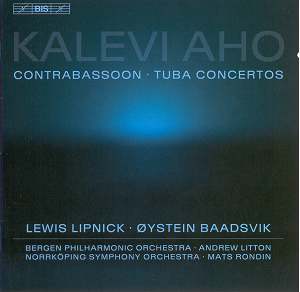
Concerto for Tuba and Orchestra (2000-01) [28:30]
Concerto for Contrabassoon and Orchestra (2004-05) [34:24] Øystein Baadsvik
(tuba), Lewis Lipnick (contrabassoon)
Norrköping Symphony Orchestra/Mats Rondin (tuba)
Bergen Philharmonic Orchestra/Andrew Litton (contra.)
rec. 23-24 February 2006, Grieg Hall, Bergen, Norway (tuba);
November 2006, Louis de Geer Concert Hall, Norrköping, Sweden
(contra.) BIS CD-1574 [63:42]
Being a composer and a sub-contrabass flute player,
I do know a little about extreme
instruments and the problems and challenges which exist
in writing for them. I believe the gauntlet is still waiting
to be picked up when it comes to a concerto for my instrument,
but tuba concertos have been increasingly a part of concert
programmes since Ralph Vaughan Williams’ pioneering work
in the genre from 1954. There have been a few good examples
since, including some recorded by
two of my former teachers Edward Gregson and Roger Steptoe.
Given the opportunity and the technical challenge, players
will rise to the demands of such works, and the standards
expected of new generations of professionals increase as
a result.
One aspect of the tuba concerto is, in general, a tendency
to brevity when it comes to their composition. This may have
something to do with sympathy for the soloist, who might
be expected to stagger from the stage, barely having survived
such a heavy blow – another reason being the difficulty in
creating a sustained serious work for something which is
often perceived as a ‘comedy’ instrument. Kalevi Aho’s approach
involved close collaboration with a seasoned professional,
and the work actually begins and ends on notes chosen by
Harri Lidsle, tuba player with the Lahti Symphony Orchestra.
In his own notes, Aho reminds us that “by nature, the tuba
is a very songful instrument”, and indeed there are many
highly lyrical lines, themes and passages which explore the
expressive upper ranges of the instrument. The instrument’s
surprising agility is also given free rein, and sensitive
orchestration means that the low tessitura and resulting
limitations of the instrument’s projection through heavy
textures are avoided. This is not to say that the orchestra
is in any way restricted either. The tidal waves of sound
in the final movement, with brass, strings and a battery
of percussion in full flow are truly symphonic in character,
fulfilling the promise of a grand scale which can be assumed
from the half-hour timing of this work.
Most of the writing
for the soloist is conventional, but as the third and final
movement draws to a close, the player sings at the same time
as playing, as well as grunting and snorting like some kind
of strange animal – combining with the orchestra to magical
effect. With the lyrical writing of the second movement’s
cadenza the tuba actually sounds like a smaller instrument
on occasion, but far from being the slower middle movement
one might expect, the second begins with high, almost cinematic
drama. Øystein Baadsvik’s playing is truly excellent, employing
subtle vibrato here and there, tonsil rattling low notes
and stunning technique when it comes to articulation. The
combination of powerful orchestral writing and genuine musicianship
from all concerned is an unbeatable one, and this work deserves
to be taken up globally.
The contrabassoon is an altogether different, and to my ears
more uncontrollable beast than the tuba. Lewis Lipnick writes
his own note for the piece, having commissioned it, and subsequently
confronted with “the most challenging work ever written for
the contrabassoon.” Aho’s concerto in fact took the instrument
a whole octave above its recognised range, and it was the
designs and construction of an acoustically superior instrument “by
luck or fate” in the U.S. which ultimately made the work
playable. The recording here is made up from two live performances
with the Bergen Phil. conducted by Andrew Litton, and the
performance certainly has plenty of concert-hall vibrancy
although I detected no audience noise at all.
The composer’s notes tell us that the first ever contrabassoon
concerto was also written for Lewis Lipnick in 1978, the
composer in this case being Gunther Schuller. Other examples
are virtually non-existent however, and Aho again consulted
extensively with specialists before writing this incredible
work. Like the tuba, and in fact many other ostensibly subterranean
instruments, the contrabassoon can have a very cantabile character,
and while the whole range of the instrument is explored,
its lyrical nature comes through remarkably well. Again,
imaginative orchestration is very much part of Aho’s successful
negotiation with his unusual solo instrument, and trios with
the contrabassoon, heckelphone and alto saxophone provide
some of the more intriguing moments.
The Contrabassoon Concerto is, in the composer’s own
words, “the most monumental of my instrumental concertos – in
essence [ ] almost a symphony for contrabassoon and orchestra.” I
do note however, that one of the aspects both of these works
share is that neither out-stays their welcome, and neither
really gives the impression of being ‘long’. Both kept me
on the edge of my seat, and Lipnick’s playing is an inspiration.
Aho’s musical voice is highly individual, but if you want
some references, then one or two woodwind passages reminded
me of a wild kind of Nielsen, you might get a whiff of Shostakovich
here and there, the occasional Sibelian inflection in the
richness of the orchestration. Aho’s symphonic work is recognised
as having a kind of Mahlerian power, and on the strength
of the Contrabassoon Concerto I can well believe it:
the opening six minutes or so of the work is like entering
some kind of breathtaking temple or vast undiscovered inner
space, and the climax of the final movement from about 5:00,
even including the dropping of heavy chains; is something
which may do damage to your dentures, such is the jaw-clenching
tension which develops.
The recordings are superb, and well up to BIS’s own high
standards. Collectors of this label’s ongoing range of releases
by this composer (see below) will already have this disc
on their wish-list, and will most
certainly
not
be disappointed.
Former
non-initiates
like me will have had an entirely new world opened for them,
which, for the price of a CD, has to be something of a bargain.

























 Øystein Baadsvik
(tuba), Lewis Lipnick (contrabassoon)
Øystein Baadsvik
(tuba), Lewis Lipnick (contrabassoon)