This excellent CD
contains three groups of settings from the Lamentations of
Jeremiah, which are part of the Roman liturgy for Holy Week,
at the end of which comes the Triduum: Maundy Thursday (Coena
Domini), Good Friday (Parasceve) and Holy Saturday
(Sabbatum Sanctum). Typically this liturgy is varied, complex
and unusually rich, with material drawn from the Old and New Testaments,
various responsories, antiphons and special prayers and ceremonies.
These include the Tenebrae, which reach a climax during
the ‘Benedictus’ at Lauds, when (church) candles are progressively
extinguished. Lessons, lectiones, are usually based on
biblical passages, reflections on such texts and/or extensive
quotations from the Lamentations. Other ceremonies commenting
on the events of Easter take place throughout this period with
a huge store of texts from which composers were also able to choose
in marking this holiest time of the year.
Palestrina made
four complete Lamentations settings in all, of which
this disc contains the third. In common with the others, the
composer selected only a small portion of the Gospel narratives
of the Passion. These are not only similar to the other three
settings, but are also lectiones with reflective, sometimes
melismatic interludes on the corresponding letters in Hebrew
- aleph, beth, vau etc: they have symbolic meaning - that preface
them. Polyphonic settings of unvarying texts coming before the
lectiones themselves were also the norm; as were conventions
for the closing exhortation of each lectio: ‘Ierusalem,
Ierusalem convertere ad Dominum Deum tuum’.
An almost greater
the challenge for composers than these rigorous conventions
was to write music of such sombreness and unrelenting intensity
that was nevertheless usable, accessible. The settings on this
CD are, make no mistake, grave, slow and reflective. But Palestrina’s
genius extends far beyond mere figurative melancholy. Yes, he
uses some word painting; he underlines the pith and anger of
the text. But it’s from the overall effect of grief in the music
that its impact comes. To communicate this detachment, which
must never hint at the maudlin or self-pitying, is the challenge
of the performers. The Choir of Westminster Cathedral under
Martin Baker are well up to the challenge; their approach is
forceful and appropriately dignified and the CD can be recommended
as a result.
A composer as familiar
as Palestrina with the musical pitfalls of a somewhat restrictive
text, who yet possessed the great imagination that he did was
able to produce music of power and resonance in his Lamentations.
He achieved this by using a rich harmonic palette, original melodic
developments and by making full use of those elements (referred
to above) external to the essence of the liturgy: there is a noticeable
contrast between the story of the text on the one hand, and its
atmosphere as conveyed by the sentences surrounding the lectiones
and acting as commentary on the other. It’s a relief pointed up
by the difference between homophony and polyphony. The articulation
of ‘Vau’ (Hebrew ‘W’) for example is plain and makes an interesting
contrast with the rest of Lectio II.
The approach of the
forty-some strong Westminster Cathedral Choir is as though they
entered their sessions with the weight of the world on their shoulders,
then let the music do what it must. Nothing unduly melancholy;
certainly nothing depressed. Just sincere, evenly paced; never
understated nor yet lacking in spirit. It’s singing of power,
restraint - yet singing that bears lucid witness to the seriousness
of this period of the church year. Organic, united without being
uniform, the wholeness is persuasive, though never so crystalline
and transparent as would be an equivalent performance by the Tallis
Scholars, for example.
Each of the three
Lamentations on this disc has three lectiones; each
lasts between seven and ten minutes; but they are no miniatures.
Nor does the Westminster Choir’s approach give the feeling of
having either condensed their range or stretched them unduly for
easier impact. They are sung with plainness, clarity, conviction
and trenchancy. It’s music with a searing purpose and tone benefiting
from a performance assembled carefully and intelligently.
Mark Sealey
























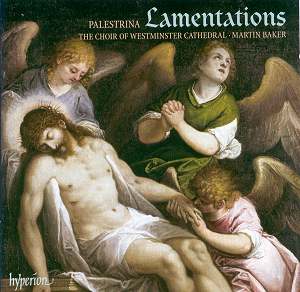

 Choir of Westminster
Cathedral/ Martin Baker rec. 10-12, 14 July 2006, Westminster Cathedral,
London. DDD
Choir of Westminster
Cathedral/ Martin Baker rec. 10-12, 14 July 2006, Westminster Cathedral,
London. DDD