This is the essential
John Ireland containing three works
that stand among the composer’s finest.
Satyricon and the Studies
are pleasing makeweights.
Along with the items
on SRCD
240 (Tritons, The Forgotten
Rite, Mai-Dun, A London
Overture; Epic March; Julius
Caesar; The Overlanders suite)
issued in January 2007 all these derive
from recordings first issued on black
disc in the late 1960s by Lyrita Recorded
Edition. They were:-
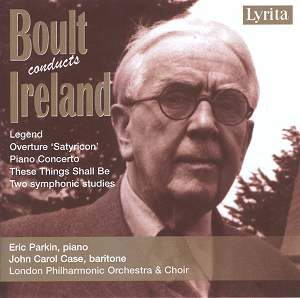
SRCS32 The Forgotten
Rite; Mai Dun; Legend
for piano and orchestra;
Overture Satyricon
SRCS36 These Things
Shall Be for baritone solo, chorus
and orchestra; Piano Concerto
SRCS45 Symphonic Prelude:
Tritons; Two Symphonic Studies;
Suite The Overlanders; Scherzo
& Cortege (Julius Caesar)
Julian Herbage wrote
in the liner note that Legend forms
a natural trilogy with The Forgotten
Rite and Mai-Dun. Yes and
No. Certainly it is taken up with the
prehistory of Southern England but it
has little to do with the more overtly
romantic-melodramatics of Mai-Dun with
its Tchaikovskian references largely
uncloaked. Legend has more in
common with The Forgotten Rite.
Both are taken up with the hidden ancient
England which can be glimpsed in fugitive
moments amid coppices, at twilight and
on lonely hillsides. The Lyrita technical
team produced a lucid, poetic balance
not wanting in muscularity. The brass
and the piano are given a deeply satisfying
place in the sound picture. This loosely
linked tripartite form can be characterised
as dramatic (Mai-Dun), poetic-elusive
(The Forgotten Rite) and hieratic-invocative
(Legend). The sturdy gait and
sustained tension of this piece suggests
some enigmatic druidic ceremony. For
an even more sensuous take on this work
don’t ignore Bryden Thomson’s Chandos
version. For Mai-Dun and The
Forgotten Rite the most poetic version
is that of John Barbirolli on Dutton
but then you have to contend with historic
mono sound. Legend’s way with
the piano and the orchestra can be compared
with the considerably more loquacious
Bax Symphonic Variations – a
much earlier work or the more concentrated
Northern Ballad No. 2. Satyricon
is yet more outgoing and clearly took
lessons in vigour from the Walton overtures.
It also has some of that peculiarly
lush Ireland romance drifting into Bax
concert overture territory at times.
However Walton suggests itself again
in the first section of the impressive
Two Symphonic Studies - two fugitives
from the music for the film The Overlanders
not included in the Mackerras-arranged
suite. This is the Walton of the Hamlet
funeral march. Both sections are
supremely well recorded showing how
the analogue process could attain the
highest standards and do so with shattering
fidelity.
The Piano Concerto
is given a most patrician and yielding
performance by Eric Parkin who much
later went on to record almost all the
Ireland solo piano music in stereo versions
to replace the mono LPs from Alan Rowlands
issued by Lyrita in the early 1960s.
The sound is gorgeously and assertively
transparent and flatters this work which
remains memorable for its bleached romanticism
and Petrushkan playfulness.
These Things Shall
Be also benefits from a recording
that lays bare the detail without being
sterile. It’s a fine work with a desperately
unfashionable text by the poet John
Addington Symonds. This sort of idealism
now draws a smirk or a sneer but its
utopian ambitions remain admirable.
And when sung as here with burnished
fervour the words and music register
strongly – try the wonderful unanimity
of the words A Loftier Race at
tr.7, 4:03
onwards. The recording does however
tend to congeal and thicken during the
louder and more blazingly impassioned
choral moments. Later still the choir
ascend to the heights for an ecstatic
'Trascending all we gaze upon' that
may well have affected the choral writing
in Patrick Hadley’s The Tree So High
on the words ‘And Daffodils …' .
The whole of These Things Shall Be
has a moving quality that lifts it above
the Piano Concerto. The version that
completely catches the wildly aspirational
convictions of this text is the now
venerable and damaged Barbirolli recording
on Dutton. Ireland courts the Elgarian
and then turns from it in the hymnal
Nation with nation … With Boult
we have John Carol Case whose incipient
vibrato is noticeable but under control.
Only when he came to record Finzi’s
Let Us Garlands Bring for Lyrita
some fifteen years later did this bring
him to grief.
What of the more immediate
future for Ireland and Lyrita? The cupboard
is not quite bare. April 2007 issues
include SRCD.242 Ireland: Concertino
Pastorale; The Holy Boy;
Minuet & Elegy (Downland
Suite) Bridge: Rosemary;
Suite for Strings; Sally in our Alley;
Cherry Ripe; Lament; Sir
Roger de Coverley LPO/Boult.
Fine and even essential
John Ireland in performances as freshly
conceived and played as they were when
first issued almost four decades ago.
Rob Barnett
The
Lyrita Catalogue
ALSO AVAILABLE
SRCD.240
Boult conducts Ireland – vol. 1
SRCD.220
Boult conducts Parry
SRCD.222
Boult conducts Holst
SRCD.231
Boult conducts Bax
These Things Shall Be comparative
reviews
Barbirolli http://www.musicweb-international.com/classrev/2002/Apr02/Barbirolli_English.htm
Hickox http://www.musicweb-international.com/classrev/2004/Jan04/Ireland_Hickox.htm
























 for
details
for
details
 Eric Parkin (piano)