Editorial Board
MusicWeb International
Founding Editor Rob Barnett Editor in Chief
John Quinn Contributing Editor Ralph Moore Webmaster
David Barker Postmaster
Jonathan Woolf MusicWeb Founder Len Mullenger
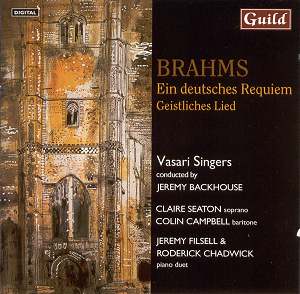
Johannes BRAHMS (1833-1897) Ein Deutsches Requiem (1868) [60.03] Geistliches Lied (1856) [4.36] Clare Seaton
(soprano)
Colin Campbell (baritone)
The Vasari Singers/Jeremy Backhouse,
Jeremy Filsell and Roderick Chadwick (piano duet).
rec. St. Jude’s Church, Hampstead, London, U.K., 24-26 October
2003. DDD GUILD GMCD7302 [64.39]
Brahms' German
Requiem, beloved of English choral societies, is such
a big piece in every respect that one would expect a performance
with piano accompaniment to be doomed to failure. Yet it
was the composer himself who agreed to his publisher's
request to provide the transcription for piano duet used
in the present recording. What is transcribed, however,
is not simply the orchestral part, but the vocal parts
too, making clear its purpose to allow access to this remarkable
work in the absence of singers. Its use as an accompaniment
to the choral version seems at least questionable, and
the fact that it was given in this way at its first English
performance, in a private home, is not really a convincing
argument in its favour.
The
present recording appears to be the third in this form. The
playing of Jeremy Filsell and Roderick Chadwick is beyond
praise, but the arrangement gives them few opportunities
to shine. The overall colour is dark, darker indeed than
the orchestral version where Brahms, not a composer we associate
with orchestral brilliance, demonstrates a remarkable mastery
of the use of the orchestra to bring out contrapuntal lines.
The uninspiring nature of the arrangement perhaps explains
in part why the present pair are in no way outclassed by
the altogether more illustrious names of Brigitte Engerer
and Boris Berezovsky (playing on two pianos) on the rival
disc given by the French chamber choir Accentus conducted
by Laurence Equilbey (Naïve).
If
one reason for giving the work in this version is to try
to recreate the intimate, chamber music atmosphere of the
first English performance, one other advantage is certainly
that the choral writing is presented with greater clarity.
Jeremy Backhouse seems carefully to have rethought the work
so as to place it in this different context and his excellent
choir follow his lead. Tempi are faster than we are used
to almost throughout. For the first movement, for example,
Backhouse takes just over eight minutes, the fastest of any
other reading I have for comparison and faster by almost
two minutes than Klemperer's classic (and irreplaceable)
reading on EMI Great Recordings of the Century. Not content
with a fairly rapid overall tempo Backhouse even presses
forward impulsively in one or two places, though in this
movement at least the more inward aspects of the music are
not unduly neglected. The tempo of the second movement is
in line with those chosen by Gardiner or Masur, but the choir's
tone could be darker at the outset, and in spite of a well-managed
crescendo in the accompaniment the horns are cruelly missed
in the passage leading to the loud, second statement of the
theme. The well-known and well-loved fourth movement, "How
lovely are thy dwellings", is also very fast, too fast
for me, I'm afraid, lacking weight and meaning at this tempo,
and with even the hint of a waltz lurking behind the notes.
Klemperer really is the benchmark here: just listen to the
multiple suspensions at the climax, and the delicious staccato
woodwind figures which follow to know how it really should
be done. I found the fast section of the sixth movement even
more disappointing. Tempo indications for Brahms' own version
of "The trumpet shall sound" include Vivace,
but the music sounds very rushed here. The opening, too,
of this same movement, where St Paul's words to the Hebrews "…for
here we have no permanent home, but we are seekers after
the city which is to come" has a jauntiness quite at
odds with the sentiments of the text.
The
two soloists sing well and any decent choral society would
be delighted to welcome them into their midst. On record,
however, for repeated listening, one needs rather more. Colin
Campbell's voice is rather dry as recorded and his reading
of the third movement is severe rather than supplicating.
Claire Seaton sings beautifully, with excellent vocal control
and intonation but her reading lacks the intimate, comforting
quality one hopes for in the movement which Brahms added
later following the death of his mother. And given the number
of times piano, dolce and espressivo figure
on the pages of this movement much of it is simply too loud.
The recording brings all the performers well forward, somewhat
neutralising the church acoustic. This, too, is probably
deliberate, but it certainly does not help the soloists.
One
no longer wants or expects a marmoreal German Requiem,
but this one is positively brisk in places, and the lack
of weight is ultimately unsatisfying. Kurt Masur's performance,
live in 1995 with the New York Philharmonic Orchestra (Teldec),
shows how the music can be kept moving, bringing warmth and
comfort but retaining the work's essential gravity. And the
previously mentioned French reading is also outstanding,
Accentus even more accomplished than the excellent Vasari
Singers, more satisfying soloists and the conductor's tempi
more in line with accepted notions. If you must have the
piano accompaniment I think this is a better choice.
The
programme is completed by a reading of the beautiful Geistliches
Lied of 1856 which, perversely perhaps, I found much
more pleasing. The Vasari Singers and their conductor ensure
that the final Amen of this highly canonic piece flowers
as it should, their singing as passionate and disciplined
as any admirer of Brahms' choral music could wish for.
William Hedley
Please support our advertisers below by clicking on the logos for further information.

























 Clare Seaton
(soprano)
Clare Seaton
(soprano)