Editorial Board
MusicWeb International
Founding Editor Rob Barnett Editor in Chief
John Quinn Contributing Editor Ralph Moore Webmaster
David Barker Postmaster
Jonathan Woolf MusicWeb Founder Len Mullenger
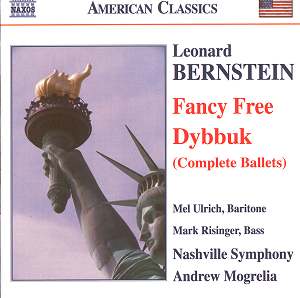
Leonard BERNSTEIN (1918–1990) Dybbuk (1974)a [45:16] Fancy Free (1944)b [28:59] Mel Ulrich
(baritone), Mark Risinger (bass)a;
Abby Burke (vocal), Stephen Kummer (piano), Roger Spencer
(double bass), Samuel D. Bacco (drums)b
Nashville Symphony/Andrew Mogrelia
rec. Blair Hall, Nashville, May 2005 and MTSU Dept. of Recording
Industry, July 2006 (Big Stuff) NAXOS 8.559280 [74:14]
Bernstein
collaborated with Jerome Robbins on four occasions. It all
started with Fancy Free (1944), went on with Facsimile (1945)
and West Side Story (1957) and ended with Dybbuk (1974).
These collaborations were differently received by critics
and audiences. Fancy Free and West Side
Story were immediate, resounding successes; Facsimile and Dybbuk got
somewhat lukewarm receptions. The paradox is that in strictly
musical terms both the choreographic essay Facsimile and Dybbuk are
by far the finest; but the music for – or because of – all
its seriousness obviously lacks the popular appeal that makes Fancy
Free and West Side Story so successful.
These scores belong to the Bernstein works that clearly demonstrate
what Bernstein could achieve when he kept his invention and
musicality under strict control. Other similar works are
the gripping First Symphony Jeremiah and the
beautiful Serenade for violin and orchestra.
Having Fancy
Free and Dybbuk side by side makes
it all perfectly clear. The music of Fancy Free is
a fine example of Bernstein at his most extrovert, uninhibited;
and displays the typical Bernstein mix of jazz, blues,
Neo-classical Stravinsky and echoes of Copland - the
latter is clearly to be heard in the penultimate section Danzón.
The music is straightforward, colourful, lively, full
of contrast, joyfully eclectic and superbly crafted.
I have known this work for many years, and listening
to it again sets me thinking that the whole score might
well be a theme and variations on the opening number Big
Stuff (“in juke-box style”). However, do not take
my word for it; I may be wrong after all. There is not
much to choose between this performance and that of Leonard
Slatkin (EMI CDD 7 63905 2), in which Big Stuff really
sounds as being played by an old worn-out juke-box, and
the last recording made by the composer many years ago
(DG), in which Bernstein sings and plays Big Stuff with
his inimitable chain-smoker voice. The Nashville orchestra
play with energy and obvious enjoyment, relishing the
score’s many happy touches.
As
already mentioned earlier in this review, Dybbuk,
written to commemorate the 25th anniversary of
the state of Israel, is a rather more serious affair drawing
on Shlomo Ansky’s eponymous drama. The insert notes go into
some detail about the action, and I will not repeat them
here. Suffice to say that the subject of Dybbuk is
about the universal and eternal struggle between good and
evil, brightness and darkness, symbolised by the clash between
diatonic and twelve-tone music. This is not particularly
new in Bernstein’s output, since the diatonic-chromatic dichotomy
is also present in much of the music of his Third Symphony Kaddish;
but there is nothing here that may compare with the overtly ‘Coplandesque’ big
tune heard in the Third Symphony. The most remarkable thing
in Dybbuk is the extraordinary stylistic coherence
displayed throughout. This is a substantial score and has
been hailed by some as Bernstein’s finest achievement. The
utter seriousness and austerity of much of the music are
perfectly attuned to the no-nonsense subject of the ballet.
There are many moments of real and great inspiration, and
none of the ramshackle eclecticism that sometimes mars some
of Bernstein’s serious, deeply-felt works. Dybbuk is
undoubtedly an imposing achievement, but one that will never
become popular, which makes as fine a performance as the
one under review the more welcome. I do not doubt that the
real Bernstein is here, in this serious, austere and complex
work.
These
performances are very fine indeed, beautifully played and
obviously committed as well as nicely recorded. One slight
grumble, however, concerning the all-too-clean rendering
of Big Stuff at the beginning of Fancy Free.
Well, yes, I know, juke-boxes are no longer what they used
to be in 1944, but this had been successfully realised in
Slatkin’s EMI recording. Nevertheless, this is a welcome
release putting both sides of “Janus Bernstein” into sharp
contrast. Another attractive instalment in this Bernstein
series from Naxos.
Hubert Culot

























 Mel Ulrich
(baritone), Mark Risinger (bass)a;
Abby Burke (vocal), Stephen Kummer (piano), Roger Spencer
(double bass), Samuel D. Bacco (drums)b
Mel Ulrich
(baritone), Mark Risinger (bass)a;
Abby Burke (vocal), Stephen Kummer (piano), Roger Spencer
(double bass), Samuel D. Bacco (drums)b