Editorial Board
MusicWeb International
Founding Editor Rob Barnett Editor in Chief
John Quinn Contributing Editor Ralph Moore Webmaster
David Barker Postmaster
Jonathan Woolf MusicWeb Founder Len Mullenger
Buy
through MusicWeb
for £14.30/15.10/ 15.60 postage
paid World-wide. You
may prefer to pay by Sterling cheque or
Euro notes to avoid PayPal. Contact
for details
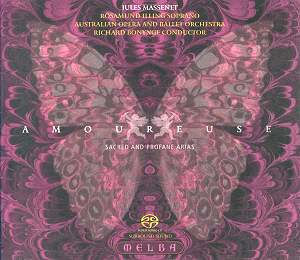
Jules MASSENET (1842–1912) Amoureuse – Sacred and Profane Arias
1. Sainte Thérèse Prie(1902) [3:29]
2. Amoreuse (1898) [3:06] La Grand Tante (1867)
3. Je vais bientôt quitter [2:46] Marie Magdeleine (1873)
4. O mes soeurs [4:43] Eve (1875)
5. O nuit [2:57] La Vierge (1880)
6. O mon fils [5:10]
7. Rêve infini! [5:08] Hérodiade (1881)
8. Il est doux, il est bon [4:53]
Le Cid (1885)
9. Plus de tourments [3:03]
10. Pleurez mes yeux [5:00] Sapho (1897)
11. Ce que j’appelle beau [2:33]
12. Ah, vous avez parlé [3:07]
13. Demain, je partirai [5:56]
14. Vais-je rester ici? [4:02] Griséldis (1901)
15. Loÿs! Loÿs! [3:51] Chérubin (1905)
16. Vous parlez de peril [1:54] Ariane (1906)
17. Avec tes compangnes guerrières [3:18]
18. Je comprends … un heros! Un roi [4:32]
19. Ils mentaient! A quoi bon [6:05] Rosamund
Illing (soprano)
Australian Opera and Ballet Orchestra/Richard Bonynge
rec. November 1998, Eugene Goossens Hall, ABC Sydney MELBA MR301106 [75:41]
Today we regard Massenet as an opera composer but he wrote about
200 songs and his earliest successes were with oratorios. On
this disc we are treated to examples of all three genres,
and rarities they are, almost all of them. We also recognize
Massenet’s fingerprints: a melodious proclivity, sweet harmonies,
skilful orchestration and a kind of perfumed atmosphere.
Taken in large doses this can be claustrophobic – too much
of a good thing. Not even reviewers need to sit through a
five-quarter-hour-long recital such as this without a couple
of breaks. However there is enough variation and even though
most numbers are sweet and slow there are some thrilling
dramatic outbreaks to liven things up. There is also a natural
ebb and flow that keeps the music alive and with singing
of the calibre of Rosamund Illing’s one can just lean back
and savour one delicacy after another. Hers is a more or
less ideal voice for this repertoire: clear, beautiful, flexible
and warm and she never becomes over-sweet; there is a healthy
freshness in her voice. Richard Bonynge, who has championed
so much lesser-known music for almost half a century, is
an ideal conductor for such an enterprise.
The disc opens with two songs for voice and piano, one religious,
the other anything but. Here they are performed in the composer’s
own unpublished orchestrations. They are beautiful – and
sweet. Then follows an aria from Massenet’s first foray into
the world of opera, an opéra comique in one act. It
saw seventeen performances and the title role was sung by
a seventeen-year-old Marie Heilbron, who at double that age
was Massenet’s first Manon. It is a light and rather anonymous
piece.
From his sacred oeuvre we are treated to arias from three works: the
oratorio Marie Magdeleine, which was Massenet’s first
great success; the mystère Eve, which starts after
Adam’s rib-operation; and the légende sacrée La Vierge.
Beautiful music all of it, especially Mary’s simple entrance
aria from Marie Magdeleine, sensitively sung.
The subject for Hérodiade was taken from a story by
Flaubert. As opposed to Oscar Wilde’s and Richard Strauss’s vicious
Salome, Massenet’s character is an innocent young girl in
love with John the Baptist. When she learns of the death
of John she stabs herself. Il est doux, il est bon, sa
parole est sereine, she sings at the beginning of her
entrance aria (He is gentle, he is good, his speech is serene),
and that is also a fair description of the aria.
Rosamund Illing is appropriately girlish in L’Infante’s happy
song from Le Cid, while Chimène’s Pleurez mes yeux,
with its clarinet obbligato, is full of sorrow. Sapho was
a ‘sung play’ based on a novel by Alphonse Daudet. An artists’ model ‘with
a past’, Fanny Legrand, starts a love affair with a much
younger man. ‘Friends’ inform him about her earlier life
and he leaves her but later he returns. Fanny however realises
that it can’t last and in the last scene she sneaks away
since he has fallen asleep. Emma Calvé, a legendary Carmen
and famous for her histrionic skills, was Fanny Legrand and
in the second excerpt here (tr. 12), where she is furious
at the ‘friends’ after having revealed her past, she probably
had a field day. So does Rosamund Illing, who characterises
well, shouting and snarling Canailles! (Villains!)at
the end. The remaining two songs from Sapho are sad.
In the beginning of the last act, entitled “Solitude”, Fanny
sings about her lost love. There is an orchestral introduction
with a beautiful but sombre cello melody and the aria is
expressive, catching the heroine’s subdued despair. It is
sung with touching eloquence, as is Fanny’s farewell to her
young lover.
I am not sure whether it was due to this reviewer’s fatigue or the
fact that Massenet’s inspiration ran dry towards the end
of his life, but apart from the heart-rending aria from Griseldis the
rest of the recital felt a little matter-of-fact. This doesn’t
diminish the overall appeal of the disc; Massenet’s by-ways
are well worth exploring, especially in such committed and
well-sung readings. The recording, originally made in 1998,
has been re-mastered and surround sound mixed, giving a very
full but rather over-resonant effect. I actually preferred
listening in traditional two-channel mode.
Production values are high, as always with Melba issues.
Rodney Milnes’ essay
is a good read, Graham Johnson provides an appreciation on
Massenet, entitled “The Master of Charms”, full texts and
translations are included with annotations to each number
by Maestro Bonynge, often giving details about premiere singers.
For a broader picture of Massenet’s creativity this disc
has a lot to offer and Rosamund Illing sings everything admirably.
Göran Forsling
Please support our advertisers below by clicking on the logos for further information.
























 for details
 Rosamund
Illing (soprano)
Rosamund
Illing (soprano)  [75:41]