Editorial Board
MusicWeb International
Founding Editor Rob Barnett Editor in Chief
John Quinn Contributing Editor Ralph Moore Webmaster
David Barker Postmaster
Jonathan Woolf MusicWeb Founder Len Mullenger
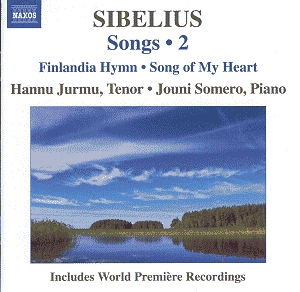
Jean SIBELIUS
(1865–1957)
Songs – Vol. 2
1. Finlandia-hymni, from Op. 26 [2:53]
2. Jääkärien marssi (March of the Jaeger
Battalion), Op. 91a [2:28]
3. Aamusumussa (In the Morning Mist), JS
9a [1:56]
4. Ateenalaisten laulu (Song of the Athenians),
Op. 31, No. 3 [2:22]
5. Sortunut ääni (The Broken Voice), Op.
18, No. 1 [1:33]
6. Isämaalle (To My Country), JS 98a [2:17]
7. Karjalan osa (Karelia’s
Fate), JS 108* [5:10] 8. Siltavahti (The Guard of the Bridge),
JS 170 [2:38]
9. Uusmaalaisten laulu (Song of the Uusimaa
People), JS 214 [2:32]
10. Laulu ristilukista (Fool’s Song of the Spider), Op. 27,
No. 4 [4:08] 11. Kullervon valitus (Kullervo’s
Lament), from Op. 7 [2:11]
12. Kolme soeksaa sisarta (The Three Blind Sisters), Op. 46,
No 4 [3:27]
13. Tule, tule, kultani (Come, come, my
darling), JS 211* [1:33]
14. Miss’ on , kussa minun hyväni (Where
is my beloved?) from Rakastava (The Lover), JS 160c
[1:41]
15. Mummon syntymäpäivivänä (Grandmothers’
Birthday Song), JS 136*
16. Partiolaisten marssi (Scout March),
Op. 91b [2:48]
17. Koulutie (The Road to School), JS 112
[5:19]
18. Tuule tuuli leppeämmin (Blow, wind, more gently), Op. 23,
No. 6a (arranged by Olavi Pesonen) [3:25]
19. Sydämäni laulu (Song of my Heart),
Op. 18, No. 6 [2:34]
20: Kallion kirkon kellosävel (Bell Melody
of Kallion Church), Op.65b [3:02]
21. Herran sinuous (God’s Blessing), JS
95* [2:30]
22. Soi kunniaksi Luojan (May the hymn of
honour now resound), Op. 23, No. 6b [2:36]
Hannu Jurmu (tenor), Jouni Somero (piano)
rec. Selosali, Espoo, Finland, 28–30 July, 1, 13,
14 August 2005. DDD
NAXOS 8.570020 [60:58]
I
wasn’t too enthusiastic about the first instalment in this, as
it turns out to be, two-disc survey of Sibelius’s songs. It might
be argued that there is enough already of Sibelius’s oeuvre available.
Honestly there is a plethora of recordings, but this collection
is still of interest since it includes a number of songs never
before recorded. Volume one included several of the most frequently
heard songs, mainly those to Swedish texts. It should have been
an attractive bait for budget-seekers. However the singing wasn’t
too inviting (review)
but I am happy to report that volume two is a much better proposition.
It contains few of the great songs; on the other hand Hannu Jurmu
here sings in his mother tongue and this seems to liberate his
singing. There were examples of great singing in the first volume,
too, but too much was over-loud, unsophisticated and strained
and the overriding impression was of a lack of subtlety.
I
reported some surprise after reading Jurmu’s biography, since
his greatest successes have been in Mozart and light Puccini,
whereas his voice as heard here rather points to Radames and
even Otello. It is definitely a voice with heroic potential
and the opening number on volume 2, the well-known Finlandia-hymni
shows him in a favourable light, noble and powerful. Jouni Somero
accompanies excellently, as he does throughout the recital.
Laulu ristilukista (Fool’s Song of the Spider) from the
incidental music for Adolf Paul’s play King Christian II
(tr. 10) also finds him in splendid vocal shape. The song is
among Sibelius’s finest with its wide ranging accompaniment.
He sings powerfully in the early Sortunut ääni, originally
for male chorus, a song I sang quite frequently during my years
as a male chorister. Here, however, he shows a tendency to shout,
which happens now and then and mars some of the more dramatic
songs. Thus Siltavahti (tr. 8) is far too strained and
unsubtle but unquestionably he produces a thrilling final note.
Many of the songs were never published during Sibelius’s lifetime
and several of them are less than masterpieces, hearty and enthusiastic
but in the last resort quite plain. But there are also more
inward and poetic songs, like Aamusumussa (In the morning
mist) (tr. 3) from 1897 and originally for children’s choir.
Kolme sokeaa sisarta (The three blind sisters) (tr. 12)
is from the incidental music for Pelleas et Melisande (1905),
is simple in an almost Mahlerian way and is simply sung. Koulutie
(The road to school) (tr. 17) is another children’s song, composed
in 1924. It is folksong like, simple and catchy and Hannu Jurmu
sings it beautifully with great warmth. Miss’ on, kussa minun
hyväni (tr. 14) should be well-known to most readers from
Rakastava for string orchestra. It first saw the light
as a setting for male chorus and tenor soloist, which was later
arranged as a solo song.
Those
who want a representative disc with some of Sibelius’s best
songs – and those are mostly settings of Swedish poetry – should
look elsewhere. However for a substantial helping of lesser-known
songs, sung in Finnish, the present disc could be a suitable
proposition. It isn’t spotless but the singing is far better
than on the previous volume.
Göran
Forsling
Please support our advertisers below by clicking on the logos for further information.

























 Hannu Jurmu (tenor), Jouni Somero (piano)