Editorial Board
MusicWeb International
Founding Editor Rob Barnett Editor in Chief
John Quinn Contributing Editor Ralph Moore Webmaster
David Barker Postmaster
Jonathan Woolf MusicWeb Founder Len Mullenger
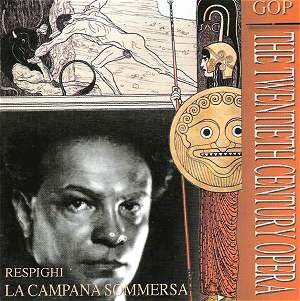
Ottorino RESPIGHI (1879-1936) La Campana sommersa (The Sunken Bell)
- opera in four acts (1925-27) Margherita
Carosio (soprano) - Rautendelein
Rita Malatrasi (soprano) – Magda
Lucia Danieli (mezzo) – La Strega
Umberto Borso (tenor) - Enrico
Tommaso Frascati (tenor) – Il fauno
Rolando Panerai (baritone) - Ondino
Plinio Clabassi (bass) – Il curato
Pierluigi Latinucci (baritone) – Il maestro
Angelo Mercuriali – Il barbiere
Orchestra Sinfonica e Coro Di Milano delle RAI/Franco Capuana
rec. 11 July 1956, Milan GREAT OPERA PERFORMANCES GOP66.360 [71:20
+ 65:38]
Ian
Lace has provided an excellent account of Respighi’s intriguing
opera La
Campana sommersa for MusicWeb readers and I won’t
duplicate the valuable information he has provided.
I
can’t, though, resist adding one further allusion to the
opera, which I recently came across. Ian Lace gives an account
of the opera’s American premiere. In the issue of the magazine Time,
dated 3 December 1928, is a further account of that occasion:
“Last week La Campana Sommersa, the music by Ottorino
Respighi to a libretto by Claudio Guastalla taken from
Hauptmann’s
play, had its U.S. premiere at the Metropolitan Opera House,
Manhattan. Rautendelein was still its inspiration, Heinrich
[Enrico] still the heckled human. And for it all Respighi
had made lovely, lyric music. But operatic singers, operatic
trappings rarely enhance a poetic mood. Soprano Elisabeth
Rethberg as Rautendelein managed her bulk skilfully, sang
difficult music easily, spent clear high notes lavishly.
But her appearance, her acting left little illusion. Nor
could Giovanni Martinelli forget he was a tenor for the sake
of the bellcaster. Dramatically it was Baritone Giuseppe
de Luca in a minor role who served best. As Nickelmann [i.e.
Ondino] he never once stepped out of the well, just poked
up his moss-covered head, beat his webbed hands against the
side. Yet when with a ‘Brekekekex’ he lost Rautendelein,
the audience was sorrier than it ever was for Heinrich. And
it was happier for the ‘Brekekekex’ that won her back
than for any of her flawless cadenzas.
The composer had the ovation. A sturdy, middle-aged Italian,
Respighi had come to the U.S. especially for the premiere.
Only in
Heaven, he announced after the general rehearsal, could
one hope for so perfect a production as the Metropolitan’s.
The Metropolitan audience tried to return the compliment,
called
him again and again before the curtain. For critics The
Sunken Bell was commendable, if unimportant, an opera
to make one pleasant evening, if scarcely half a dozen.”
“Commendable,
if unimportant …” … Well, I’d suggest that La Campana
sommersa deserves more than such damnation by faint
praise. It is a thematically rich work, full of attractive
music.
At the thematic level it presents, amongst other things
that “conflict
of orthodox Christian faith with older, more pagan beliefs
as represented by the fairy folk” which Ian Lace discerns
as one of its themes. The opera is made up of a number
of dualities, such as those between human and fairy worlds,
between stable married love and the amorous possibilities
of the alien and unknown, between art and craft and so
on.
It can also be seen as a study in the destructive possibilities
of an absolute commitment to the demands of the imagination.
At the level of plot it is structured around acts of choice,
and their consequences, made by Rautendelein the fairy-maiden
and Enrico, the bell-caster. Its fable of destruction is
built upon two love interlocking love triangles: that in
which Rautendelein is the desired of both Ondino and Enrico
and that in which Enrico is married to Magda and infatuated
with Rautendelein.
Musically, La
Campana sommersa is full of reminders of the Respighi
of the famous orchestral tone poems. The vocal writing
at times suggests the influence of Puccini and belongs
broadly in the Verismo tradition. Plot and theme are
not allowed to halt for the sake of musical set pieces.
There
are some more dualities here – as Verismo meets fairy tale
and as triumphantly Italian musical language and syntax
meet a narrative which is decidedly Germanic. But that
particular duality – of Italian musical language and
Northern European text often seemed to bring out the
best in Respighi
(as in his settings of Shelley and of Scottish songs,
for example) and it certainly does so here.
Suffice
it to say that the opera contains some magical music – and
that at least some of the magic survives on this 1956 performance,
presumably originally a radio broadcast. There are cuts
in the score and the recorded sound inevitably falls well
short
of modern standards. The standard of the singing is variable.
At her best Margherita Carosio - who as a 19 year old sang
with Chaliapin in London! - was a fine lyric soprano. She
made her debut at La Scala in 1929. At the time of this
recording she was, by my reckoning, approaching fifty and
within three
years of her retirement. Unsurprisingly her voice is not
what it once was and there are moments of unattractive
stridency. Her voice at this stage of her career, in any
case, was altogether
too mature, too full of lived human experience,
for her to be fully suited to this particular role, to
the vocal
embodiment of Rautendelein, the elf-maiden innocent of
the ways of the human world. In my experience of his work
Umberto
Bosso seems always to have been a reliable and highly competent
tenor and that is very much the case here. Some of his
contributions – notably
in his duets with Magda and Rautendelein are very commendable
indeed, delicate when necessary and pretty powerful, without
rant, when called upon to be so. He can be genuinely moving;
this is a fine interpretation of the role. Rolando Panerai
makes a striking Ondino, and the lesser parts are all sung
decently (and before anyone else makes the joke I was tempted
to make, there really is a wine called Tommaso Frascati – or
at any rate San Tommaso Frascati – a dry yellow wine from
the Lanuvian hills). The orchestral writing, so full of
richly balanced orchestral colours, needs a better recorded
sound
than it gets here if it is to be fully appreciated.
I
am almost always fascinated by live operatic recordings
from the archives, whether they come from the opera house
or the
radio studio. They give one the chance to hear singers
who are otherwise just names in reference books; they give
one
the chance to hear singers of the ‘second rank’ (often very
good – we know how fickle fame can be) or to hear singers
in repertoire with which they are not normally associated.
This recording of La Campana sommersa is well worth
hearing for these and for other reasons, or if you have
a special interest in Respighi or any of the featured singers.
For a ‘mainstream’ performance in good modern sound a far
better choice is the recording conducted by Friedemann
Layer on Accord
476 1884.
Glyn Pursglove
Please support our advertisers below by clicking on the logos for further information.

























 Margherita
Carosio (soprano) - Rautendelein
Margherita
Carosio (soprano) - Rautendelein