While I enjoy Mozart piano concertos played on modern instruments
I prefer period ones. Yes, the fortepiano is an acquired
taste. It never has the power or the sonority of the modern
grand, but neither do the orchestral instruments, though
they compensate with a more penetrating tone. The gain I
feel is in a sense of authentic scale. I understand that
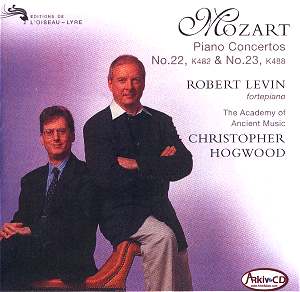
on this CD Robert Levin plays a copy by Christopher Clarke
of a fortepiano by Anton Walter whose instruments Mozart
used.
First comes Piano Concerto 23. Christopher Hogwood’s orchestral
introduction is sunny and smooth and Levin’s fortepiano can
be heard in an accompanying role adding sonority and crispness
to the texture. The opening piano solo has a blithe, airy,
dancing quality. The second theme (tr. 1 3:02) has just a
touch more breadth, contemplation and gratitude. The more
you hear, the more you appreciate that piano and orchestra
are of the same mind. When in the recapitulation Levin returns
with the second theme as a solo (7:05), his florid decoration
has an engaging spontaneity.
Levin and Hogwood’s is a flowing Adagio with all the
simplicity and purity of pathos, enhanced by the fragility
of the fortepiano tone, leaping quietly, almost furtively,
in its opening theme to top D. The second theme (tr. 2 0:46)
is creamier because here it is led by the flute doubling
the first violins who become achingly apparent at the loud
entry (1:02). The piano’s expansive musings are then further
convincingly elaborated from 1:23 by Levin’s additional ornamentation.
But when the opening theme returns at 3:18 the even greater
intensity of the ornamentation is perhaps overdone. I like
Levin’s embellishment of the piano version of the second
theme at 4:52 but prefer the poignant bare leaps of the coda
from 5:17 to his continuing florid decoration.
Levin and Hogwood’s rondo finale is of irrepressible joie
de vivre, partly because they play it, as marked, very
fast with the orchestra almost falling over itself in response
to the piano’s opening solo. Tunes shower forth, because
played on a fortepiano, with emphasis on dexterity and
lightness. A very catchy piano one (2:33) finds violins
and violas’ pizzicato backing like light but gleeful
handclaps.
I
compared the 1991 recording by Melvyn Tan and the London
Classical Players/Roger Norrington (Virgin 5 62343 2). Here
are the comparative timings:
| Timings |
I |
II |
III |
Total |
| Levin & Hogwood |
11:20 |
6:18 |
7:53 |
25:31 |
| Tan & Norrington |
10:50 |
5:28 |
8:17 |
24:35 |
In the first movement Tan and Norrington’s
approach is smoother with the emphasis on melody and euphony.
The piano’s second
theme is fluent to the point of seeming matter-of-fact. Levin’s
playing sparkles more. This is partly because his phrasing
is more clearly and individually pointed, partly because
Levin is recorded with more presence and body, without presenting
a false power to the fortepiano. Hogwood brings more freshness
and zip to the introduction, more slinky sleekness to the
second theme (tr. 1 0:56). Tan demonstrates how neat and
varied Mozart’s cadenza is. Levin’s own cadenza is equally
virtuosic but, at a timing of 1:31 allowing himself 24 seconds
extra, he makes it seem more ornate and also more personal
with tender melodic recall, or rather half recall because
variation at the same time.
Tan’s treatment of the slow movement is more direct but with
less nuance than Levin. He achieves an effective contrast
at the late return of the opening theme by playing sotto
voce, though it’s not marked so. Here Levin provides
much additional ornamentation, the theme itself almost no
more than implied. His approach has a more vocal quality
which gives greater breadth and clarity to his phrasing even
if by his second solo the decoration has become extravagantly
operatic. Tan decorates a little but seems more determined
to progress than Levin’s savouring of the experience.
Tan and Norrington’s finale is well shaped, the piano on
a roller coaster, the orchestra spirited, but Levin being
a bit faster poses more challenge for Hogwood’s orchestra
which is accepted with relish so the movement becomes a game
of vivacious, quicksilver darting between piano and orchestra.
Again Levin’s phrasing has more individuality and variation
than Tan’s.
Next on this Levin CD comes Piano Concerto 22 where the intimate
character of the opening piano solo is clear in stark contrast
to the ebullient passages for full orchestra. To give one
example, the filigree work in triplets (tr. 4 3:29) is delicate
where on a modern piano it tends to be showy. Levin makes
the second theme (4:31) gently smiling and increases the
floridity of its ornamentation on repetition in a natural
and graceful manner. Levin’s own cadenza has an elaboration
that’s entirely consistent with what has gone before and
also remembers the element of filigree delicacy.
The slow movement begins with sensitively veiled, muted strings
and the fortepiano on the edge of audibility as part of the
accompaniment. The piano solo which follows is a lament with
the halting nature of the expression caringly apparent. The
first orchestral episode is a make believe contrast, the
second still more so. In between the piano’s first variation
is a richly intricate mining of the depth of the lament.
Later the second variation juxtaposes stark orchestra and
eloquently tragic piano.
In
the rondo finale it’s a gracious, occasionally glittering,
light of foot, contrast that piano makes with the orchestra,
jubilant horns in particular. The theme of the central Andantino
cantabile section is very smoothly presented by Hogwood,
then Levin’s repeat (tr. 6 4:55), doubling the first violins
with additional ornaments, seems totally in keeping because
of the soft focus of the piano and balance between the two
lines.
I
compared the 1987 recording by Malcolm Bilson and The English
Baroque Soloists/John Eliot Gardiner (Archiv 463 111-2).
Here are the comparative timings:
| Timings |
I |
II |
III |
Total |
| Levin & Hogwood |
12:38 |
8:08 |
11:56 |
32:42 |
| Bilson & Gardiner |
13:10 |
8:51 |
12:02 |
34:03 |
Bilson
and Gardiner’s first movement is more rhetorical with more
emphasis on the progression of the argument. Levin and Hogwood
focus more on the melody, with subtler shading on Levin’s
part. To my ears the brighter edged sound given Levin and
Hogwood, albeit in a drier acoustic, is more natural, with
piano and orchestra given a little more perspective. But
both accounts are rewardingly contrasted. Where Levin’s development
is clear sighted, Bilson’s is more contemplative. I prefer
Levin’s own cadenza as its focus is surveying the variety
of melodies where Bilson’s own cadenza juxtaposes martial
bounce and poetic reflection.
There’s
a more studied quality about Bilson and Gardiner’s slow movement.
The introduction is fully formed in its dolefulness. The
piano solo is of exquisitely studied sorrow, the first orchestral
episode a tableau of a happier mood. The piano’s first variation
is resolute with the bass especially firm against the poignant
melody but the second orchestral episode thereby becomes
a logically warm outcome. The second variation is a sterner
version of the resolute manner but not totally stark and
warmth returns as the coda grows more melting. Levin and
Hogwood’s presentation of the introduction is simpler, more
chaste and apt for the development which the movement provides.
The piano solo has a halting, hesitating sensitivity, of
which the smaller tone of the more set back recording is
an element. In keeping with this the first orchestral episode
(tr. 5 2:23) is a gentle, hesitant but growingly confident
sunny alternative. The piano’s first variation (3:22) thoughtfully
weighs both sad and sunny moods. The second orchestral episode
(4:31) is buoyantly sunny. This performance of the second
variation (5:20) clearly contains both moods, the piano the
more upbeat, the orchestra firmer but not without warmth,
allowing a smooth transition to a sunnier coda (6:55).
Bilson
and Gardiner make the finale a light and jolly, dancing affair
with a rather demure, neatly pointed Andantino cantabile in
which the Bilson’s ornamentation while doubling the first
violins, unlike Levin’s, seems rather obtrusive and less
deft. Bilson’s own cadenza supplies brilliant flourishes
around the rondo theme. Levin and Hogwood’s approach is quieter
but still bubbling and luminescent. The second theme (tr.
6 2:27) is presented in simpler, happier fashion than Bilson
and Gardiner’s warmth. The Andantino cantabile is
also more ingenuous and flowing. Levin’s own cadenza begins
with intriguing variations on the second theme before pyrotechnics.
Levin is well known as a master of improvisation. His cadenzas
are improvised as is the ornamentation he applies. More importantly,
the understanding between him and Hogwood and therefore the
orchestra is finely balanced, giving these performances a
real sense of spontaneity and partnership. I could quite
happily live with them as my only recording of these concertos.
The
Arkiv CD under review doesn’t have booklet notes but I gather
all future releases will and existing releases are gradually
being upgraded.
Michael
Greenhalgh
























 Robert Levin
(fortepiano)
Robert Levin
(fortepiano) [58:33]