Editorial Board
MusicWeb International
Founding Editor Rob Barnett Editor in Chief
John Quinn Contributing Editor Ralph Moore Webmaster
David Barker Postmaster
Jonathan Woolf MusicWeb Founder Len Mullenger
Wolfgang Amadeus
MOZART (1756-1791)
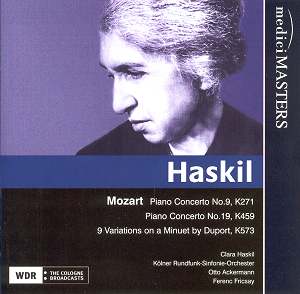
Piano Concerto No. 9 in E flat Major K271 [30:41]
Piano Concerto No. 19 in F major K459 [26:25] Variation on a Minuet by Jean-Pierre Duport K573
[10:38] Clara Haskil
(piano)
Kölner Rundfunk-Sinfonie-Orchester (K271 & 459)/Otto Ackermann
(K271), Ferenc Fricsay (K459)
rec. live, 11 June 1954 (K271), 30 May 1952 (K459), 7 September
1956 (K573), Funkhaus, Saal 1, WDR Cologne (K271 & 459),
Besançon
Festival (K573) MEDICI
ARTS MM004-2 [67:46]
Not for the first time, I find it rather difficult to write about
Clara Haskil. Her manner of playing is ostensibly very plain,
almost unaffected. And yet the listener is held constantly.
She may appear to spell out her opening phrase too literally
in K271, yet listen to how she starts the finale. Some pianists
rattle this off. With Haskil, the dynamic gradations are
small yet infinitely subtle, as are her tiny inflections of pace.
The music breathes, it has life. In the minor variation of
K573 her tone does not seem especially modulated, nor her
left-hand textures especially refined. What she seems to
communicate is a higher truth. I can only liken this to a
singer whose voice is so intrinsically individual and fascinating
that she does not actually need to do very much to convey
her message. Or rather, Mozart’s message, for the music is
made to speak to us directly. Bryce Morrison’s booklet notes
quote an unidentified writer as saying she was “one who observed
the smallest detail in the music without drawing attention
to it”. Those who pay attention to her will find every smallest
detail in the music revealed to them.
In Otto Ackermann she found an ideal partner, one who matches
exactly the Olympian luminosity of his soloist. Only recently
I was
listening to a Klemperer issue in this series from the Cologne
archives and was not very impressed either by the orchestral
playing or the recording. The woodwind here are not quite
as creamy as on the best Philharmonia discs of the period
but I heard nothing to disturb me orchestrally and the recording
seems as good as can be reasonably expected for the date.
As well as the logo of Medici Arts, the production bears
that of the WDR, so it’s an official release using the original
masters.
Fricsay’s recordings of some of the Mozart operas have been seen as
harbingers of historically informed practice. None of that
here. He is far too smooth and under-motivated. In the “allegretto” the
intended dialogue becomes a sort of music lesson. The orchestra
plays a phrase mechanically; Haskil shows how it should go;
on to the next. Unfortunately it’s a lesson Fricsay doesn’t
want to learn. The result is that, while K271 and the variations – somewhat
more brightly recorded – can be recommended to anyone in
search of Mozartian truth, K459 will appeal chiefly to admirers
of the pianist.
I find I’ve already reviewed K459,
on a Urania disc which also had K415 with the Berlin RIAS
Orchestra under Fricsay. I wondered on that occasion where
the recordings came from and felt they were so poor as to
limit interest to confirmed Haskil fans. Making a straight
comparison, it’s obvious now that Urania had got hold of
somebody’s off-the-air tape, for the recording sounds about
twenty years older there. I’m sorry for Haskil fans who paid
good money for that, but they’ll need this new issue. It’s
as clear a demonstration as one could have that, if a historical
performance can’t be transferred from the original source,
where it exists, more harm than good may be done by issuing
it.
Incidentally, why do we only hear of Otto Ackermann in connection
with the wonderful series of operetta recordings for EMI
and historical reissues where he accompanies famous soloists?
What were the orchestral items played on 11 June 1954 and
would they be worth hearing?
Christopher Howell
Please support our advertisers below by clicking on the logos for further information.

























 Clara Haskil
(piano)
Clara Haskil
(piano)