It
mighjt be a matter of interesting debate
What are the most appropriate
forces to sing Parry’s Songs of farewell?
Here is a medium-sized, fresh-voiced
mixed choir of undergraduates, naturally
recorded, close but not too close, in
a comfortably rounded acoustic. Richard
Marlow displays My soul there is
a country as a work of measured,
lyrical contemplation. The crescendo
and animato at ‘O my soul awake’
(tr. 1 1:24) illustrates how contemplative
the general atmosphere is but the real
reason for it is to wake up the listener
to focus on the slower, expressive setting
of the keywords ‘love’ (1:33) and ‘die’
(1:39) realized in poised fashion. Marlow
enjoys Parry’s madrigalian feel for
word painting, as at the bastion picture
of ‘thy fortress’ (2:18), sopranos flying
the flag, as it were, on a sustained
top G while the other parts’ rising
emphasises the scale of the bulwarks.
I compared the recording by the Choir
of St George’s Chapel Windsor/Christopher
Robinson (Hyperion CDA 66273). This
was recorded in 1987, the same year
in which Marlow’s was published. Robinson’s
use of trebles on the top line makes
the expression more incisive, less smoothly
rounded and emotive than Marlow. This
in turn brings the structure more sharply
into focus, to neat but less subtle
effect.
Marlow’s performance
of I know my soul hath power
is concentrated and quite surprisingly
intense, coming from Parry’s emphasis
of keywords through harmonic and dynamic
effects. The clarity and directness
of the smoothly stated, gradually opening
out ‘I know my soul hath power to know
all things’ to the beaming tone at ‘power’
and thereafter, followed by the quietening,
chopped delivery and grey tone of ‘Yet
she is blind and ignorant in all’ is
typical of the faithful representation
of the antitheses throughout the poem.
Robinson’s slightly faster account,
2:18 to Marlow’s 2:31, makes for at
first more striking, starker, more dramatic
contrasts but Marlow’s more rounded
tone allows the poem’s message to resonate
more.
Parry’s Never weather-beaten
sail is less clean cut, more troubled
than Campion’s original: music more
of mood than melody with ‘my wearied
sprite’, wishing to escape the body,
floating in the sopranos over the other
voices. Marlow goes for a softer focus
in the lower parts here whereas Robinson
more clearly shows the sprite leaping
in all parts. At the end of the first
stanza the appeal ‘come quickly, sweetest
Lord’ grows more urgent and climactic
from Marlow. The second stanza begins
more extrovertly with ‘Glory’ vaunted
and Marlow gets across distinctly that
this stanza is about the reality of
Heaven.
There is an old
belief opens in a simple, flowing
style matching the comforting verse,
the voices hugging one another in convivial
imitation. For this piece Marlow’s smoother
delivery and lighter application of
imitation works better, I think, than
Robinson’s firmer structural emphasis.
And Marlow shows how spaciously ‘Beyond
the sphere of Time and Sin’ opens out
in sopranos’ high tessitura without
dominating. ‘That creed I fain would
keep’ Marlow gives startlingly direct
treatment. The alternative of ‘Eternal
sleep’ is considered expansively and
unflinchingly falling into oblivion
before the close offers the hope of
a sunrise on ‘waken’.
At the round earth’s
imagined corners is unusually flamboyant
with vocal fanfares of trumpets and
vivid ascents of souls rising. This
makes the icy austerity of the spare
‘And you whose eyes shall behold God’
from Marlow’s female voices only (tr.
5 1:56) all the more telling. The harmonies
don’t soften till 2:38. As Donne’s verse
moves from the universal to the personal,
the stark unsentimental pleading of
‘Teach me how to repent’ (4:51) is another
memorable feature of Marlow’s performance.
Robinson’s is more virtuosic and thrilling
but also more impersonal than Marlow’s.
Lord, let me know
mine end is a dramatic psalm setting
which respects the tradition of chant,
not so much in repetition of music as
constant imitation, at the beginning
enhancing the calm, placatory manner,
later, as at ‘Take thy plague away from
me’ (tr. 6 5:03) magnifying the bitter
anguish. Marlow’s performance clarifies
the contrasts by distinguishing between
expansive measure and degrees of greater
animation. Spotlighting of the lower
voices is also effectively revealed,
as at their repeat of ‘ev’ry man living
is altogether vanity’ (2:01) and then
use of ‘vanity’ as a mantra, or their
very measured, monotone ‘I became dumb’
(4:00). This is partly because Marlow’s
sopranos crown the texture more than
Robinson’s trebles but I feel Marlow’s
smoother contours suit this piece more
than Robinson’s greater formality.
Stanford’s Three Motets
have a special place in the repertory
of Trinity College Choir as they were
dedicated to them. To Justorum animae
Marlow brings a calm opening yet strong
assertion as the crescendos climax at
‘Dei’ (tr. 7 0:12, 0:49) emphasising
the departed souls are with God. The
stormy central section, ‘et non tanget’
(1:27) is more animated but not markedly
so. It soon becalms for the luminous
coda (2:40). I compared the 1997 recording
by Winchester Cathedral Choir/David
Hill (Hyperion CDA 66964). His slightly
faster tempo, 3:10 against Marlow’s
3:48, together with trebles on the top
line, makes for a more searing radiance
and a more contrasted injection of venom
in the central section, but Marlow’s
more measured approach and less reverberant
acoustic reveals more details of the
part writing.
Coelos ascendit
is for double choir so every line of
text delivered by one choir can be capped
by an Alleluia in the other. Marlow
makes it spirited but firmly articulated
so it goes with a fair swing. His performance
has at the same time strength and a
relaxed assurance, especially the closing
Amen. Hill’s performance is more dramatic
and outwardly celebratory yet Marlow’s
has an equally effective inner density.
Marlow’s Beati quorum
via opens with the radiant purity
and sunny flow of female voices, two
soprano parts and one contralto, followed
by the gently affirmative response of
male voices, one tenor and two bass
parts. The second section, ‘Qui ambulant
in lege Domini’ proceeds smoothly but
purposefully with an effective slow
tiered climax from tr. 9 1:19 pointing
the seriousness of the latter text,
‘in the law of the Lord’. Again upper
and lower voices again alternate, this
time with the call ‘Beati’ like a beacon
of a blessing cutting through a harmonic
haze like one of incense. The opening
returns in expansive line, from 1:57
on the first soprano imitated by tenor
and contralto before returning to first
soprano. Marlow handles this with ideal
breadth, space and humility, the ‘Qui
ambulant’s of the coda floating more
than previously. I compared the 1982
recording by the Cambridge Singers/John
Rutter (Collegium COLCD 107). This is
slightly faster, 3:21 against Marlow’s
3:50 and accordingly less tranquil.
There’s a firmer sense of structure
and control about the performance, but
for me Marlow’s balancing of the sense
of flow and contemplation makes the
motet come across as a more spontaneous
and satisfying experience.
Eternal Father
is a sensitive, richly textured setting
which picks out key elements of Robert
Bridges’ poem on which to focus. The
first is on the address to the Eternal
Father, ‘To all men be Thy name known,
which is Love’ (tr. 10 0:43 to
0:54), achieved by the use of distinctive
harmonies and interchange of voices
and leading to an ecstatic close to
the end of the first section. In the
second the focus is on ‘joy’ (2:15),
this time more through repetition, but
quickly followed by a telling recognition
of ‘pain’ (2:35). The darker elements
of the verse now start to predominate:
anger, sin and, in particular dissonant
focus, ‘terror’ (4:58 to 5:34) before
the pure hope of ‘comforted’ is dropped
like the application of balm at the
end. Another 1997 recording by Winchester
Cathedral Choir/David Hill (Hyperion
CDA 66974) is slightly faster, 6:05
against Marlow’s 6:28 and thereby brighter,
more assertive and crisper in texture,
but Marlow displays awe rather than
declamation.
Stanford’s Latin setting
of the Magnificat for eight-part
chorus makes a splendid finale. The
vigorous opening motif on ‘Magnificat’
returns early in the piece and for the
Gloria. The music only calms down 1
minute in for ‘Quia respexit humilitatem
ancillae suae’ where Trinity College
Choir is at its finest, producing smooth
contoured singing of feeling followed
by the effortlessly soaring sequence
of ‘ex hoc beatam me dicent’ from tr.
11 1:34. Marlow gets just right the
contrast between the sturdy assertion
of ‘Quia facit mihi magna qui potens
est’ in the sopranos (2:36) and the
comely humility of ‘Et sanctum nomen
eius’ in the lower parts (2:42), emphasised
first by repetition, then return in
reversed scoring. ‘Dispersit superbos’
(4:55) could have more venom but the
ethereal nature of ‘Esurientes implevit
bonis’ (6:41) and gauntness to ‘et divites
dimisit inanes’ (7:02) are well differentiated.
Hill (CDA 66974) gives a faster account,
10:09 against Marlow’s 11:34. This makes
for more virtuosic sinewy passages but
less beauteous contrast for the reflective
ones.
The sensibility of
Marlow’s emotive performances catches
well the sensitivity of the composers’
settings. The Arkiv CD under review
doesn’t have booklet notes but I gather
all future releases will and existing
releases are gradually being upgraded.
Michael
Greenhalgh























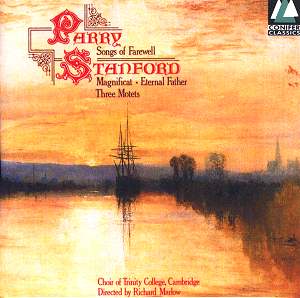

 Choir of Trinity College Cambridge/Richard
Marlow.
Choir of Trinity College Cambridge/Richard
Marlow.