This
is the first time in my experience that an opera production
has been released simultaneously on DVD, CD and a well-filled
highlights disc. Filmed and recorded live during last year’s
Salzburg Festival these are obviously not absolutely identical
performances, even though I can’t quite put my finger on the
differences. What is clear is that the DVD is more ‘live’: it
is longer and includes applause whereas the CD version has all
the stage noises and some audience reactions – neither very
disturbing – and no applause. There are a couple of instances
on the DVD where applause start before an aria is completely
finished and since there is no corresponding situation on the
CDs I suspect there may have been some tidying up without an
audience. The recording period indicated in the heading concerns
the CD version. The DVDs were recorded during a much shorter
period: 22–26 July. Interpretatively and vocally the differences
are minimal.
Claus
Guth’s staging transports the action from Mozart’s days to modern
times. All four acts are set in a spacious hall with an enormous
staircase. There are doors on several levels and also an open
window for Cherubino to jump through. Guth introduces an extra
character, a mute cherub, very much a projection of Cherubino
but with real angel’s wings. This Cherub appears from time to
time and acts as a kind of director who guides the characters,
sometimes by force, sometimes as puppet-master with invisible
strings. The last act is set not in the park as the libretto
says, but in the same hall as before though we can see the park
through the open doors. There is a slightly absurdist feeling
about the whole performance but it is almost constantly entertaining
and filled with interesting and amusing details. With a cast
of excellent singing actors who do their very best to fulfil
Guth’s intentions, this is as attractive a production as any
I have seen. I can’t believe that anyone will feel offended
by the approach, unless one is absolutely against any kind of
liberties in relation to the original libretto.
With
the Vienna Philharmonic in the pit the orchestral backing is
everything one could wish with lush string playing and admirable
wind. As always when Nicolaus Harnoncourt is in charge one can
expect unorthodox things to happen. The overture is leisurely.
Sir Thomas Beecham once said that the Figaro overture should
be as long as it takes to boil an egg. It seems that Harnoncourt
likes his eggs rather hardboiled, since he clocks in at over
five minutes, where the average is a minute shorter – but this
gives him opportunities to accentuate certain phrases and make
us listen with fresh ears to the well-known music. At first
I suspected that he was going to out-Klemperer Otto Klemperer’s
infamous recording from the early 1970s. Certainly he is often
slower than most competitors but even though the stop-watch
tells us this in absolute figures, the experience is of a fairly
slow but far from lethargic performance. It has weight but is
not heavy. He also adds importance to the recitatives by employing
a cello beside the harpsichord for the continuo. There are some
eccentric interpretative devices. One is in Cherubino’s first
act aria Non so più where the basic tempo is the expected
one but the end becomes gradually so slow that it almost comes
to a stand-still. It feels un-Mozartean but in practice it is
very effective, magical even, and Christine Schäfer’s singing
leaves the listener breathless. In the middle part of Figaro’s
Non più andrai at the end of the same act, where Figaro
tells Cherubino about his future life as a soldier ‘with musket
on your shoulder, sabre at your side, head erect and bold expression’,
the orchestra comments on every phrase with a warlike fanfare.
According to the score – and that’s the way it is always done
– the fanfare and the singing should overlap but Harnoncourt
inserts a caesura every time and exposes the fanfare. It’s a
bit idiosyncratic but Harnoncourt may have his reasons. I think
it disrupts the flow of the music and the forward movement.
In the bonus documentary Anna Netrebko says of Susanna’s aria
in act 4, Deh vieni, non tardar, that Harnoncourt wanted
it much faster than usual, like a barcarolle. It is well paced
but at circa 4½ minutes this is more or less the standard tempo
nowadays. I found half a dozen recordings with almost identical
timings, the most recent being Miah Persson on BIS. For a really
fast version one has to go to Netrebko’s own recording with
Abbado on “The
Mozart Album” where she beats herself by a whole minute
and that is quite a difference in so short a piece. I
think the more relaxed tempo on the present recording is preferable.
There
isn’t a weak member in the cast and it is good to find a native
Italian in the title role. Ildebrando D’Arcangelo has the perfect
voice for Figaro. Searching my memory for comparisons I finally
settled for Cesare Siepi on the more than 50-year-old Decca
recording under Erich Kleiber. It was through that recording
that I learnt to love this opera. It is Siepi’s voice I hear
when I hum Figaro’s arias. Dark, voluminous and flexible D’Arcangelo
comes as close to his older compatriot as is possible. He is
a splendid actor and his interplay with Susanna, Netrebko, is
a pleasure to watch and hear. Ms Netrebko is possibly the loveliest
Susanna imaginable and besides her nuanced singing she is a
superb actor. To watch her face in the act 3 scene, going through
all kinds of emotions when she tries to understand that Marcellina
and Bartolo are Figaro’s parents and thus are going to be her
own parents-in-law, is almost worth the price of the set. Bo
Skovhus, who recorded Almaviva for Mackerras in the mid-1990s
and again, in 2002, for Halasz on Naxos, is a little drier of
tone than before but he is as intense and expressive as ever.
He is slightly too hectoring sometimes in the manner of Fischer-Dieskau,
but this is part and parcel of the character. His Contessa is
Dorothea Röschmann, who is certainly one of the best Mozart
sopranos at the moment; she is especially impressive in her
third act aria Dove sono. The one who steals the show
every time he/she appears, is Christine Schäfer as Cherubino.
She makes a wonderful portrait of the young boy and no one in
my experience has looked better in the role. She was Cherubino
also on the Cambreling-conducted
Paris version appearing about a year ago.
Marie
McLaughlin is a both bitchy and charming Marcellina and she
sings well. The rubber-faced and boomy-voiced Franz-Josef Selig
grabs every opportunity to make his mark as Bartolo. On his
first entrance he is in a wheelchair, but he recovers quickly;
soon he walks with a crutch and towards the end of the opera
he limps along with no means of assistance at all. The smaller
parts are all well taken and as soon as one has accepted the
Cherub – on DVD only, of course – one has to admire Uli Kirsch’s
eloquent body-language.
There
are good essays in the booklets – different for DVD and CD since
they naturally focus on different aspects – and the sound is
excellent in both formats. The highlights CD with 78 minutes
playing time finds room for practically all the well-known arias,
even Barbarina’s little cavatina in act 4, and there are also
some ensembles and the overture.
I
can’t imagine many readers wanting both complete sets, but since
I now have both I will surely play them, since invariably the
CD version focuses more on the music. Perhaps an ideal solution
for those on a tight budget is to buy the DVD and the highlights
CD as a complement.
As
always with Harnoncourt there are some idiosyncratic touches
but the general impression is that this set belongs in
the top-tier of Figaro recordings.
Göran
Forsling
























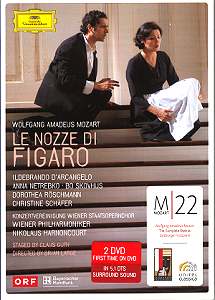

 Ildebrando D’Arcangelo (bass) – Figaro; Anna Netrebko (soprano)
– Susanna; Bo Skovhus (baritone) – Il Conte di Almaviva; Dorothea
Röschmann (soprano) – La Contessa di Almaviva; Christine Schäfer
(soprano) – Cherubino; Marie McLaughlin (soprano) – Marcellina;
Franz-Josef Selig (bass) – Bartolo; Patrick Henckens (tenor) – Basilio;
Oliver Ringelhahn (tenor) – Don Curzio; Florian Boesch (bass) –
Antonio; Eva Liebau (soprano) – Barbarina; Uli Kirsch (mime) – Cherub;
Ildebrando D’Arcangelo (bass) – Figaro; Anna Netrebko (soprano)
– Susanna; Bo Skovhus (baritone) – Il Conte di Almaviva; Dorothea
Röschmann (soprano) – La Contessa di Almaviva; Christine Schäfer
(soprano) – Cherubino; Marie McLaughlin (soprano) – Marcellina;
Franz-Josef Selig (bass) – Bartolo; Patrick Henckens (tenor) – Basilio;
Oliver Ringelhahn (tenor) – Don Curzio; Florian Boesch (bass) –
Antonio; Eva Liebau (soprano) – Barbarina; Uli Kirsch (mime) – Cherub; [2 DVDs: 202:00]