Music & Arts
has now made another vast contribution to Monteux studies with
this new collection. Its San Francisco box set Sunday Evenings
with Pierre Monteux is a vast thirteen CD epic of incalculable
interest, though I did attempt to calculate it on this site
both in its original 10 CD set and in the expanded fuller edition
(see review).
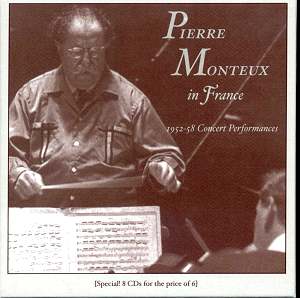
This further offering gives us French concert performances made
between 1952 and 1958. The news is pretty much all good. The
sound is very, very much better than the Horenstein box set,
devoted to that conductor’s Parisian performances and issued
by M&A. True, the repertoire duplicates works that Monteux
recorded, sometimes multiply, but there are eight pieces entirely
new to his discography and that constitutes a major act of reclamation
in itself. Additionally a number of the performances do shed
a new slant on those familiar (or less familiar) commercial
discs either in subtly reinforcing his sheer consistency of
approach or allowing one to reflect on processes of absorption
of his ideas by different orchestras.
One such opportunity
is afforded by the Elgar Enigma Variations. Some are
not as keen on the LSO recording as others; it happens to be
my favourite. Contours in Paris are broadly similar to the recording
made in the same year, 1958, and one can sense Monteux’s underlying
mastery of its structure. The orchestra sounds less sure. Some
of the variations are more palpably etched though that’s not
always an advantage. The winds are less athletic than their
London rivals, Nimrod doesn’t begin with a hushed pianissimo
or crest so nobly; EDU is played rather garishly and untidily
– and elsewhere things can occasionally become metrical. Tchaikovsky’s
Fifth Symphony shares disc space with the Elgar. He makes some
metrical adjustments but generates plenty of lyric intensity
and vitality within accepted expressive limits despite the broadening
of the second subject - in which he was of course hardly unique.
This is a reading that offers a symphonic structure that remains
warm without mannerism or overtly interventionist manipulation.
Monteux and Stravinsky
- it goes without saying. Petrushka is a composite.
The bulk derives from May 1958 but the Third Tableau comes from
a Paris performance of June 1955. One wouldn’t otherwise know.
The sectional balancing here is fine, textures are well delineated
and the playing is knowing and affirmative. The Rite of Spring
was taped a week after the 1955 Strasbourg performance of the
Third Tableau and it has a few rough edges in the brass section.
But Monteux, who never went in for artifice, sheen or superficiality
brings tremendous finesse. And if there is rhythmic imprecision
in the second part the performance is never less than timbrally
revealing.
Beethoven is
represented by four symphonies. No.2. is vigorous and
successful – it lacks a first movement exposition but sports
a warmly phrased slow movement. The finale has wind lines answered
in brisk fashioned by the incisive string choirs, buoyed up
by Monteux’s spruce and no-nonsense rhythmic attack. The Seventh
was taped in Strasbourg in 1952 and offers even greater
rewards – noble directness and a straightforward and yet notably
subtle command of colour. The Allegretto has a forward moving
gravity that never sounds at all breathless and develops a powerful
eloquence. The only quibble in the reading would concern the
rather studied trio section of the scherzo. Monteux apparently
referred to No.8 as the “Symphony of the Basses.” It’s
a reading chockfull of wit and sly humour – not a performance
that seeks to assert the Eighth as an overlooked monolith –
and one that fully reaps the benefit of naturalness of phrasing
and proportion. The Ninth was recorded in the same year
as his commercial recording and this live traversal is, surely
unsurprisingly, very similar indeed, both in terms of proportion
and contour – the movements “time” almost exactly. Monteux maintains
a prudent balance between tensile extroversion and a sensitive
unfolding of melodic strands. Vocally he has Josef Greindl on
powerful though somewhat stentorian form – with a wide vibrato
to match. Maria Stader is commanding but a touch strident.
Helene Bouvier and Libero de Luca do well.
The two Mozart
performances show us Monteux the accompanist. At the start the
sound is swishy but Casadesus is on characteristically sensitive
and long-breathed form in K491. His phrasing is elegant
and his legato spun with splendid control. The orchestral winds
however have other ideas and their idiosyncratic tone makes
for a clash of cultures. Monteux meanwhile summons up Janissary
drama for the slow movement. In K219, the Fourth Violin
Concerto, the soloist is Annie Jodry whose intonation is suspect,
tone rather thin but whose slides are tasteful.
The Prokofiev
Classical Symphony is buoyant, avuncular and full of
high jinks. Monteux rightly avoids portentousness. There’s a
terrific performance of Hindemith’s Nobilissima Visione
where he conveys palpable depth of feeling even at relatively
bracing tempi – indeed through the use of such driving tempos.
The conductor proves as adept at the march rhythms of the second
movement as he does in unfolding its gravely warm ensuing pastorale.
Similar control enlivens the finale – alternately trenchant
and lyrical.
He takes Debussy’s
Images at quite a lick. This jaunty but never superficial
reading brings vivid and characterful playing. Monteux’s malleable
but sharp rhythmic awareness fuses with moments of sensuousness
(solo violin) and acidic drama (Iberia II) to produce
a reading of élan and disciplined brilliance. Since he premiered
Jeux but never recorded it commercially its presence
here is highly desirable, to put it mildly. He conducts with
penetrating insight – teeming with detail and incident and forthright
in its emotive candour. Ravel’s Shéhérazade is
with Germaine Moysan; a preferred soloist was Monteux’s niece
Ginia Davis though his well-known commercial recording was given
with de los Angeles. Moysan though sings with high intelligence
and fine tone. This all-French disc ends with a Stokowski-esque
riot in the shape of the Couperin-Milhaud, also new to
the Monteux discography. There’s no excuse for this – just great
fun.
I wasn’t quite
sure how Monteux would respond to Respighi’s Pines
of Rome but I needn’t have worried. Whatever relative limitations
there may be about the sound and also concerning the rather
un-opulent orchestral playing are swept away by the vitality
of Monteux’s conducting. True, the trumpet principal’s vibrato
will be too florid for many and tidiness is not the name of
the ensemble game but there’s excitement here a-plenty. Monteux
was a fine but underused Straussian and he proves so
again in Tod und Verklärung – a performance without idiosynbcracies
but with plenty of humanity and a sure ear for the climax of
a phrase.
Wagner
was one of Monteux’s two favourite composers – the other of
course was Brahms, a fact he often used to tax those who insisted
he reprise his Franck or Stravinsky. His Dutchman is
bedevilled by some weak orchestral playing but is otherwise
splendidly virile. He often professed to be bored by the Franck
Symphony and left behind multiple recordings of it, the best
of the three being the one made in Chicago. This Paris
perfomance however is biting and controlled; and if its power
is perhaps not quite matched by orchestral finesse, then there
are compensations in hearing once more Monteux’s control of
line in this work so closely associated with him.
John Canarina, Monteux’s pupil
and biographer, has contributed excellent and extensive notes.
Anyone remotely interested in the Mâitre will now need
both M&A sets which are complementary and shed important
light on each other. I’m sorry for your finances but not for
the musical enjoyment you will receive.
Jonathan Woolf

























 Orchestre National
de France (Orchestre National de la RTF)/Pierre Monteux
Orchestre National
de France (Orchestre National de la RTF)/Pierre Monteux