|
EXPLORE
Musicweb - CLICK
------------------
Message Board
Announcements
Twitter @MusicWebINt
------------------
RECORDING
OF THE MONTH
Shostakovich Symphony 8
RCO, Nelsons
RECORDING
OF THE MONTH

HALLÉ WALKURE
4+1CDs £22 post free
RECORDING
OF THE MONTH

Complete Orchestral Works

EMI Complete Ferrier

Storyteller

Mahler
Symphony 7
Bamberger Symphoniker
Jonathan Nott
................
RECORDING OF THE MONTH

Simone Young
RECORDING OF THE MONTH
Italia Nicola Benedetti

Only complete set
on the Market
35CDs £67

RECORDING
OF THE MONTH
Momentous!
BARGAIN
OF THE MONTH

Italian Cello Concertos
and Sonatas
3CDS £10.95

Brahms Symphonies Zinman
£26.85
RECORDING
OF THE MONTH
Beethoven Symphonies
Thielmann


Magic Moments of Opera
10 Operas Arthaus £95

Brilliant Classics 40CDs

Brilliant Classics 60CDs

9 Symphonies Chailly
£31.90

9
Symphonies C Davis
£18.70
BARGAIN
OF THE MONTH
Absolutely marvellous!
£5.99 post free

Bruch VC1 Gluzman
Quite the finest performance of the Bruch concerto
I have ever heard.

The best opera DVD of the year so far [ST]

Mahler Song Cycles
Katarina Karnéus
Available
again
The Raga Guide
4CDs + 196 page book
£33 post-free world-wide
15,000 copies sold
Editorial
Board
Classical Editor
Rob Barnett
Seen & Heard
Editor Emeritus
Bill Kenny
Editor in Chief
Stan Metzger
MusicWeb Webmaster
Len Mullenger
Assistant Webmaster
David Barker
|
 |
 |
|
Preiser
Records
|
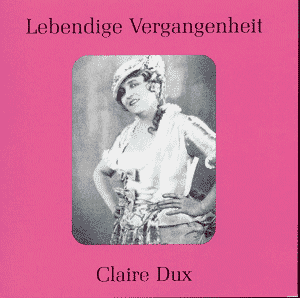
Claire Dux (1885-1967)
Wolfgang Amadeus MOZART
(1756-1791)
Marriage of Figaro (1791) – Nur zu flüchtig [4:30]
Marriage of Figaro (1791) – Endlich nacht sich die Stunde [4:54]
Il re pastore (1775) – Dein bin ich
[4:36]
Carl Maria von
WEBER (1786-1826)
Der
Freischütz (1820) – Wie nahte mir der Schlummer [4:25]
Giuseppe VERDI (1813-1901)
Rigoletto (1850) – Schon seit drei
Monden [3:31]
Il Trovatore (1853) – Es glänzte
schon [3:52]
Il Trovatore (1853) – In deines
Kerkers tiefe Nacht [4:17]
Il Trovatore (1853) – Befreit, o
welche Seligkeit [2:12] ¹
Charles GOUNOD
(1818-1893)
Faust (1859) – Es war König in Thule [3:35]
Faust (1859) – Ha, welch’ Glück [3:24]
Georges BIZET
(1838-1875)
The Pearlfishers (1863)– O süsse Stund’ [4:18]
Ambroise THOMAS (1811-1896)
Mignon (1866) – Kennst du das Land [4:16]
Giacomo PUCCINI
(1858-1924)
La Bohème (1896) – Man nennt mich Mimi [4:20]
La Bohème (1896) – Will ich allein des Abends…[2:34]
La Bohème (1896) – Sind wir allein? [7:59] ²
Madame Butterfly (1904) – Eines Tages she’n wir
[4:09]
Tosca (1900) – Vissi d’arte [3:35]
Engelbert HUMPERDINCK (1854-1921)
Königskinder (1910) – Ach, bin ich
allein [3:31]
Königskinder (1910) – Sieh her, ob
mir Hunger die Glieder entziert [2:35]
Claire Dux (soprano)
Joseph Schwarz (baritone) ¹
Carl Jörn (tenor) ²
Unidentified orchestras
rec. 1911-20
PREISER 89688
[78:17]
|
|
Claire Dux, with the Franco-Polish name,
was born in 1885 in what was then Bromberg in Prussia and is
now in western Poland. She studied in Berlin and plied her early
trade in Cologne. Her career escalated and by 1909 she was singing
Mimi with Caruso, signing for the Hofoper in Berlin, and taking
engagements to appear for Beecham at the first British Rosenkavalier
at Covent Garden. The war interrupted her career but she was
young enough to resume, albeit patchily, afterwards but friction
led to an estrangement from the Hofoper and she travelled to
America, though not to the Met. Her operatic career then rather
trailed off and she gave a series of lieder recitals before
the Second War. She also made a series of increasingly interesting
marriages – to the writer Imperatori, the actor Hans Albers
and the finally the man always rather gleefully referred to
as “the multimillionaire meat-packing magnate” Charles Swift.
She was a beautiful singer with a technique
that sounds in the main effortlessly effective. The sheer quality
of the voice can be gauged early from the Marriage of Figaro
sides recorded in 1916 for Grammophon. The singing has a fluid
grace and elegance and an appealing timbre. But what it also
shows critically speaking is a weak chest voice – sample the
German language Endlich nacht sich die Stunde where one
feels the disparity in registral strength. Nur zu flüchtig
is similarly beautiful as regards the actual quality of
the voice but there is evidence of rather uneven vocal production
such that the legato is slightly compromised. I don’t think
anyone would feel short-changed by her Weber in terms of timbre,
control or articulacy but perhaps one might in terms of dramatic
projection. For all her many beauties – of tone, of inflection
– there are moments when she comes over as a rather static artist.
This element of remove might possibly explain why she failed
to compete in the burgeoning post-war operatic world – given
that a number of sides here date from 1920 and sound similarly
reserved it might explain why her operatic performances were
limited subsequently to smaller houses.
Her 1911 Königskinder extracts are
valuable and she recorded them early, as the premiere had only
been the previous year in New York. Dux essayed the Farrar role
here and with some success. However she sounds a touch thin
in her 1916 Rigoletto duet with the magnetic Joseph Schwarz
and I think the disparity between his dramatic impersonation
and her rather withdrawn one – though possibly magnified by
the recording technique – reinforces the matter of her depth
of characterisation. But that relative inertness should not
efface the beauty of her voice. The French repertoire reflects
well on her, and strongly suits both her voice and her dramatic
strengths. This was a voice, German in training, and perhaps
better employed in Bizet, Thomas or Gounod.
The transfers are unproblematic, straightforward
and not over-filtered. The small blasting in the Weber is not
representative of the whole. Dux was a memorable singer, not
always convincing theatrically perhaps, but who possessed much
beauty of voice. And in the end that counts for a lot.
Jonathan Woolf

|
|
Advertising
Rates
Visitor
stats
MusicWeb
International
has over 40,000 Classical CD reviews on offer
Discs
received
Having a problem
Donating?

Gerard
Hoffnung Concerts &
The
Bricklayer Story
New
Releases

New
Releases


MusicWeb
sells the Polish
catalogue CDAccord
£10.50 post free W-W

MusicWeb sells the
Arcodiva catalogue
£12.00 post free W-W

£11.75
post-free world-
wide
MusicWeb
can now offer
you discs from the following catalogues:
Prices include postage
Musicweb
Special
Offers
Monthly
Best Buys
Google
Ads - for information about privacy matters, click here.
Amazon Musicweb International is a participant in the Amazon
EU Associates Programme, an affiliate advertising programme designed to provide
a means for sites to earn advertising fees by advertising and linking to Amazon.co.uk
and Amazon.com
|