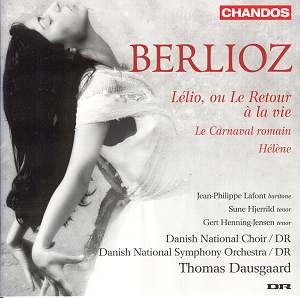
Three Berlioz scores
from the enterprising British independent record label Chandos.
Le Carnaval romain is a staple of the repertoire. However,
the scores Hélène and Lélio though appealing are
rarely heard and make a welcome appearance in the catalogue.
The opening work
on the disc is the popular and exciting Le Carnaval romain
(Ouverture caractéristique). From 1844
the score was originally intended as a symphonic introduction
to the second act of his opera Benvenuto Cellini - a
work that had failed at the Paris Opéra in 1838. By the time
the overture was completed Berlioz had decided that he would
issue the score as a stand-alone concert overture.
The short work Hélène
was originally composed in 1829 as a song for two voices
and piano using translated texts from Thomas Gounet, after Thomas
Moore. In 1844 Berlioz completed a version for chorus and orchestra
that was premièred the same year in Paris at the same concert
as the first performance of the Le Carnaval romain.
Hélène has
a distinctive brassy, fanfare-like opening. Over muted strings
and light percussion the chorus sounds as if it consists of
all-male voices, which must represent a choir of shepherds singing
about the love between Hélène and William. One notices
that the brass section, especially the trumpets are never far
away. In 6/8 time, Hélène is a difficult work to categorise,
light-hearted and akin to a cross between a drinking song and
a tender ballad.
The featured composition
on the disc is the ‘monodrame lyrique’, Lélio, ou Le Retour
à la vie or The Return to Life. It
seems that the rarely heard and performed score was composed
in 1831-32. It was designed by Berlioz as a sequel and second
part to the Symphonie fantastique (An Episode in the
Life of an Artist). A concert on 9 December 1832 at the
Paris Conservatoire, where both works were programmed, was described
as a ‘Grand Concert Dramatique’, to further emphasise
the connection between the two works.
Berlioz’s Symphonie
fantastique was motivated by his love for the Irish
actress Harriet Smithson. However, it is also thought
that the romantic inspiration for Lélio was his fiancée
Camille Moke. Other commentators say that Miss Smithson was
again the muse.
The programmatic
Symphonie fantastique is a dramatic pictorialization
in music. Not surprisingly, in view of Berlioz’s love of the
stage, Lélio is a part-theatrical work, that amalgamates
orchestral and choral music using texts mainly in French. There’s
also some Italian, with vocal soloists and a substantial part
for a narrator who speaks in French. Lélio is unusual
and can also be a confusing work. The descriptions of the score
that were available to me, I experienced as unhelpful in the
main; maybe other writers were just as perplexed as I. My description
of Lélio is a pasticcio, comprising assorted fragments,
loosely fitted together by a narrative. Evidently the sprawling
and often bewildering text of Lélio comprises quotations
from his own letters and the inspiration from his literary favourites;
such as Goethe and Shakespeare. Berlioz described it as a Return
to Life, depicting his own awakening from the nightmare
effects of the treacherous poison where Lélio (Berlioz’s
alter-ego) searches for his ideal love-mate, assisted by his
friend Horatio.
During Berlioz’s
lifetime, Lélio was a tremendous popular success with
Parisian audiences. However, the unusual mix of requirements
undoubtedly makes it such a rarity both in the concert
hall and on disc. In particular the generous amount of spoken
dialogue results in listening difficulties, unless one actually
follows and concentrates on the translated text.
Whilst listening
to the score I compiled the following notes:
The score to Lélio
commences with a narrative and is divided into six distinct
sections. Each section is surrounded by a narrative:
1. The Fisher,
‘Ballade of Goethe’, Andantino.
For tenor and piano,
a delightful ballad attractively and brightly performed by Gert
Henning-Jensen (Horatio) displaying a vibrato that is distinctive
but never off-putting.
2. Chorus of
Shadows, Largo, misterioso.
For mixed chorus
and orchestra. For this chilling death march the brass, low
strings and percussion are joined by the mixed choir. The music
achieves considerable sweeps of choral and orchestral power
over a steady pulse from the percussion.
3. Song of the
Brigands, Allegro marcato con impeto.
This is a rousing
and exciting section for baritone, chorus and orchestra. In
his role as soloist Jean-Philippe Lafont, as the captain, is
in impressive form; noticeably strong and expressive.
4. Song of Bliss
- Hymn, Larghetto un poco lento,
The inner voice
of Lélio.
Here the strings
and woodwind provide light accompaniment to tenor Sune Hjerrild,
as the inner voice of Lélio, who sings beautifully; searingly
tender. The part for harp is especially effective.
5. The Aeolian
Harp - Recollections, Larghetto
A highly attractive
section for strings and harp with a poignant part for clarinet
solo. I am strongly reminded how many years later Percy Grainger
used tremolo strings to similar effect, to represent
the wafting and gusting winds that he called “wogglings”
in his Sailor’s Sea Shanty, Shallow Brown for chorus
and orchestra (1910).
6. Fantasia on
Shakespeare’s Tempest
a) The Introduction,
Andante non troppo lento (sung in Italian) by mixed chorus,
orchestra and piano four hands. A generally relaxing section
that flows easily. The music on occasions reminded me of the
songs from Brahms’s Liebeslieder Walzer for chorus and
piano 4-hands, Op. 52 (1868-69).
b) The Tempest
marked Allegro assai, un peu retenu en commencant for
mixed chorus (sung in Italian) and orchestra contains menacing
orchestral playing tempered by a female choir at 1:43 (track
15).
c) The Plot,
marked Un peu moins vite for orchestra and mixed
chorus (sung in Italian) is a bright piece that canters along
with purpose.
d) The Conclusion
for orchestra. Rousing and heroic with a pursuit quality
somewhat reminiscent of Rossini’s Overture to William
Tell (1829).
I cannot readily
bring to mind any early nineteenth-century precedents that may
have influenced Berlioz to write Lélio. To some degree
Lélio invites comparison with Mendelssohn’s 1843 incidental
music to ‘A Midsummer Night’s Dream’ for soloists, chorus
and orchestra, Op. 61 in the edition with narratives for male
and female speakers. Now virtually unknown, the Ode-Symphonie,
Le Désert by Félicien David, was a work evidently inspired
by Lélio becoming a success in 1844 Paris. Le Désert
consists of orchestral sections, melodramatic fragments, marches,
dances and pieces for choir, interspersed with spoken narrative.
The Danish National
Symphony Orchestra under their chief conductor Thomas Dausgaard
provide alert and responsive playing throughout. It would perhaps
have benefited from a touch more bite at times. I must single
out the famous cor anglais solo from Le Carnaval romain for
special praise. The singing from the Danish National Choir in
Hélène and Lélio demonstrates impressive unison
and the soloists; tenors: Henning-Jensen and Hjerrild, and baritone
Lafont provide pleasing performances. It is hard to fault the
narration by Lafont, which is particularly well enunciated,
displaying a fine feeling for the words. The sound quality is
of a high standard, feeling especially well balanced. I thoroughly
enjoyed the essay from Richard Langham Smith, although, I am
still searching for a clearer description of Lélio.
Probably the best
known version of the popular concert overture Le Carnaval
romain is the robustly dramatic 1965 performance from the
London Symphony Orchestra under Sir Colin Davis. Available as
part of his 6-disc set of Berlioz’s: Complete Orchestral Works
on Philips 456 143-2. The box set also includes a commendable
1980 account of Lélio (without the narration) also performed
by the LSO under Colin Davis with the John Alldis Choir and
soloists: Jose Carreras and Thomas Allen.
In spite of fine
performances and recording, Lélio, the featured work,
is I fear, a curiosity destined for continued obscurity. An
interesting disc that will probably appeal to Berlioz completists
only.
Michael Cookson

























 Gert Henning-Jensen (tenor) (Horatio)B