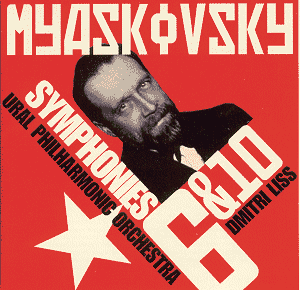
Right from
the start Liss makes it clear that this is going to be a
gripping and urgent account of the Myaskovsky Sixth Symphony.
It’s a reading of elemental spontaneity seemingly swept along
by the fire or poetry of the moment. That flame, in the first
movement, can produce moments that teeter close to a gabble.
One wonders whether the young Golovanov produced similar
results for his premiere at the Bolshoi on 4 May 1924.
The majestically
singing lyricism of the long third movement can be heard
in both in its magnificence and its understated poetry between
10:04 and 11:49. The finale has moments that suggest a light-hearted
bumpkins' dance but after the celebrations fall away we come
to the brief choral part soaked in the music of the Russian
orthodox liturgy even if the sentiments of the text point
elsewhere. The symphony ends in a peace in which peaceful
threads of silver and gold interweave.
The Sixth
is an enigmatically loveable symphony with the instinctive
accelerandos and rallentandos of any of the great Tchaikovsky
symphonies. Its material might be seen to be hewn from the
tragic pages of Manfred and then passed through the
Myaskovsky alembic to produce searing magnificent tragedy
and tender nostalgic regret.
Liss's
reading is more volatile and possessed than that of Järvi
on DG but not as polished. It ranks high among the increasingly
numerous competition.
Contrast
the sprawling generous structure of the Sixth with the compact
single movement Tenth Symphony premiered by the conductorless
Persimfans in 2 April 1928 in Moscow. It is a densely packed
and stormily taut work. Its inspiration is from Alexander
Benois's illustration to Pushkin's The Bronze Horseman and
the surging and tempest of the music is illustrative of the
devastating floods of Leningrad in 1824 associated with the
story. It has all the elements of a symphony but crammed
into just over a quarter of an hour – perhaps influenced
by Sibelius’s Seventh. Stokowski premiered the Tenth in Philadelphia
in 1930 but unlike the world-beating Fifth and the famous
twenty-first it has never won a following. Like the expressionistic
thirteenth it is amongst the least fawningly ingratiating
of his works and ends in an enigmatic rolling growl.
The exemplary
notes are by Malcolm Macdonald, Tempo editor and John Foulds
authority. They are freshly written and thoughtful. Interesting
that he places Myaskovsky 6 as the most significant Russian
symphony between Tchaikovsky 6 and Shostakovich 4.
Rob Barnett
Alternative Myaskovsky Sixths
Stankovsky (Marco Polo 8.223301) - review
Svetlanov (Olympia OCD736) - review
Kondrashin 1978 (Melodiya 1000841) - review
Järvi (DG 471 655-2)
- review
|
Advertising
Rates
Visitor
stats
MusicWeb
International
has over 21,000 Classical CD reviews on offer
Gerard
Hoffnung Concerts &
The
Bricklayer Story
New
Releases

New
Releases


MusicWeb
sells the Polish
catalogue CDAccord
£10.50 post free W-W

MusicWeb sells the
Arcodiva catalogue
£12.00 post free W-W

Price
Reduction: £11.00
post-free world-wide
Try
it and see - Sale or Return
MusicWeb
can now offer you discs from the following catalogues:
Prices include postage
MusicWeb
Recommended Recordings 2008
DISCS
OF THE YEAR 2007
|