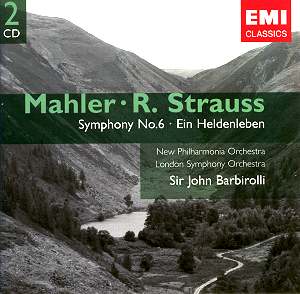
This Gemini double is an exact replication of EMI's Forte 569349-2,
right down to the 1996 remastering. If you have the previous
set, you do not need this one. If you do not already own
these performances, these very individual accounts deserve
your consideration.
Barbirolli's Mahler 6 is a flawed diamond, but a diamond nonetheless.
I have lived with this performance for the last decade or
so and, though I am aware of its faults in execution and
interpretation, I am drawn back to it often. More often,
in fact, than I am drawn to other recordings in my collection
which I probably profess to prefer.
The Sixth is Mahler's most despairing symphony and the only one that
ends with defeat rather than joyous resolution, rapture or
resignation. Barbirolli, so often the master of orchestral
warmth, takes Mahler's doom-laden score right to the edge
of insanity. In his hands, the vicious march that opens the
first movement becomes a bone-racking trudge, with the cellos
and basses digging deep into their strings. Even the Alma
theme of the first movement offers little respite from the
gloom. Really, this beautiful melody should shed a little
sunshine in a movement that is written to contrast hope and
despair and which ends in the major, but I find Barbirolli's
dark clouds compelling.
A sorrowful but lovingly detailed andante follows the first
movement, with the rough and nasty scherzo placed third.
This order
of movements was Barbirolli's preference in live performances.
I prefer the scherzo second so that the first two movements
balance the fourth, with the andante as the fulcrum. Luckily,
the second, third and fourth movements are all on the second
CD, so my preferred order of movements is easily re-established
without the need to swap CDs too often mid-symphony.
The finale is of a piece with the scherzo and first movement, a deliberately
paced and unrelenting essay in desolation. There are more
orchestral slips here than in the preceding movements, including
a prominent trumpet fluff at about 25 minutes in. No matter.
The interpretation holds it together.
Barbirolli's Mahler 6 is unique. It is certainly a very personal
conception - some would say a wilful one - but I think that
is the reason
his performance of this symphony succeeds for me where his Heldenleben fails.
Mahler's music is intensely personal and intensely emotional,
qualities that give it the resilience to absorb all sorts
of interpretative approaches and emerge relatively unscathed,
though perhaps viewed from a different angle or in a different
light. Without wanting to get in to an argument with Gunther
Schuller, I would say that Mahler's symphonies can handle
more 'interpretation' than most other works in the symphonic
canon. That probably explains why I can simultaneously love
Solti's orchestral powerhouse (Decca) and Boulez's clear
and almost classical view of the score (Deutsche Grammophon)
as much as this terrifying and emotionally draining performance.
Strauss's tone poems are a different matter. This is music
of the head rather than the heart and all it really needs
is spectacular
orchestral playing and a firm hand to shape it. It tolerates
fewer indulgences and, in its brilliant scoring, shows up
those who cannot play it as a seamless whole.
Barbirolli's way with Strauss's tone poem is, as one would
expect, very personal. He lingers lovingly over some details
in the
score, glosses over others and sacrifices some ensemble balance
and precision for atmosphere. If you are familiar with his
late recordings of Elgar, you will know what to expect.
On first listening, I found his approach annoying and his interpretation
distended. The Hero's Battlefield lumbers and creaks
but does not excite, however brilliantly the recording captures
the offstage trumpet fanfares. The Hero's Companion,
rendered with all care and tenderness by an uncredited John
Georgiadis, loses focus and tension at Barbirolli's sluggish
tempo.
Subsequent hearings have softened my view of this recording.
Barbirolli's
affection for this colourful score is obvious and he does
create some memorable moments. The sneers and jeers of the
critics are brutal, and there is certainly a sense of glowing
fulfilment in the final pages. Although there is a lot to
appreciate in this performance, other recordings in my collection
- including Karajan's 1959 reading on Deutsche Grammophon,
Previn's on Telarc, Reiner's on RCA Living Stereo and Kempe's
on EMI - are much stronger in conception and eminently more
recommendable to anyone primarily interested in this tone
poem rather than the conductor.
How to sum up this issue? It is compulsory for Mahlerians, though
they may not love it, and essential for Barbirolli fans,
who undoubtedly will. A missed opportunity though - an Abbey
Road Technology remastering would have tempted collectors
to repurchase these old recordings, but as it is this reissue
will tempt newcomers only.
Tim Perry



 London Symphony Orchestra/John
Barbirolli
London Symphony Orchestra/John
Barbirolli