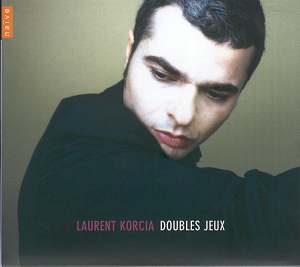
The title of this album, Doubles jeux, may have double
connotations. Literally it translates as double play and
refers no doubt to the fact that not only is this to a great extent
music for two, duos, but also that the musicians play double roles
and move into fields they are not usually associated with. Take
Michel Portal, for instance: one of the world's greatest
classical clarinettists, who also with pleasure plays jazz - also
on saxophone - and, as here, the bandoneon, the original German relative to
the accordion, brought by German immigrants to Argentina, where
it found a central place in the tango music. Then there's
Jean-Louis Aubert, leading French pop-rock singer, who here
indulges in romantic songs from the Caruso repertoire. It is also
the mix - call it juxtaposition - of music from different genres: tunes from the
repertoire of Le Hot Club de France (tracks 1 and 14) versus Debussy's
violin sonata; improvisations on Michel Legrand's Les parapluies
de Cherbourg versus the Schönberg and Haba-inspired duo by
the Jewish Czech composer Gideon Klein, who died aged 26 in a
concentration camp just before the end of WW2. The pivot of the
whole project, Laurent Korcia, although classically schooled and
primarily active within this field, also constantly crosses barriers,
walking in and out of the many differently furnished rooms of
this play house. 'Cross-over', a buzz word today, may be an applicable
term, were it not that in my vocabulary this implies something
casual. Maybe 'border-less' an expression I used a couple of
years ago concerning a disc with Saffire - The Australian Guitar Quartet
(see review)
would be a more appropriate description.
The meeting with a jazz violinist and a classical one is of course
nothing new. Stéphane Grappelli and Yehudi Menuhin made a series
of LPs more than 30 years ago for EMI along the same lines.
Menuhin was certainly one of the most open-minded of classical
musicians, being engaged in World Music long before that was a
common concept. Maybe Korcia and Florin Niculescu are on even more
equal terms - it seems that Laurent Korcia has a more down-to-earth approach
to the jazz idiom, his bow digs deeper into the strings with a
raw, animal power, sacrificing tonal beauty for expressiveness.
The opening number, Minor Swing, has more of the smoky
jazz club of the 1930s than the refined salon jazz of certain
epigones. Ravel's Blues (tr. 3) is in itself cross-over;
we know the composer's genuine interest in jazz - here we can
hear both banjo and percussion and it is played with energy and
intensity. Even more interesting are the Bartók duos, which are
a micro-cosmos of sounds, rhythms and varying moods. I have for
many years treasured an EMI LP with Perlman and Zukerman playing
the whole group. Without making direct comparisons I feel that
Korcia and Radulovic are that much less refined, that much more
earthbound, finding their inspiration where Bartók found his:
among the genuine rural fiddlers.
There
are echoes of Bartók also in Klein's deeply moving, even partially
frightening Duo. Here is no redeeming beauty for the sake
of beauty just seemingly open wounds. This was for me the real
find. But it was also the first time I had fully realised what
a formidable masterpiece Debussy's violin sonata is, when played
as whole-heartedly as here, blowing away any feeling of impressionistic
sophistication, of bloodless fragility. They lift the veil and
say: "Hey! Listen! This is expressionist music about life and
death".
Wieniawski
is so often referred to as a violin virtuoso writing virtuoso
violin music for virtuoso violinists. There is very little of
fireworks in this Étude-caprice but all the more of inward
melancholy.
The
two concluding numbers with guest vocalist Jean-Louis Aubert also
build perspective. In 1912, the year of Massenet's death, his Élégie was recorded by the world's greatest tenor, Enrico
Caruso and the fabulous young Ukrainian violinist Mischa Elman.
Nothing can be further removed from that strictly classical approach
than Aubert's closely-miked and smoky crooning but it has a fascination
and validity of its own. And so has the melodically enticing song
by Luigi Denza, best known for Funiculì, Funiculà,
the song about the Vesuvius funicular. We are used to hearing
Pavarotti and others in his songs but if Anne Sofie von Otter
can sing Elvis Costello and ABBA, and Sting can devote a whole
disc to John Dowland's 17th century songs, why can't
Jean-Louis Aubert tackle Caruso repertoire? It's all a matter
of 'double play'.
Have I in any way kept it as a secret that I liked this disc? I
hope not. Removing borders, opening doors, being open-minded - that's
what this collection is about. One could argue that the
over-riding mood is one of gloominess and tears but the joy of the
music-making is so clearly visible through those tears and the
contrasts of styles, genres and instrumental combinations so
many-faceted that one rather feels uplifted after spending just
under one hour in the company of these musicians (by the way, the
cover says playing time 57:12 but my player stopped at 54:45!).
The people who surround Laurent Korcia are all superb, with an
extra rosette to pianist Michael Wendeberg, the recording is
fairly close and immediate, which probably also adds to the
nearness to the music. Korcia also contributes a highly personal
discourse on the music, and the song texts are printed - but only in French.
I
don't think I am double-crossing anyone by saying that this double
play should be attractive to everyone but the most single-minded.
Göran Forsling



 Laurent Korcia (violin)