As soon as I heard
of the release of this disc I was intrigued.
Herbert Henck has somewhat of a reputation
for highlighting the unusual and under-appreciated
pieces in contemporary musical literature,
including his stunningly dark and well-recorded
works for piano by Avant-Garde Soviet
composer Aleksandr Mosolov, recorded
in the 1990s for ECM New Series.
Regarding the composer,
Magne Hegdal, there isn't a lot of wide-ranging
biographical material online to choose
from. He received his degree in composition
from the Oslo Music Conservatory in
1972 and has been the main music critic
for one of Norway's primary newspapers.
Much of his earlier music relies on
aleatoric methods, and this to some
extent haunts his later output. Hegdal
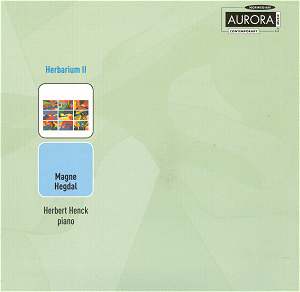
also paints using these methods, one
example being the rather minuscule inclusion
on the cover.
With Herbarium II
we have, not a continuation, but a replacement
of Herbarium written in 1974,
which consisted of 45 "flowers"
instead of Herbarium II's fifty-seven.
The earlier version is, according to
the composer's wishes, no longer to
be performed. The work is organized
into something approximating taxonomic
groupings, with six "Families"
and a final section of five pieces in
the group "Doubles and Variants."
Not one of the pieces tops 1:45 and
fits comfortably on a page of the printed
score. Dynamics and tempo are left up
to the performer of the work.
This recording is recommended for those who
like piano works to puzzle over. Flower No. 2 "Alea" is a variant
of Flower No. 55 Included in the score, as referenced by the
liner-notes, is an aphoristic phrase quoted from another composer
who appears to be somewhat of a touchstone for both performer and
composer: Josef Matthias Hauer (1883-1959): Expression according
to colour. This might well be the key to the work, which makes a
point of sorting these miniatures in ways that approach the
scientific. Another possible foothold is - and this is in the very
interesting and helpful notes written by Herbert Henck included in
the booklet - a link to Czech composer
Reicha. Reicha composed a work entitled
The Art of Variation in 1804,
his op. 57, which has fifty-seven variations
and, with the Hegdal, matches the number
of movements in this Hegdal work. Of
the works I've reviewed recently, this
one holds the greatest potential for
rewarding close study of the score.
The soundworld that
this piece inhabits fits best in the
atonal works of the avant-garde, with
a good deal of alliance to the Russian
avant-garde composers of the Teens and
Twenties, Lourié and Roslavets
being two examples. The piece could
be seen as a sort of new Ludus Tonalis,
minus the contrapuntal aspect.
The recording quality
of this release is very good, rivalling
that of the ECM discs Henck has produced
earlier. The listening is challenging,
but rewards close study. The works don't
give up their secrets easily, but that,
to a great extent, is an important part
of the listening.
David Blomenberg



 for
details
for
details
 Herbert Henck (piano)











