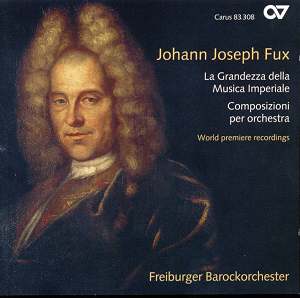
Fux followers - and there are some - will have cause to welcome
this latest Carus disc because it renders valuable discographic
duty. The works here have only fairly recently been rediscovered
and none therefore had been recorded before. Because of the nature
of the works - none tied to a specific event - it's
impossible to date them with any certainty. But it's conjecturally
supposed that they were written around 1700, a period which
saw him imperial court composer to Leopold I and therefore
around the time he assumed the position of music director
at St Stephen's Cathedral and was elevated still further
in the imperial echelon.
Fux
is best known for his masses and oratorios, and other church
music, as well as his pedagogic study Gradus ad Parnassum. Around
two thirds of his surviving oeuvre is constituted by such
works. But he did write orchestral music and these five are
pleasing examples of his command of dance forms, whether
stylised or more personal.
The Ouverture in D N4 for two oboes, two
violins, viola and bass continuo is a seven-movement work of
ingratiating skill. Robustly played though it is, it never quite
hides the rather conventional nature of the writing - certainly in the opening.
Later on nightingale evocations are to be heard and a generally
improvisatory element encouraged. Just when the Minuet seems
to be running out of steam the Passepied trio erupts into
rude health. Experienced practitioners in the field the Freiburger
Barockorcester under their violin-leader Gottfried von der
Goltz refuse to linger in the Air and bring earthy vitality
to the Francophile dance movements.
The
Concerto in D E112 is actually a more compact but emotively
more personal and complex work. It veers from the external
and rather showy to the more plangently reflective with some
avidity. The players pick up on its chilliness as well as
its seamless lines. And they are on the ball in the Fantasie third
movement where we journey from avuncular to notturno introspection
with rapidity.
The
Intrada in C is a four-movement dance based piece. This one
however has a virtuosic role for violino piccolo, presumably
played by van der Goltz and an accomplished if rather impersonal
air all round. The Suite in C N83 is quite a brash and ceremonial
affair and its French sounding leanings are confirmed in
the Rondeau and in the ebullient concluding March. The final
work, to round out this portrait of Fux the composer of dance
music, is the little Rondeau in C.
The
orchestral works don't, it's true, add materially to what
is known of Fux. Too conventional to be stamped with any
highly personalised traits they satisfy more domestic and
traditional courtly needs. They are nevertheless played with
vigour and understanding by the Freiburger Barockorcester
and Fux Followers will need no second invitation.
Jonathan
Woolf



 Freiburger
Barockorcester/Gottfried von der Goltz (violin and director)
Freiburger
Barockorcester/Gottfried von der Goltz (violin and director)