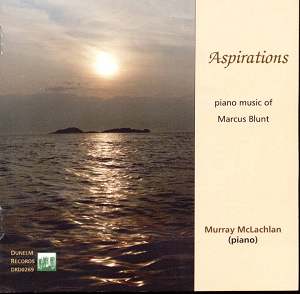
The British composer Marcus Blunt was born in
Birmingham in 1947. He studied composition at the University
College of Wales in Aberystwyth and has since travelled widely,
and worked widely, before moving to Scotland in 1990. His
biography includes such occupations between 1970 and 1976 as
warehouse packer and photographic processor -
which puts George Lloyd's mushroom and carnation business into
some kind of compositional context! He's now the composer-in-residence
for the Dumfries Music Club.
Given that the
majority of his works are instrumental it makes sense to
concentrate on his piano music. It's played by the dedicatee of
one of his most recent pieces, the avidly curious and eloquent
Murray McLachlan. You'll note that I've retained the upper and
lower case particularities of that piece and also the fantasies on
the names of Scriabin and Fauré - these are explained more fully in the notes and
don't affect one's appreciation of the music.
This conspectus gives us three piano sonatas, programmed in
reverse. The compact eleven-minute plus First was written in
1971-72 - that's to say shortly after he graduated - and revised in 1997. It consists
of a Fantasia and a series of Variations. There's a puckish
baroque spirit at work in the first and a strong flirtation with
twelve-tone in the variations. The Second Sonata followed in
1977 but like the First was subject to revision, this time in
1998. This is a particularly revealing and successful work. The
first movement rocking themes coalesce with a powerful sense of
character in the chordal writing. The finale of this tightly
constructed three-movement work is agitated and quite
declamatory - the repetition of the chordal writing gives it a
starkly uncompromising nature - and the Messiaen touches seem to
me to be deliberate.
The Third Sonata (1988 revised 1994) bears the title The
Life Force. In only seven minutes we meet some astutely
fluid writing, still maybe bearing ghostly trace marks of the
influence of Tippett. Rolling and dramatic and with strongly
contrapuntal elements this is a fine example of Blunt's inheritance
and unassuming control of sonata elements.
The early Preludes
are in fact his earliest piano works. They're not yet fully
characteristic but show intimations of the composer to come. The
Theme, the second of the seven, is spare but has atmosphere
whilst the Jiglet has a pawky humour. The Scarlatti homage is
actually very clever - never resorting to pastiche or nostalgia.
The two Scriabin homages are clearly imaginative foretastes
of his later compositional association - in the shape of the
1992 Fantasy - with a composer who has clearly been highly influential
on him.
The two little Iona
pieces are rather too elliptical for full pleasure but the Nocturnes
impress more. They summon up a sense of place and personality.
The tribute to the composer's friend Frank Bayford is
especially warm and affectionate. He retains independence in his
Scriabin Fantasy - this is an artful and eventful piece, finely textured
- and the Fauré tribute summons up the spirit of the composer
through the sparest of means. Finally there's the tribute to
McLachlan, which begins quietly but generates a fulsome,
powerful dynamic - how astute a character study this is perhaps only
the pianist can know!
So a most enjoyable
recital, attractively recorded, and played with typical sensitivity
by a pianist fully in sympathy with the music's demands and
nature-mystic moments. But when will we hear Blunt's Piano
Concerto? Admirers of the composer should agitate for it and
Dunelm should go on a drive to get this in the recording can
without undue delay.
Jonathan Woolf



 Murray McLachlan (piano)