This is a valuable disc, one that complements
the first volume in this series, given over to The Well Tempered
Clavier (see review)
and also Arbiter's exploratory work in Feinberg studies (see
reviews 1;
2).
We have evidence
in the first Arbiter volume of how titanically febrile Feinberg
could be in Beethoven. His Appassionata opens with galvanic
intensity. Here we have three more examples, very much more
equable, of his approach to Beethoven interpretation.
The Op. 7 sonata
is writ in extrovert relief. To cite a near contemporaneous
performance, the mono Kempff, is to do no more than set one
pianist at odds with another. Where Kempff is lightly articulated
and generous with rhythmic swing, we find Feinberg masculine,
much quicker and deliberately more leaden. The chording and
pedalling in the Largo are more externalised, gradients are
deeper, more loamy, and dynamics are bigger. Similarly the decorous
pointing of a Kempff has no place in Feinberg's grittier and
squarer-jawed Beethovenian sound-world.
These are the kinds
of differences and distinctions one will find throughout the
three performances. The Op.22 sonata is highly emotive and driving
in Feinberg's hands; left hand accents aren't pointed with Kempff's
refinement or strategic intent. Feinberg's sound picture is
very much more dense, more congested than that cultivated by
the German player. Those darker and teakier textures are most
obvious in the same sonata's slow movement. There's more of
everything; more arm weight, more pedal, more obvious depth,
a blacker, bleaker place entirely.
Op.109 sees an intensification
of these qualities and it remains entirely consonant with the
other examples of his sonata performances of the composer. There's
less graphic drama and detail in his performance than in the
recording by Schnabel. He's certainly considerably quicker than
Schnabel in the Andante molto cantabile ed espressivo
revealing once more a definably Feinbergian sense of stoic nobility,
animated seriousness and a reluctance to indulge external sentiment.
He differs in this rather profoundly from Schnabel's own interior
and introspective Olympian stance and indeed from Kempff's own
more refined qualities.
The tapes are in
relatively but not absolutely good estate. There is post-echo
in the second movement of Op.109 and other small concerns elsewhere.
But these are important documents of a musician of the highest
spiritual qualities.
Jonathan Woolf



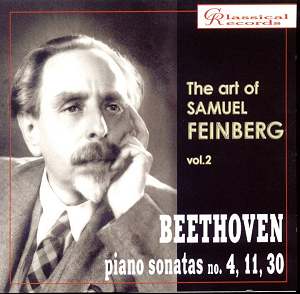

 Samuel
Feinberg (piano)
Samuel
Feinberg (piano)











