This second instalment
in the continuing cycle of Ries's piano concertos from Naxos
is a disc for your wish-list.
Ries is more famous
today for being Beethoven's pupil and biographer than for his
own career in music. In his day he ranked with Hummel and, yes,
even with Beethoven himself as one of Europe's greatest composer-pianists.
Thanks to the efforts of Naxos and Allan Badley's Artaria Editions,
we can now hear for ourselves what it was that so excited nineteenth
century audiences.
All three works
here show Ries to be a composer of originality, though one with
a respect for his musical forebears. It would go too far to
call him daring or revolutionary. Nonetheless, despite the
backward glances at Mozart, his facility for contrasting grand
orchestral statements with piano writing of a free, rhapsodic
lyricism bridges the gap between Beethoven on the one hand and
Chopin and Schumann on the other.
The Swedish National
Air with Variations opens with a proud and darkly coloured
orchestral flourish, which is immediately contrasted with a
gently glittering statement from the piano. This pattern of
contrasts is repeated throughout the 15 minutes of this piece,
as Ries plies his skill at conjuring variations, first dazzling,
then soulful. He casts the orchestra as chorus rather than
as equal partner in dialogue, but he knows how to use its tone
colours – listen to the lovely clarinet commentary about five
minutes in, for example.
The Piano Concerto
in C sharp minor is a delightful work, written largely on the
road as Ries toured and then fled Russia in 1812. It is natural
to want to draw comparisons with Beethoven's C minor concerto
of 12 years earlier, but similarities are few and comparisons
unhelpful. Apart from a few blustery tuttis, Ries uses the
minor mode to spice harmonies and lend interest rather than
to generate Beethovenian drama. The material is predominantly
lyrical but virtuosic in the outer movements. The central slow
movement lasts for less than five minutes, but is the heart
of the concerto. Here Ries'sw gentle lyricism calls for a Chopinesque
rubato and lightness of touch. His writing for orchestra, though,
is better than Chopin's and full of interesting details and
colourings.
The Introduction
and Polonaise may have been composed 21 years after the
other two pieces in this programme, but it demonstrates a remarkable
consistency in Ries's idiom across the years. This piece is
full of Mozartean turns of phrase, but with harmonic touches
that point to Schumann. Again, there is some charming writing
for the clarinets and flutes as they comment on the piano's
discourse.
The Austrian pianist
Christopher Hinterhuber plays with commitment and is a fine
advocate for these works, just as able to command attention
with flashes of fire as he is to lead the ear through the most
delicate figurations. Grodd and the Gävle Symphony Orchestra
support him well enough, though there is a little raggedness
in the upper registers of the violins towards the close of the
Introduction and Polonaise. The recorded sound is fine
and the booklet notes by Allan Badley are interesting, though
they hint at but do not explain the reconstruction of the score
of the C sharp minor concerto.
All up, this disc
offers you satisfying performances of satisfying music. How can
you refuse?
Tim Perry
see also Review
by Colin Clarke of Vol.1 in this series
























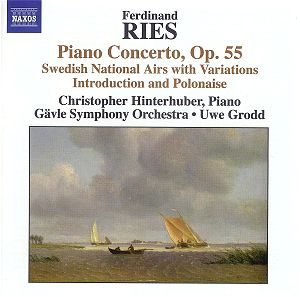

 Christopher
Hinterhuber (piano)
Christopher
Hinterhuber (piano)