The top line is that
this ‘new’ release from Lyrita is essential
listening for all enthusiasts of British
music in general and Frank Bridge in
particular. It is great to see the results
of two classic chamber music analogue
sessions back on the market.
I intend to consider
these CDs in chronological order rather
than that given on the track-listings
above.
The Miniatures for
Piano Trio (Set 3) is a melancholy
little collection. They were written
well before the Great War but were not
published until 1915. The opening movement
is anything but a typical Russian
Dance – at least not of the flamboyant
variety. Somehow I feel that there is
a touch of ‘England’ in this music.
The Hornpipe makes up for any
doubt about the work’s nationality,
although once again this work is not
totally innocent. This is a valedictory
hornpipe: the sailors do not seem to
be returning home. The last movement,
a March Militaire is powerful
and belies the word ‘miniature’. In
spite of the almost ‘end of pier’ quality
of the main tune it does not bode well
for future history. There is little
doubt that this work is more involved
than a first glance at the track-list
would suggest. It is hardly surprising
that it was published in 1915.
The Phantasy Quartet
of 1910 was one of a number of works
commissioned by Walter Wilson Cobbett.
He approached eleven British composers
and asked them to each produce a work
for a variety of instrumental combinations.
Bridge was presented with that for piano
quartet. Edwin Evans suggests the lack
of a time constraint on this piece allowed
Bridge to produce what is his personal
best work in this form; perhaps even
excelling most of the other composers’
efforts. The Phantasy is marked
by a directness of language and a reasonably
traditional harmonic writing. It fair
to say that Bridge is moving away from
his earlier style yet there are intimations
of the more complex works of the post-Great
War years. This is not to suggest that
the work is somehow deficient, because
it is a transitional work. The Phantasy
actually shows Bridge as supremely confident
with his material. He is both ‘refined
and eloquent’ and often passionate.
The piece is written in a typical ‘Phantasy
style’ – an andante followed by a scherzo
and trio before finally referring back
to the opening music. It is not too
much to say that this work is a beautiful
and satisfying example of both the ‘Phantasy’
form and the Piano Quartet.
Bridge’s Third String
Quartet is the perhaps the first
important example of his hiatus of musical
style. It is clear, from even the most
cursory hearing, that this work is influenced
by Bela Bartók and Alban Berg.
It seems to be a million miles away
from Bridge’s orchestral works such
as The Sea or even the Second
Quartet. It is obvious that Frank
Bridge was looking to Europe for his
‘new’ musical language. Yet, as Paul
Griffiths points out in his history
of genre, it is also patent that the
composer never quite manages to "screen
out the wandering Englishness that he
had espoused in his earlier quartets
…"
Interestingly, Bridge
was totally satisfied with this Quartet:
he wrote in a letter to Elizabeth Sprague
Coolidge "that this score contains
the best of me, I do not doubt.’
The work is quite long,
lasting more than half an hour and is
fairly evenly divided up into three
movements. Edwin Evans notes that the
slow movement of this work recruited
friends for this quartet that were not
yet ready to "bestow approval on
the allegros." It is true that
there is a certain wistfulness in this
middle movement that is not apparent
in the other two. These outer movements
are characterised by the use of all
twelve semitones, the abandonment of
octave doublings and a certain fragmentation
of line. The constructional principles
appear to be motivic development. These
are expanded and contracted in an elaborate
web of sound.
It is often hard for
a music critic to balance head and heart.
Everything tells me that this is a masterpiece
and I do not mean just other writers
and reviewers. There is something about
this music that makes one know that
you are in the presence of a great composer.
Yet my heart tells me that I am a long
way from regarding this work as a personal
favourite. However my respect and love
for Frank Bridge tells me that I will
persevere.
The Piano Trio No.2
is a difficult work. For anyone brought
up on the orchestral tone poem Summer,
the Suite for Strings or the
song Go Not Happy Day and some
of the piano pieces, it is a different
world – if not universe. It is perhaps
easier on the ear than the hard-bitten
Third Quartet, yet it is never
going to be an ‘easy’ listen. The programme
notes suggest that the Trio is
Bridge’s chamber music masterpiece.
I know that Anthony Payne would agree
with that statement. I consider this
a great work, yet give me Bridge’s earlier
chamber works any day for sheer indulgence
and enjoyment. Yet the other side of
the coin is that it is a work that we
feel we must get to know. I have listened
to this Trio twice for this review
and a number of times over the years.
I would be being dishonest if I said
I understand or even ‘enjoy’ it – but
slowly some of its secrets and beauties
are revealed to me.
This music cannot be
described as obviously ‘English’ - or
belonging to any other national language.
It is often easy to see passages of
Scriabin, Berg, Bartok and Schoenberg
in these pages but I suggest that Bridge
has used these composers’ methods to
create a personal language.
The Fourth String
Quartet is a bit like Janus – it
faces in two directions. On the one
hand, the harmonic dissonances and contrapuntal
language of the Third Quartet
is obvious. Yet Anthony Payne has remarked
that the formal structure of the work
is more ‘classical’ with its ‘clear
cut sonata-form first movement, followed
by a minuet and a rondo finale."
Rob Barnett notes that this work is
still that of a romantic, in spite of
the obvious influences of the Second
Viennese School. Once again the work
was dedicated to Mrs Coolidge and was
first given at her Berkshire Festival
of Chamber Music in Massachusetts in
1937. It was a work that was written
at a time when Bridge was ill and was
having a crisis in his artistic development.
Yet the end product is a fine addition
to the string quartet repertory. The
‘note’ of Englishness has never quite
left the imagination of this great composer.
It was his last great work - with the
exception of Rebus and the promise
of the unfinished Symphony for Strings.
These CDs derive from
two LPs issued by Argo in the nineteen-seventies.
I was only able to afford the ‘Trio’
in those days – so it is fantastic to
have the Allegri Quartet edition of
the Third and Fourth Quartets
after all these years. I would not wish
to choose between the Maggini, the Brindisi
and the Allegri versions of these two
great works. I will simply say that
there are two dozen recordings of the
Bartók String Quartets. There
are three or four of the Bridge. There
can never be too many editions of this
cycle of British string quartets by
one of our country’s greatest composers.
The same sentiment applies to the Trio
and the Phantasy Quartet. Lyrita
have to be congratulated for reissuing
these fine recordings.
John France
see also review
by Ewan
McCormick
Lyrita
Catalogue























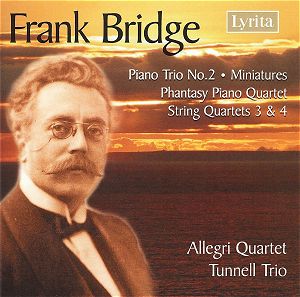
 for details
 Allegri Quartet (Hugh Maguire (violin);
David Roth (violin); Patrick Ireland (viola);
Bruno Schrecker (cello))
Allegri Quartet (Hugh Maguire (violin);
David Roth (violin); Patrick Ireland (viola);
Bruno Schrecker (cello))