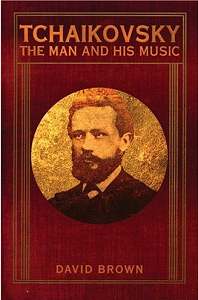
David Brown’s four
volume work on Tchaikovsky containing
an extensive detailed analysis of all
the music represents one of the most
extensive essays on any composer ever
written. Alan Walker covered Franz Liszt’s
75 years in three volumes, Stephen Walsh
covered Stravinsky’s 89 years in two
volumes. Brown took four volumes (600,000
words) to relate and analyze Tchaikovsky’s
53 years.
This one volume essay
is not intended as a summary of that
longer work, but as a new and different
work intended for the general reader.
Also the author has taken advantage
of material not available to him at
the time of the earlier work and has
updated some of the story. In a writing
class, both Mr. Walsh and Mr. Walker
would likely get a higher grade than
Mr. Brown, but that is an unfair comparison.
Mr. Brown is a perfectly good writer
and if at times I had trouble knowing
what year it was, or keeping track of
who is who, it’s mostly because of the
amount of material to cover, the complexity
of events, and the perennial Russian
nick-name problem.
Much of the book consists
of detailed descriptions and analyses
of the music, lists of "what to
listen for," intended for those
not familiar with classical music. I
am critical of all such essays, and
in fact I skipped them when reading
the book, since I have been listening
to the music of Tchaikovsky for 65 years.
I don’t mean to say I have nothing to
learn from Mr. Brown, only that I feel
it is understandable to feel irritated
at being lectured on a very emotional
matter which you already feel in control
of. I don’t deny that some may find
such essays valuable, but someone who
knows a great deal about classical music
may not really know what it sounds like
to someone who has little experience
with it.
I have made my own
stab at being a high priest of music
and preaching the gospel. One friend
knew exactly what classical music is
and what it does, and patiently explained
that he doesn’t want that in his life.
Another artist friend dismisses all
classical music as "cathedral music"
and, again, doesn’t want that in his
life. Classical music, or perhaps more
accurately "fine art" music,
argues its own case without assistance.
The problems with classical music in
our society are not that the subject
is arcane, but that there are people
who dislike and oppose classical music
and actively work against it in schools,
institutions, and government. They don’t
want it in their lives, they defend
others who might or might not want it
in their lives by denying them the choice.
Or they expend vast amounts of money
and effort to attempt to resuscitate
the dead body of "jazz" as
the "authentic American music"
and keep its rotting corpse on display
before the public, in place of classical
concerts at schools and auditoriums.
I know this sounds like the prevailing
fashion in conspiracy theories, so I
suggest that you make your own investigations
to see whether or not I’m right. All
the public needs is the right of access,
and the music will make its own case.
If you want to help the "cause,"
give classical CDs to your local public
library and watch to make sure they
are allowed to circulate and are not
discarded or sold off at 50 cents apiece
to the trustees because there is "no
room" or "no one wants them".
It doesn’t take much
listening to his music to appreciate
that Tchaikovsky was a very emotional
man, a man whose passions often got
the best of him. He suffered from bi-polar
disease, with highs and lows following
upon one another with bewildering rapidity.
This book relates episodes of depression,
panic attacks that often result in flight,
many tearful reactions to events, impulses
to overwhelming generosity and kindness,
also a few rare bursts of angry temper.
The result of all this emotional stress
and struggle was that in 1890 when Tchaikovsky
was in America, some commentators took
him to be in his sixties, ten years
older than his actual age, and this
had the effect of depressing him even
further.
Tchaikovsky’s homosexuality
is extensively described, a difficult
task because many of the letters and
documents were censored by his champions
who attempted to protect his reputation.
He apparently believed that only in
heterosexual love could a man find a
lifetime of complete affectionate happiness
with someone his own age, and throughout
his life he pursued sexually mostly
his servants and young men he met casually.
Apparently being gay in Paris in 1870
was just about exactly what it was in
1950. It is hard to believe that Tchaikovsky,
who moved in the artistic circles of
all the nations of Europe, knew of no
adult men living together as lovers
— such as Britten/Pears, Barber/Menotti
— for they must certainly have been
there for him to see — as they have
been in all cultures in all times —
if he cared to notice. But he preferred
to feel sorry for himself and bemoan
his great loss. I was amazed to read
of his many years’ "affair"
with French opera singer Désirée
Artôt which came to an end when
she attempted to use her influence with
him to gain a favor for another man.
Also I didn’t know that Tchaikovsky’s
wife Antonina, whom he never divorced
and continued to support (even through
her affairs), continued to protest her
love for him and survived him to lay
the largest wreath on his coffin.
Unfortunately Mr. Brown
is unable to resolve one way or the
other the controversy over the "court
of honor" story of Tchaikovsky’s
death, but it is apparently well documented
that Tchaikovsky did drink knowingly
and publicly a glass of unboiled water
in the midst of a cholera epidemic in
Moscow. There is no word for that but
suicide. But I think Mr. Brown makes
too much of the "inconsistencies"
in the accounts of Tchaikovsky’s last
days. In time of severe stress people
do forget what day it is. Also in Russia,
persons of Tchaikovsky’s eminence —
he was revered almost as a saint by
his friends and the public — are held
in religious awe, to be physically incorruptible,
hence it is not surprising that someone
would want to embrace and kiss his body
after he had died of a contagious disease,
or that regulations concerning disposal
of the bodies of epidemic victims would
be deferred in the case of his funeral.
The greatest irony is that if he had
caught cholera unintentionally, we now
know that all he would have to do is
drink plenty of clean salty water while
ill and he could easily have survived.
If the "court
of honor" story is true, it makes
a sad point. The story concerns a letter
to the Tsar bearing a complaint by a
nobleman against Tchaikovsky for paying
sexual attention to the nobleman’s son.
So long as Tchaikovsky confined his
sexual attentions to servants, students,
and young men of the common classes,
no one would attack him. But when, like
Oscar Wilde, he paid attention to a
young man from the aristocracy, his
social superior, that was different.
Even though the Tsar on occasion chatted
with Tchaikovsky as a cousin, the latter
must never forget his place.
As the son of a mining engineer, Tchaikovsky
was forever a commoner no matter if
he was the most beloved artist in Russia,
and one of the world’s greatest living
composers. Tchaikovsky could probably
have fled to exile in Paris, but Brown
makes it clear that Tchaikovsky would
rather die than be exiled from his beloved
native land, so suicide was his only
honorable course. However this whole
story hinges on the testimony of a single
elderly individual relating events of
many decades before. There is no direct
evidence, no physical letter to the
Tsar, no positive identification of
the nobleman involved, no record of
a witness to Tchaikovsky’s alleged infractions.
In his many works Tchaikovsky
embraces such a variety of forms and
textures that Mr. Brown makes no attempt
to speculate what sort of music Tchaikovsky
would have written had he lived. But
I will be more bold; had he lived to
be 73, it would have been Tchaikovsky
and not Stravinsky who would have written
Firebird, Petrouchka and
Sacre du Printemps and I think
Stravinsky would have agreed with me.
Paul Shoemaker