Classical CD and DVD reviews. MusicWeb is not a subscription site and it is our advertisers that pay for it. Please visit their sites regularly to see if anything might interest you. Purchasing from them keeps MusicWeb free.

Classical Editor: Rob Barnett                               Founder Len Mullenger


CD REVIEW


Site Map

More Reviews

How to find a review

Classical CD Review Archive

Book Reviews

Film Music Reviews

Jazz CD Reviews

Nostalgia

Comment

Norman Lebrecht Weekly

Arthur Butterworth Writes

Phil Scowcroft's Garlands

Classical blogs

Reviewers Logs

Announcements

Don't Go Here!

Community

Bulletin Board

Web Ring

Reviewers

Helpers invited!

Resources

Quiz

British Composers

British Light Music Composers

Other composers

Indexes
   Label
   Masterwork

Discographies

On-line Music
[Download sites]

Themed Review pages

Our Classic Classics

Online books
MWI Classical
     Encyclopaedia

Gilder Dictionary of
     Composers

MWI Pop
     Encyclopedia

Other Complete Books

Programme Notes


British Music Society
Performers
The BBC Proms
Musical WWW pages
Classical Music Online

Recording Companies and Retailers
Agents and Marketing
Publishers
Non-Classical Web pages
Orchestra Web Sites
Newsgroups
Web News sites etc


Editorial Board
Classical Editor
   
Rob Barnett
Seen & Heard
Editor and Webmaster
   Bill Kenny
MusicWeb Webmaster
   Len Mullenger
Assistant Webmasters
   Patrick Waller
   David Barker

PotPourri
A pot-pourri of articles

MW Listening Room
MW Office
Helping MusicWeb
Advice to Windows Vista users  
Questionnaire    
Site History  
What they say about us
What we say about us!
Where to get help on the Internet
CD orders By Special Request
Graphics archive
Currency Converter
Dictionary
Magazines
Newsfeed  
Web Ring
Translation Service

Rules for potential reviewers :-)
Do Not Go Here!
April Fools

Would you like a hyperlinked weekly summary of the CDs we have reviewed?
Click for further details

Sample: See what you will get


alternatively   AmazonUK   AmazonUS


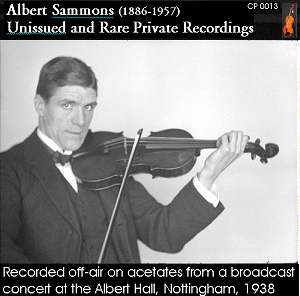
Albert Sammons (violin) (1886-1957)
Unissued and Rare Private Recordings

Albert SAMMONS (1886-1957)

Phantasy Quartet Op.8 (1915) [13.12]
Albert Sammons (violin)
William Primrose (violin)
Lionel Tertis (viola)
Beatrice Harrison (cello)
Private recording 1927
Cadenza from the Beethoven Violin Concerto (1919) [2.06]
Cadenza from the Brahms Violin Concerto (1922) [1.58]
Albert Sammons (solo violin)
Columbia recordings (unissued) 1924
Music Hall Selection;
Knocked ‘em In The Old Kent Road [5.01]
Burlington Bertie From Bow [3.51]
"Alberti" with the Orchestra of the Tivoli Theatre, Leicester Square, London
Clarion cylinders, recorded 1906
Fantasia on the National Anthems of the Allied Powers (first performed 1918) [4.45] Albert Sammons (violin) with the Regimental Band of the Grenadier Guards directed by Major Bertram O’Donnell
Columbia recording (unissued) 1919
Guirne CREITH (1910-1995)

Violin Sonata (c.1935) [17.38]
Albert Sammons (violin)
Guirne Creith (piano)
BBC Transcription recording, 1937
Edward ELGAR (1857-1934)

Violin Concerto (1910) – second movement (complete) [10.50]
Albert Sammons (violin)
Vienna Symphony Orchestra/Felix Weingartner
Recorded off-air on acetates from a broadcast concert at the Albert Hall, Nottingham, 1938
Pyotr Ilych TCHAIKOVSKY (1840-1893)

Sérénade mélancolique – abridged (Op.26) [3.37]
Albert Sammons (violin) as "Manuello"
Ellen Tuckfield (piano)
Regal disc, recorded 1919
Bonus DVD

The 1951 Carl Flesch International Violin Competition [4.35]
"A Violin Lesson" Pathé Newsreel at the Royal College of Music, 1952 [2.19]
Mr Sammons Receives the C.B.E. Pathé Newsreel 1944 [0.54]
Region Code 0, Sound Formats PCM Stereo, Dolby Digital 5.1 DTS 5.1, Languages English, German, French, Picture Format NTSC 16:9, Disc Format DVD9
CREMONA PRODUCTIONS 0013 [CD 59.35 + DVD 7.48]


I suspect that the eyes of Sammons’s admirers will be sticking out on stalks at the extraordinary compilation of material enshrined in this CD and DVD set. So diverse is it – and so astonishingly rare – that I doubt anyone will have encountered any of these recordings, and few will even have entertained the possibility of any of it having survived.

The recordings are sometimes fragmentary, it’s true, and in two cases there has been considerable damage to the only surviving test pressings. In the case of the off-air Elgar survival some acetate deterioration has meant a short patch from the commercial 1929 recording. The two Clarion cylinder recordings are not, to my ear, quite correctly pitched. But this is carping.

The earliest items are indeed those Clarion cylinders and they date from 1906. We know that he recorded for the company in 1908 – he made a single cylinder, of Mendelssohn – but no one had previously made the connection between "Alberti" and Albert Sammons. But back in 1906 he was playing in theatre and pit orchestras and had in fact been leader of the Tivoli Theatre band at around the time in question. The notes, by Gerald E. Cooperman, don’t go into speculative detail as to why he hid behind the single name but the reason seems clear enough to me – fashion. The Music Hall ditties – don’t forget that Sammons had played in theatre bands for Florrie Forde, Gus Elen and many other greats – are dimly recorded but one can still make out Sammons’s big and expressive tone. These are the earliest known recordings by him, pre-dating that other Clarion and also the 1910 sides he made when leader of the Beecham Symphony Orchestra

It was the discographer Ronald Meyerstein who first made the connection between some of the "Manuello" sides and Sammons. I don’t wish to blow my own trumpet but I identified a further single side. "Manuello" was a generic name for a mass of violin discs – the Dutch player Boris Lensky was the main artist - and the records were issued on Regal, Columbia’s cheap label and are amongst the "hidden" Sammons records. There is no great difference between these and his recordings issued contemporaneously on Columbia – they are prime examples and this Tchaikovsky features his regular "Regal" partner, the tragically short-lived Ellen Tuckfield, who was carried off by influenza in 1919.

There’s a famous photograph of the khaki-clad violinist atop a tank in London as he plays his fiddle to soldiers below. Not inappropriately we can hear him in a pot-pourri of the National Anthems of the Allied Powers - a bit of Vieuxtemps, a dash of Sarasate, and what sounds very like two bars from Ysaÿe’s Rêve d’enfant which because of the Belgian’s great admiration for Sammons, entirely reciprocated, leads me to think the anonymous arrangement is Sammons’s own.

Students and interested parties have always been intrigued by Sammons’s cadenzas – now we can hear them played by the Master. They were long out of print but are now available on a special print via Boosey and Hawkes. The Beethoven is entirely thought-through and a superb alternative to more established cadenzas; the Brahms is a sinewy piece of masculine sensitivity teeming with thematic interest and at one point distinctly impressionist harmonies.

These are late acoustics but we now come to a private early electric that will drain all but the most sanguine of their lifeblood. The foursome of Sammons, William Primrose (then still a violinist), Lionel Tertis, reigning virtuoso of the viola, and Beatrice Harrison essay Sammons’s own Cobbett prize-winning Phantasy Quartet. Gerald E. Cooperman misses opportunities galore here in his error-strewn summary of this piece. It was not influenced by Arensky and any similarities with Francophile models are surely unintended. It was not published by Farquar, it was published by Hawkes (his regular publishers) and it was not recorded by Vocalion in 1922. Waldo Warner’s Phantasy Quartet was recorded by Vocalion in 1922 – Warner was the viola in the London String Quartet of which Sammons was for nine years the first violin – but Cooperman’s litany of mistakes is simply unforgivable.

The tonal breadth of the foursome is staggering, with Tertis pouring forth golden tone and Sammons reaching oratorical heights of brilliance. Primrose too shows why many considered him Sammons’s natural heir and Harrison is not at all the salon player so rudely caricatured by such as Stravinsky and Hindemith. The only limitation is the sound quality of an ad-hoc studio run-through (Columbia’s Clerkenwell Road I should think – though against that speculation it should be noted that Harrison was contracted to HMV, Primrose flitted between HMV and Columbia and Sammons and Tertis were by now Columbia men.)

One of those present at Lionel Tertis’s (as it happened) premature Retirement dinner in 1937 was the strangely named Guirne Creith. She sat at Sammons’s table. He’d performed her Concerto with the BBC Orchestra and Constant Lambert conducting and together she and Sammons had performed her Sonata at Wigmore Hall, Aeolian Hall and for the BBC. The BBC transcription was not retained by the corporation but comes from a private collector. The work is a pungent and entertaining one – a compound of Roussel, Respighi, a touch of cyclical Franck, neo-classicism in the All’antiche third movement, hints of Goossens’s No.1 and Finzi’s Introit and strong affiliations with Milhaud in the finale, where Sammons "plays the Blues" superbly (what a pity he never recorded the Ravel). This has fair claims to be considered one of the most entertaining British Sonatas of the 1930s – and really first class recording quality as well.

In the concert diary he kept Sammons marked important dates in capitals. Such were his collaborations with Mengelberg and Monteux, Beecham and Malko (Szymanowski and Delius in the same programme). One other outstanding collaboration was an unlikely sounding one – the touring Vienna Symphony (not Philharmonic) under its conductor Weingartner in the Elgar Concerto in Nottingham, of all places. The pioneer home recordist G. Dudley Twose (later made C.B.E for his work in radio wave conductivity research) managed to preserve the slow movement when the concert was broadcast by the BBC’s Birmingham transmitter, though not alas the remainder (hear his many other amazing recordings at the National Sound Archive). I judge this movement the superior of the 1929 New Queen’s Hall/Wood commercial recording. For one thing Sammons’s tone takes on an almost spine-chilling grandeur that even eclipses the commercial disc (something one also notices in the live 1944 Delius Concerto preserved at the National Sound Archive) and Weingartner manages to imbue the strings with a profoundly "European" gravity and sensibility, something that aligns the concerto with the continental far more than any other performance I have ever heard. The small "patch" noted above is utterly insignificant and very brief.

As if this were not enough we have a brief but invaluable DVD bonus; I say brief but it’s of immense interest to those who like to see their musicians as well as hear them. Sammons served on the jury of the 1951 Carl Flesch International Violin Competition and he is seen in a short Pathé newsreel chatting to some other luminaries – Max Rostal, in bow tie and carrying a briefcase (!), Sir Adrian Boult, armed with a glass of milk, and a man whom I believe to be (but is not captioned) Sascha Lasserson, famous Russian violin pedagogue, an Auer pupil, and long resident in London. In "A Violin Lesson" we see Sammons guiding the young Hugh Bean through the thickets of the Bloch Concerto – which Sammons played, once, in 1942. At one point we see him take his own Gofriller and execute a perfect passage, which he follows with a characteristically humorous aside – "Not bad for an old ’un!" The brief 1944 clip shows him outside Buckingham Palace where his wife, the formidable Olive Hobday (daughter of Alfred and Ethel, two great musicians, the latter a friend of Brahms), is seen relieving him of the C.B.E ribbon and squeezing his hands into a pair of leather gloves.

Fortunately companies such as Naxos, Pearl and Dutton have all been restoring a number of Sammons’s recordings to the living catalogues. All violin aficionados however will need this quite extraordinary Cremona disc – an archaeological horde of the most stunning, unexpected and brilliantly accomplished kind.

Jonathan Woolf


Advertising Rates
Visitor stats
MusicWeb International
has over 21,000 Classical CD reviews on offer


Gerard Hoffnung Concerts &
The Bricklayer Story

Naxos Classical 

Australian Eloquence CDs on Buywell.com


New Releases

Hyperion
New Releases


Guild Music


MusicWeb sells the Polish
catalogue CDAccord
£10.50 post free W-W


MusicWeb sells the
Arcodiva catalogue
£12.00 post free W-W


Price Reduction: £11.75
post-free


MusicWeb can now offer you discs from the following catalogues:
Prices include postage

[Acte Préalable £13.50]
[Arcodiva £12.00]
[Ashgate Music Books]
[Avie from £6.25]
[British Music Society £13.49]
[CDACCORD from £10.50 ]
[ClassicO £12.50]
[Hortus £14.99 ]

[Lyrita ONLY £11.75 ]
[Onyx £12.00
]
[REDCLIFFE £11 ]
[Tactus £11.50 ]
[Talent from £12.00 ]
[Toccata Classics £12.50 ]

MusicWeb Recommended Recordings 2008

DISCS OF THE YEAR 2007


Return to Review Index


Reviews from previous months
Join the mailing list and receive a hyperlinked weekly update on the discs reviewed. details
We welcome feedback on our reviews. Please use the Bulletin Board.  Please paste in the first line of your comments the URL of the review to which you refer..


You can purchase CDs and Save around 22% with these retailers: