Editorial Board
MusicWeb International
Founding Editor Rob Barnett Editor in Chief
John Quinn Contributing Editor Ralph Moore Webmaster
David Barker Postmaster
Jonathan Woolf MusicWeb Founder Len Mullenger
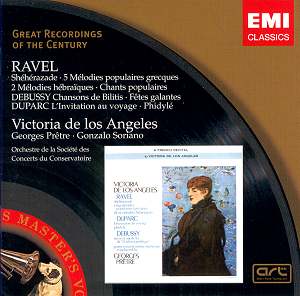
Maurice RAVEL (1875-1937)
Shéhérazade [14:57]
Cinq Mélodies populaires grècques (nos. 2-4 orch. Manuel
Rosenthal) [6:58]
Deux Mélodies hébraïques [6:14]
Quatre Chants populaires* [10:38] Claude DEBUSSY (1862-1918)
Trois Chansons de Bilitis* [9:16]
Fêtes galantes (Premier receuil)* [7:17]
Noël des enfants qui n’ont plus de maisons* [2:46]
Récit et Air de Lia: L’année en vain chasse l’année (L’Enfant
prodigue) [4:51] Henri DUPARC (1848-1933)
L’Invitation au voyage [4:08]
Phidylé [5:20] Victoria
de los Angeles (soprano)
Orchestre de la Société des Concerts du Conservatoire/Georges
Prêtre/*Gonzalo Soriano (piano)
rec. 20-21 February 1962, Salle Wagram, Paris; *19, 20,
22, 23, 25, 26 January 1966, EMI Studios, Barcelona. ADD.
Stereo EMI CLASSICS
GREAT RECORDINGS OF THE CENTURY 3458212 [72:27]
The
liner notes accompanying this CD are by the doyen of commentators
on recorded singing, John Steane. In a typically perspicacious
and knowledgeable note he makes one point in particular
that fascinated me. He says that it’s said that there are
two kinds of Spaniard; one who looks to the south and one “whose
head habitually turns northwards.” In the former category
he would class Conchita Supervia whereas Victoria de los
Angeles (1923-2005) belongs in the latter group. This disc
of French song is highly supportive of that theory for
it offers a strong reminder of the affinity that Miss de
los Angeles had for the French repertoire.
The
bulk of the programme comes from a disc of songs with orchestral
accompaniment, which features Georges Prêtre and the Orchestre
de la Société des Concerts du Conservatoire. This orchestra,
or at least in its 1962 vintage, may not be in the foremost
rank of world orchestras but they play well enough here.
To begin at the end, as it were, the pair of Duparc songs
is quite outstanding. L’Invitation au voyage is
one of the glories of French mélodie and here it
receives a superb reading. The performance is pregnant
with atmosphere and in this Prêtre and the orchestra play
a very full part. Having heard that I wondered why, in
the notes, John Steane concentrated on the performance
of Phidylé but when I listened to Miss de los Angeles
singing it I understood. It’s a magnificent performance
distinguished by much withdrawn, subtle singing. However,
the passionate outburst in the fourth and final stanza
is heartfelt and ardent.
I
found the performance of Shéhérazade equally satisfying.
Steane rightly draws attention to this singer’s tasteful
approach to the cycle. She’s not as voluptuous as some
I’ve heard but her singing is still highly responsive and
she articulates and uses the texts with intelligence, sympathy
and discrimination. This is a performance of the cycle
that I’d describe as clear-eyed rather than overtly sensuous
but I like that approach. The calm resignation that we
hear in ‘L’Indifférent’ is especially satisfying and convincing.
Her
approach to the Greek songs is simple yet sophisticated
at the same time. I share John Steane’s admiration for
the way she’s “plaintive and almost mystical” in the second
song, ‘Là-bas, vers l’église’ and for her “soft luxurious
relaxation” in ‘Chanson des ceuilleuses de lentisques’.
To cap it all you can hear the smile in the voice in the
final song, ‘Tout gai’. In the Deux Mélodies hébraïques my
attention was particularly caught by the improvisatory
feel that Miss de los Angeles brings to ‘Kaddisch’, displaying
an excellent technique in giving a performance of no little
feeling.
Most
of the Debussy numbers are drawn from a piano-accompanied
recital with Gonzalo Soriano. All the performances seem
highly successful. The Chansons deBilitis inhabit
a more rarefied sound world than that of Ravel. Miss de
los Angeles makes the stylistic transition effortlessly,
giving lovely, understanding readings of these songs. In Fêtes
galantes she’s poised and subtle in ‘En sourdine’,
a comment that applies to Gonzalo Soriano’s pianism too,
and she conveys well the capriciousness of ‘Fantoches’.
Best of all, perhaps, is the enchanting, delicate traversal
of ‘Clair de Lune’. At the other end of the spectrum, as
it were, is the extraordinary Noël des enfants qui n’ont
plus de maisons, a wartime composition in which Debussy
sets his own words. Miss de los Angeles gives a highly
involved, passionate reading. I’m very glad this item,
which is so different from the rest of the disc, was included.
This
is a wonderful disc, featuring one of the most cherishable
singers of the post-war era. Perhaps, as John Steane suggests,
she was not quite in her vocal prime by the time these
recordings were made but the singing is still very fine
and tremendously characterful. I enjoyed this disc greatly
and I hope many other collectors will do likewise. The
sound quality is good and the listener’s enjoyment is further
enhanced by the provision of all the texts and translations.
John Quinn

























 Victoria
de los Angeles (soprano)
Victoria
de los Angeles (soprano)