This, the first volume
of the harpsichord sonatas by Carlos
de Seixas, shows very good production
and performance values; no surprise
for those already familiar with Naxos’s
formidable raft of other recordings
of composers familiar and unfamiliar.
Seixas, born in Coimbra,
Portugal, was quite prolific for his
short life. The sonatas, which are of
the sound and style of Scarlatti, are
both enjoyable and virtuosic. Some of
them - numbers 19, 24 and 44 in particular
- demand that the performer executes
hand-crossing and wide chordal jumps,
which Halasz accomplishes with seeming
ease.
Seixas, something of
a prodigy, succeeded his father (at
14!) as organist of Coimbra cathedral.
Word evidently got around, and two years
later he was organist of the Chapel
Royal and Patriarchal Cathedral in Lisbon.
It is estimated, as the liner notes
indicate, that some 700 works were committed
to paper, but the catastrophic earthquake
that Portugal suffered in 1755 may have
contributed greatly to the relatively
small number of works that survive.
No original manuscripts exist.
Of the sonatas that
have come down to us, Sonata 18 is quite
enjoyable, from its brooding opening
Largo to its sprightly Bach-Scarlatti
melding in the following Allegro.
The nasal Adagio serves as a
less-than-half-minute palate cleanser
before the gigue-like final Allegro.
Sonata 34 is a delight,
spinning off and throwing sparks. Scarlatti,
a contemporary of Seixas, served as
an instructor for the younger master.
Scholarly discussion remains regarding
their mutual influence. This brilliant
sonata, with its thunderous chord changes
in the first movement and its delicate
minuet, is certainly a feather in Seixas’s
cap.
Another great standout
is the comparatively epic sonata number
10 in C, with its 13-minute first movement,
lasting longer, on average, than two
or three of the other sonatas combined.
This opening Allegro spends far
more effort in development of the thematic
material. While not as technically demanding
from a virtuosic standpoint, it is noteworthy
in its repetition and insistent drawing
out of the originally rather sunny statements.
The subtle variation in sound over the
duration of certain passages that Halász
draws from the instrument made me curious
as to whether these were due to use
of knee pedals or just how many registers
the instrument had. Little information
is given in the booklet regarding the
specifications, save that it is a copy
of a German instrument by Hass. Glyn
Pursglove, in his earlier review of
this disc
, indicated that the original from which
this new instrument was copied may be
housed at the Musical Instruments Museum
in Brussels. Various forays into their
website and elsewhere for other instruments
made by Hass were inconclusive. The
Hass instruments I was able to lay my
eyes on didn’t appear to have knee pedals
or hand stops, so this point shall remain
a mystery for the time being. Regardless,
I agree with Pursglove that this is
a very fine-sounding instrument. Halász’s
performance here is deft and demands
attention.
David Blomenberg
see also review
by Glyn
Pursglove



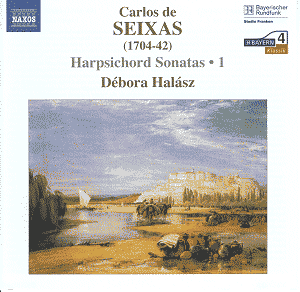
 Débora Halász (harpsichord)











