Eduard Erdmann was
one of the most respected pianists of
his generation, and was a tireless advocate
of new music. With a circle of friends
that included the likes of Alma Mahler,
Ernst Krenek and Artur Schnabel, it
is evident that Erdmann traveled in
an elite circle of musicians, and had
a standing equal to any major artist
of his day. A composer and a scholar,
his music is just now receiving some
richly deserved recognition, having
fallen by the wayside for the last fifty
or so years. He served in at least three
important academic positions, including
professorships at the Cologne and Hamburg
Academies of Music.
The era of the compact
disc and the digital music file have
produced a mass of recordings that no
one listener could hope to enjoy in
two lifetimes, much less in the four
score and seven with which we each have
to work. This embarrassment of riches
leaves us with mountains of discs through
which to wade, and not nearly enough
time to discover it all.
This is a disc worth
your time to discover. Erdmann the composer
works in traditional media with a fresh,
original and sometimes dissonant style
and harmonic language. The symphony,
his last from 1951 is more compact than
Mahler, less angular than Shostakovich
and less romantic than Weingartner.
Lush in texture, yet not syrupy, this
is music whose beauty lies in its wintry
soundscape. It is not the stuff of sweeping,
singable melodies, and yet it is not
without melodic interest. Neither is
it the sort of episodic paint splashing
that we get from many of today’s composers.
It is the canvas of a dark impressionist
rather than that of a musical Jackson
Pollock. Taut and strong, it is music
that requires you to listen, and doesn’t
let you down for your effort.
Monogramme, which
was the composer’s final work, is no
less harmonically challenging than the
symphony of four years before, but it
is far more playful and far less serious.
Its opening movement is wispy and ethereal,
energetic and noisy with dissonance
and whirling string and wind figures.
The middle movement is by turns serene
and even melodic and busy with flourishing
wind figures. It ends with a swish and
a bang.
The Serenade for Small
Orchestra is, as its title would imply,
much more jolly and playful than the
other works. Yet again, Erdmann never
indulges in romanticism or overt melody-making.
His is a musical language that although
not particularly challenging to twenty-first
century ears, must have set a few teeth
on edge in its day. His sounds are often
biting and the rhythmic figures are
unsteady and biting in character.
CPO have a knack for
bringing out recordings of fascinating
music by some of Europe’s lesser known
orchestras. The Frankfurters play with
an excellent sense of ensemble, and
employ some extremely fine woodwind
players who get a good workout in this
music. Israel Yinon is a rhythmically
aggressive conductor and he succeeds
quite admirably in finding balance in
this complex musical tapestry. His attention
to detail is evident in the subtle shadings
of the solo passages, and the broad
dynamic scope that he gets from his
players. Yet, balance is again the key
word. The loudest passages, while thrilling,
are always bearable, and the soft sections
are never inaudible.
CPO displays some carelessness
in presentation though, with an annoyingly
mismatched documentation between the
back cover and the booklet. The movement
numbers don’t align. This kind of error
occurs with maddening frequency in CD
releases and is inexcusable, especially
at CPO’s price point.
Nonetheless, this is
a disc worth owning.
Kevin Sutton



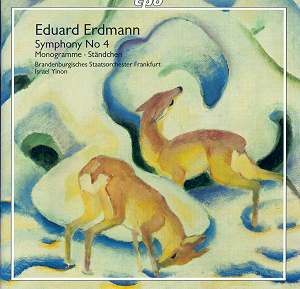
 for
details
for
details Brandenburgisches Staatsorchester Frankfurt /Israel
Yinon
Brandenburgisches Staatsorchester Frankfurt /Israel
Yinon 











