Christian
Cannabich was one of the various composers who worked at
the court of Mannheim during the 1760s and 1770s. Musical
life there was such that the Elector’s orchestra gained a
reputation as the best in the world, and Cannabich was the
musical director. Mozart was among those who heard the ensemble,
when he visited the court while en route for Paris in 1777.
After hearing a symphony by Cannabich, possibly that in E
flat major, he wrote back to his father Leopold: ‘If only
we had clarinets too. You cannot imagine the glorious effect
of a symphony with flutes, oboes and clarinets.’
And
it is true that the élan of this music makes a special effect,
again and again from one piece to the next. Cannabich is
a master of the art of orchestral technique, employing it
to maximum effect. The balancing of the ensemble is skilfully
handled, and enhanced in these spirited performances by Matthias
Bamert and the London Mozart Players. The recorded sound,
moreover, plays its full part in creating the intensity of
a live performances through the loudspeakers.
The
early G major Symphony has a three movement construction,
whereas all the others collected here have just three. They
were probably written a decade or more later, by which time
Cannabich had decided not to include a minuet movement. On
this evidence he was probably wise, since so much of the
fast movement has the directness of dance rhythms. The slow
movements can be the highlights, however, with their appealingly
graceful line.
The
planning of this collection is carefully considered, since
each symphony places the spotlight on different combinations
of wind instruments, this the importance of clarinets in
the E flat work. The writing for horns in the G major Symphony
is sometimes thrilling, while the A major has a pleasing
sensitivity of line in its central Andante. That said,
however, the whole programme does tend to add up to rather
less than the sum of its parts, at least of one symphony
after another is heard. It is best to choose just one at
a time, perhaps.
Like
many of the Mannheim composers, Cannabich is strong on technique
but relatively weaker on inspiration. The finest aspect of
the music lies in its ease of orchestral discipline, but
there is a tendency towards short repetitive phrases which
can result in a chronic, self-defeating short-windedness.
Even so, this remains a most worthwhile enterprise, with
high production standards as we have come to expect of Chandos,
and a well written accompanying essay from Richard Lawrence.
Terry
Barfoot



 London Mozart Players/Matthias
Bamert
London Mozart Players/Matthias
Bamert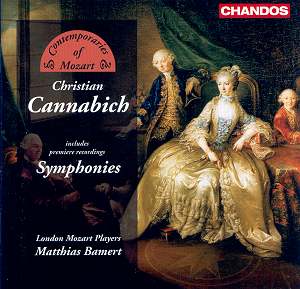
 for
details
for
details












