The
oboe has a fairly small repertoire of concertos – unlike the
flute – but the best ones, of which two are recorded here,
are delightful works. The Mozart is what I suppose we must
rather bizarrely describe as a ‘middle period’ work, having
been composed in 1777 when the composer was a mature twenty-one!
It was written for the principal oboist of the Salzburg orchestra, an Italian by the name of Giuseppe
Ferendi. It is an entirely characteristic work, perfectly
conceived for the instrument, which makes it all the more
odd that for many, many years it was Mozart’s arrangement
in D major for solo flute that was commonly heard rather than
this original version.
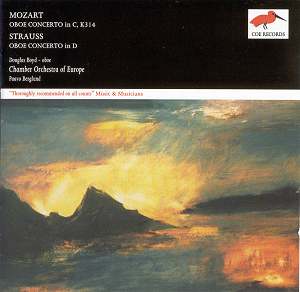
Douglas
Boyd, principal oboe of the Chamber Orchestra of Europe when
this recording was made, gives a wholly idiomatic performance,
polished in technique, elegant in phrasing and imaginatively
projected. He understands Mozart instinctively, so that he
is able to be expressive and charming without stepping outside
the stylistic bounds. The cadenzas he uses, for none exist
by Mozart for this piece, are by Boyd himself for the first
movement, Lester for the Adagio, and Bourgue (presumably Maurice
of that ilk) for the finale, and all eschew outlandish fireworks
and remain reassuringly in sight of the prevailing tonality.
There’s nothing more disorientating than arriving at the cadenza
of a lovely Mozart concerto in, say, C major, and suddenly
being subjected to whole-tone scales on F# or some such.
Nothing like that here, and Boyd and Berglund, a sensitive
but positive accompanist, give a particularly witty version
of the mischievous finale.
The
Strauss concerto was written, in contrast, in the composer’s
old age, in the difficult post-war years when he and his wife
had moved to Switzerland. It makes the perfect companion for the
Mozart, however, as it is quite deliberately imbued with the
spirit of the eighteenth century, and of Mozart in particular.
It was first performed in Zurich in 1946 by Maurice Saillet, and, as the booklet notes tell
us, Leon Goossens, the great English oboist, made the first
recording with Galliera and the Philharmonia. It is a classic
recording, though the strain does sometimes show, and Goossens
is forced here and there to take a breath that upsets the
flow of phrases, also getting his fingers in a tangle from
time to time.
No
such problems for Boyd, though his reading is very close in
feeling to Goossens, part of the same tradition. He bends
the music lovingly, making the most of the alternately lyrical
and playful music of the first movement. Berglund and the
CEO players respond wholeheartedly, and there are notable
contributions from principal clarinet and bassoon. The slow
movement is deeply expressive, and Boyd achieves a breathtaking
intimacy with the final pianissimo phrase before the
cadenza (track 4 around 14:50).
I
did wonder at one point if these were recordings of live performances;
no audience noise or applause, but quite distinct ‘off-mic’
sounds such as soloist blowing water out of keys in his bars’
rest, orchestral players shifting around etc. Not enough
to be off-putting, however, and Boyd’s reading is a joy from
beginning to the end. It would be my number one choice of
currently available versions, Boyd’s sound being easier on
the ear than Heinz Holliger’s very strong-flavoured tone on
Philips, while the orchestral playing under Berglund is more
characterful and sharper in detail than Ray Still’s version
with the Academy of London on Virgin. Just 44 minutes may seem stingy,
but this disc is packed with wonderful music-making, and,
for my money, that’s ample compensation!
Gwyn Parry-Jones
BUY NOW
AmazonUK



 Douglas Boyd (oboe)











