These two CDs, available
separately, are not quite hot off the
press; they’ve been around for a few
years but have been given another push
by Tudor. Rightly so as Paul Kaspar
proves an often perspicacious and technically
adroit guide to still under explored-repertoire.
That said the range of the pieces is
wide – from the Sonata to the three
Czech Dances and all stops in between
- and accomplishment across the spectrum
is not guaranteed. The ragtime and impressionist
influences aren’t always easy to evoke
and not every pianist can command the
full panoply of Martinů’s
influences.
Kaspar then is an assured
and musical presence and has been finely
and warmly recorded by the technicians
of Bavarian Radio. Comparison however
can find chinks in the armour, little
moments that can lessen the immediacy
of the impact of these vivacious, rhythmically
incisive and often captivating pieces.
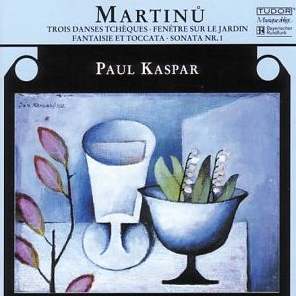
I much enjoyed his Fantasie et Toccata,
that serious minded, powerful 1940 work
but must note that chordally he has
to cede to Emil Leichner in his set
of the complete solo piano works on
Supraphon 11 1010-2, a three CD box.
Comparison with this Lion of the Martinů
piano discography is unavoidable and
indeed necessary. Both he and Kaspar
have, quite rightly, their own views
on much of the repertoire; much indeed
is complementary.
In the Czech Dances
(Trois Danses Tchèques)
for instance Kaspar is far more involved
in the syncopated and jazzy elements
and his lither traversal brings quixotic
drama where Leichner feels things less
pressingly; his Paris is still rather
more bathed in impressionist hues than
in dance bands. Try the Polka, the last
of them and you’ll find Kaspar really
dares the tempo, whilst still acknowledging
the rubato element embedded into it
– nice Ragtime tints too, preferable
to Leichner.
Regarding Fenêtre
sur le jardin, that brief but intensely
evocative four-movement set of 1938,
I have to say I find Kaspar less convincing.
He takes a bracing tempo for the first
two and relaxes somewhat for the last
two of the set. But he lacks Leichner’s
lyricism and elegance and the intensely
romantic compression that the Czech
pianist brings to bear in the introduction
of the Poco Andante. Next to
him Kaspar does sound rather vertical
and rushed
The Sonata often
causes problems in performance. Kaspar
takes a Leichner-like tempo here and
it’s really only in the finale that
there’s any real divergence in tempo
terms. But it’s Leichner who characterises
it with the greater perception and it’s
in his hands that the sonata takes on
a more compelling and formidable shape.
The second disc presents
the Etudes and Polkas of 1945,
Butterflies and Birds of Paradise,
an early work of 1920 and Borová,
the Czech Dances of 1930. It’s fascinating
to hear divergences between the essential
Leichner and Kaspar. As before Kaspar
is generally faster, and usually more
overtly jazzy in respect of rhythm and
syncopation. That’s undoubtedly
the case with the Etude in D and what’s
equally undoubtedly the case is that
Kaspar’s performance sounds corresponding
less Czech. This is a question of those
characteristic Martinů cadences
and plangencies and of the powerfully
evocative chordal depth Leichner
invariably excavates. I tend to find
Kaspar here less pawkily capricious
than his competitor. In the Etude in
C from Book II we find Leichner more
bad tempered and correspondingly more
exultant. He makes more sense of this
oppositional syntax and the direction
of the music. Kaspar inclines to a more
sectional viewpoint, less successfully
I feel.
Butterflies in flowers,
that most gloriously silken of pieces,
glitters in Leichner’s hands. Here there
is true liquidity of phrasing and imagination
and, good though he is, Kaspar has to
cede ground. Kaspar is nice and jaunty
in the first of the Czech Dances but
maybe – just maybe (it’s matter of taste)
– he’s just a touch bucolic next to
Leichner’s defter sophistication.
There are other single
issues devoted to the piano works and
one could sift through them. Of the
two under discussion I would turn to
Leichner but there are certainly instances
where Kaspar’s vivacity pays rich dividends
and you won’t be disappointed by him.
A mid way point may well be achieved
by Giorgio Koukl, the Czech born and
now Swiss resident composer and pianist.
A complete set of the piano works is
forthcoming from him on an international
label. He sent me a studio burn of some
pieces and I can say that, for instance,
his Poco Adagio from Fenêtre
sur le jardin strikes a fine and
judicious balance between Kaspar’s dynamism
and Leichner’s beauty of tone. His performances
are anticipated with keen interest.
Until then – and who knows, maybe even
then - I would argue for Leichner’s
complete set. But Kaspar has a lot to
say in this repertoire and says it with
force and conviction.
Jonathan Woolf
see also review
by Rob Barnett



 for
details
for
details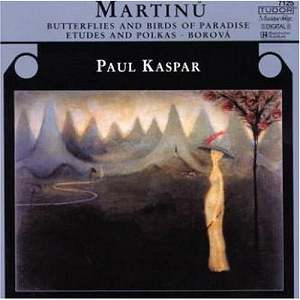
 Paul Kaspar (piano)











