When
Haydn circulated the six quartets which were to make up his
Op. 33 – written in 1781, published in 1782 – to a number
of friends and patrons he accompanied them with a letter
explaining that they were “written in a new and special way
[auf eine gantz neue besonderer Art], for I
haven’t composed any for ten years”. Some have taken the
phrase to be no more than a kind of ‘marketing’ ploy, others
have taken it to mean rather more. As Haydn’s letter itself
states, his last work in the string quartet form lay almost
ten years in the past, represented by the op. 20 quartets
of 1772.
There
is little mileage in trying to argue whether or not the op.
33 quartets are ‘better’ than the op. 20 works; or whether
the later quartets represent some sort of ‘progress’ in Haydn’s
conception of the form. It is more profitable to pay real
attention to Haydn’s own claims, which seem to amount to
insistence that these quartets of 1781 are ‘new’, i.e. different
from their predecessors and, perhaps, that they have some
distinctive quality in common as a group. Any sense of what
might be thought to be “new and special” about the op. 33
group needs to take into account what Haydn had been doing
in the intervening ten years. At Esterhazy he had been prodigiously
busy as Kapellmeister – in that ten years he had written, inter
alia, almost thirty symphonies, three masses, twenty
keyboard sonatas and fourteen operas – eight of them for
the marionette theatre. This operatic experience is surely
important to what Haydn now chose to do with the quartet, – putting
less emphasis on the sonata-forms and fugues of the op. 20
quartets and more on the rhetorical interplay of voices,
on melodic elegance, on witty inventions and dramatic pauses
which might reasonably be called ‘theatrical’. There are
comcomitant formal shifts: such as the fact that now – for
the most part - only the opening movements are in sonata
form; what were minuet movements are now generally designated scherzando or scherzo;
most of the finales are rondos or employ other reiterative
forms. The overall effect is to make the op. 33 quartets
what Tovey suggestively described as “the lightest of all
Haydn’s mature comedies” (in his still marvellous essay on
Haydn in Cobbett’s Cyclopedic Survey of Chamber
Music.
This
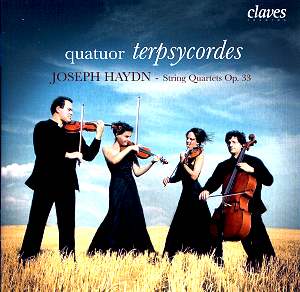
enjoyable new CD brings us performances of three of the op.
33 quartets – the others are perhaps being reserved for a
second CD?
The
Quatuor Terpsycordes began life in 1997, bringing together
four young musicians in Geneva, all of whom studied with
Gábor Takáks-Nagy at the Geneva Conservatory. Made up of
two Swiss musicians, a Bulgarian and an Italian, the quartet’s
witty name alludes to the muse Terpsichore and also allows – as
the booklet notes suggest – a punning subdivision into Terre-Psy-Cordes,
so as to suggest both earth and spirit (and the strings which
join them?). The quartet play nineteenth-century instruments – with
gut strings – made by Jean-Baptiste and Nicolas-François
Vuillaume, of the long established French family of luthiers,
instruments made available to them by Musée d’Art et d’Histoire
of Geneva.
Their
performances of these three quartets are warm-toned and well
balanced. Their style seems particularly well suited to the
first three movements of no.2, largely mellow and reflective.
The expansiveness of the largo e sostenuto third movement
has a dream-like but solemn quality and the viola playing
of Caroline Haas is especially lovely. It makes – by way
of contrast – a striking prelude to the presto finale
which obtained for the work its nickname of ‘The Joke’ as,
at the close of the movement, the theme is played phrase
by phrase, interspersed with rests until it seems to have
been concluded – at which point the opening phrase is played
again, bringing matters to a close in a fashion bound to
puzzle, or even trick, unprepared listeners. The temptation
to exaggerate this is resisted and the result is pleasantly
teasing, articulated with a knowingness that avoids arrogance,
such playfulness about beginnings and endings being entirely
characteristic of the mature Haydn. In the first movement
of no.1 in B minor the seemingly tentative and hesitant approach
to the tonic is made both witty and touching, and the slow
movement’s considerable beauty is clearly articulated, especially
in the conversation between first violin and cello. The finale
(the only sonata-form last movement in op.33) is played with
appropriate energy. No.5, which was the first of the set
to be written, receives a joyous performance of its opening vivace
assai, the interweaving of voices like a small-scale
operatic ensemble; in the ensuing largo the singing
melody punctuated by some ominous touches and the brief scherzo
offers some relaxed humour; the variations of the finale
aren’t quite made to bear the weight necessary to counterpoise
what has gone before. But in every movement there is intelligence
and a well-developed sense of shape and argument in the playing
of this young quartet.
These
are accomplished and eminently listenable performances of
some fascinating music. It is some time since I heard the
recording of the op. 33 quartets by Quatuor Mosaïques (Astrée
8801), but my memory is of slightly greater variety of colour
and a more richly spontaneous, almost improvisatory, feeling
in those recordings made in 2000. The Quatuor Terpsycordes
is still a relatively young quartet; there are moments when
their work has a certain nervous ‘correctness’ which perhaps
inhibits them, but this is music-making rich in promise and
already very accomplished. If they do record the other 3
quartets from op. 33, I shall certainly hope to hear the
results.
Glyn Pursglove
BUY NOW
AmazonUK



 Quatuor Terpsycordes
(Girolamo Bottiglieri (violin); Raya Raytcheva (violin);
Caroline Haas
(viola); François Grin
(cello))
Quatuor Terpsycordes
(Girolamo Bottiglieri (violin); Raya Raytcheva (violin);
Caroline Haas
(viola); François Grin
(cello))