It is indeed remarkable
that these recordings of Serenade
and Les illuminations here make
their first appearances on CD, 23˝ years
after the medium was launched. Of course
Decca re-recorded them in the 1960s
in excellent stereo sound and with the
composer conducting. Peter Pears still
sounded much the same then as he did
in 1953, which an A/B test clearly showed.
The sound quality on these mono recordings
is fully listenable although not much
to write home about, the strings fairly
thin and undernourished as was the case
with Decca during this period. It is,
however, good to have the original pair
of soloists, Pears and Brain, available
again. Close listening reveals that
the passing years have not left the
tenor’s voice completely unaffected.
Never a really beautiful instrument
– unless we go to his earliest recordings
and remember that he once sang Mozart
and Puccini – he was able to spin a
wonderful mellifluous pianissimo thread
in long phrases, an ability he retained
also when well past fifty, even sixty,
but his fortes could be pinched and
his vibrato became more prominent as
the years advanced. Even in 1953 all
these characteristics were there but
to a lesser degree. The voice is lighter,
steadier, more flexible and more youthful
sounding, and we have to remember that
he was already middle-aged.
Interpretatively very
little has changed in the later recording.
Tempos are on the whole the same, give
or take a few seconds and the characterisation,
the inflexions, are more or less the
same. I suppose that the intervening
ten years from the premiere in 1943
to this first recording honed his interpretation
to perfection and what we hear here
is a well-matured reading. The Elegy
(tr. 4) has a dark intensity – and beauty
of tone – that is preserved in the remake,
although the pianissimo is easier in
1953. In Dirge (tr. 5) he finds
almost Heldentenor brilliance. The light
and lively Hymn (tr. 6) is done
with casual elegance and in the later
recording he has to work harder to reach
the effect. Those who already own the
latter need not necessarily buy the
present one, unless for the sake of
the legendary Dennis Brain, and of course
he plays wonderfully, not least in the
Hymn. Barry Tuckwell on the later
recording is however just as good.
Comparison of the two
versions of Les illuminations
tells much the same story: the sound
is thinner, more primitive on the 1953
recording while the voice is that little
bit fresher, while the interpretations
differ very little. Since this work
was composed for Swiss soprano Sophie
Wyss, who also premiered it in Aeolian
Hall in London in 1940, it requires
an even more flexible and agile voice
than the Serenade. Pears executes
the whole cycle with aplomb, lively
characterisation and intense declamation.
An old Swedish Caprice LP with Margareta
Hallin shows, however, that the music
sits even better in a soprano voice.
Without in any way criticising Pears’
French, which is wholly idiomatic, I
wonder how Hugues Cuénod would
have sung these songs. Did he ever?
Anyway, the concluding Départ
is one of the most memorable inventions
by Britten and it sounds very good in
both versions.
The much later Nocturne
is far less often performed than the
two earlier works and one reason, perhaps
the reason, is the gloomy and
uninviting tonal language. It is a marvellous
composition but it takes some repeated
listening to reveal its own special
attraction. Formally it is in one movement
but it is divided in eight distinct
parts where, apart from the first and
the last, the solo instruments bring
their own colour and character to one
section each. The bassoon in Below
the thunders (tr. 20) creates together
with the double basses an ominous darkness.
This mood is retained through the following
parts, up to Wordsworth’s September
massacre (tr. 23) where the timpani
deliver frightening martial roulades.
After that the sky lightens; the cor
anglais paints a pastoral and then the
flute and the clarinet jointly illustrate
"a wind in the summer". The
conclusion, a setting of Shakespeare’s
Sonnet XLIII, where all the instruments
get together and create an almost Mahlerian
finale, ends in total light with the
tenor singing softly: "All days
are nights to see till I see thee, /
And night’s bright days when dreams
do show thee me." From darkness
to light – a truly remarkable composition.
Recorded in 1959 we are offered a sonically
riveting performance with especially
spectacular timpani. The soloists are
all masters of their instruments and
of course Pears premiered the work just
a year before the recording so his approach
is fresh and inquisitive. Finding a
later EMI recording on my shelves with
Jeffrey Tate conducting and Robert Tear
singing the solo part it was not surprising
to hear that he had largely modelled
his reading after Pears. After all Tear
was the natural heir to Pears, having
much the same vocal qualities.
Having these three
song cycles on a single disc with the
singer whose voice Britten knew better
than any other is of course convenient.
We have to be grateful to Eloquence
for making these recordings available
again after so many years. Whatever
one’s opinion of Peter Pears there is
no denying the authenticity of his singing
in Britten. Unless one is allergic to
the mono sound, at Eloquence price anyone
can afford this disc – either as a first
foray into this repertoire or as a complement
to other versions. One will have to
do without the sung texts but Stephen
Schafer’s notes are helpful to some
degree.
Göran Forsling



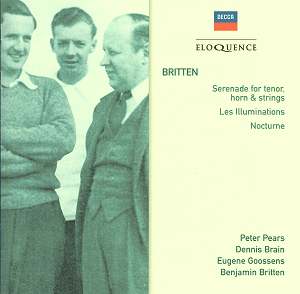
 Peter Pears (tenor), Dennis Brain (horn) (Serenade),












