The volumes of Rossini’s Péchés de Vieillesse contain
an abundance of music rich in verve and wit. Not long ago I
reviewed a volume in the ongoing complete recording by Stefan
Irmer on Dabringhaus und Grimm (MDG 618 1353-2 - see review).
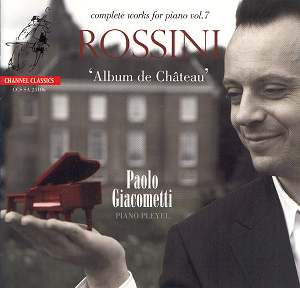
Now here is a volume from another complete recording by Paolo
Giacometti. Having been relatively neglected for many years,
the Péchés are certainly getting plenty of attention
– and very intelligent and skilled attention at that – in our
day. Indeed there is a third series by Marco Sollini on Chandos.
I haven’t heard enough of the three series to express a confident
preference for one over the others (if pressed I might, on admittedly
insufficient evidence, plump for Giacometti). Nor am I even
sure that I would want to choose one at the expense of the others
– the existence of all three is too delightful to be any kind
of embarrass de richesses.
Giacometti is a fine
pianist, thoroughly attuned to the matter and manner of these
mischievous, inventive pieces; never solemn but, in their own
distinctive idioms, perfectly serious. They are full of a rich
humanity, their brilliance tempered by a certain amused world-weariness,
by ironic self-deprecation as well as by an eagerness to poke
fun at the pomposity of others.
This is music both quintessentially Rossinian, redolent of the
younger man who had written the operas, and richly allusive in
its echoes of other composers, such as Chopin, Schumann, Liszt
and Bach - as well as in the presence of what sound uncannily
like anticipations of Satie or Poulenc.
The Prélude Prétentieux is presumably designated “prétentieux”
because Rossini is amused – or affects amusement – when he finds
himself writing a well-worked out fugue! The Valse Anti-Dansante
could certainly be relied upon to confuse most dancers; in the
brief, but interesting booklet notes by Giacometti it is aptly
described as “a crooked waltz”! The Prélude Semipastorale starts
out as pastorally idyllic as one could wish, but this mood is
disrupted by a richly virtuosic second section; the Tarantelle
pur Sang is certainly full-blooded (and technically demanding),
but its fierce momentum is twice entertainingly disrupted by the
bells of a church procession. This strategy of breaking the decorum
of forms and idioms – disrupting the rhetorical rules and expectations
in a fashion primarily humorous but occasionally also disconcerting
– is one of the hallmarks of these pieces. I wonder if it isn’t
perhaps one of the things Rossini had in mind when he called them
péchés (sins)? And they are the sins of old age not just
because Rossini was quite old when he wrote them, but because
he was too old (and comfortable) to have to worry about sticking
to the rules – they are the ‘sins’ against the ‘laws’ of music
that he could get away with as an old man.
On this recording Giacometti plays a Pleyel piano of 1858. On
some earlier volumes in the series he played an Erard of 1837.
The Pleyel suits the music perfectly – it has both intimacy and
power and it has been very well recorded by Channel’s engineers.
Whether you come to this because of a love of Rossini’s operas
or because of a passion for the piano music of the nineteenth
century, you will surely find a great deal to enjoy. There’s writing
which is beautiful and lyrical; there’s writing which is funny;
there is even some which, miraculously, is both beautiful and
funny.
Glyn Pursglove
BUY NOW
AmazonUK
AmazonUS



 Paolo Giacometti (piano)
 [75:07]