Among Verdi’s contemporary
competitors Ponchielli was perhaps the
only serious contender. Even so this
came in the shape of only one work,
La Gioconda in the wake of Verdi’s
heyday, and five years after Aida
which Verdi regarded as the end of his
opera composing. It was not until he
found the ideal librettist in Arrigo
Boito that he seriously contemplated
a comeback. Boito was a composer in
his own right and at least Mefistofeles
appears from time to time on stage and
on recordings. It’s a competent work
no doubt with scenes that are more than
that – but as an author he was a genius,
which also Ponchielli found out and
he it was who created the libretto for
La Gioconda, based on Victor
Hugo’s play Angela, tyran de Padoue
(1835). Since Boito was unwilling to
appear with his real name the libretto
was published under the pseudonym Tobia
Gorrio, an anagram of his name.
The action takes place
in 17th century Venice, with
carnivals and festivities that form
a colourful background to the cruel
reality of "intrigue, revenge and
betrayal" as Teresa Lloret puts
it in the notes. The somewhat sprawling
action is held together in this production
through sets that are built on stairs
in different configurations, dimly lit
in blue-grey. Gondolas arrive and depart
to mark the location and colourful crowds
of people fill the stage during the
public scenes. The opening chorus in
particular is full of life with playing
and running people and the chorus itself
could be regarded as a jolly counterpart
to the big chorus in the first act of
Otello. Overall the crowd scenes
are skilfully handled as is the celebrated
ballet sequence Dance of the Hours.
This is both thrilling and immensely
decorative with impressive contributions
from the two solo dancers Ángel
Corella and Letizia Giuliani. The ballet
is almost worth the price of the whole
set.
When it comes to the
real drama I am less sure of the success
of this production. The director seems
content to position the main characters
in decorative poses, often sitting or
lying on stairs and tables while singing
and elsewhere purposelessly strolling.
Where we would have expected more than
a glimpse of the inside of the characters
we are offered only façades.
Of course Ponchielli’s music doesn’t
have the depth of Verdi’s and so the
characters remain cardboard puppets.
In opera the librettist creates archetypes
and it is the composer’s task to fill
them with flesh and blood; this is where
Ponchielli fails. I don’t dismiss his
music, on the contrary I have for more
than 35 years appreciated and frequently
returned to this score for some thrilling
arias and scenes, but they give a thrill
for the moment. Where Verdi manages
to keep the tension near boiling point
Ponchielli often loses momentum and
provides well written but empty transport
sections. There is still a lot to enjoy.
The orchestra play
quite well under the direction of Daniele
Callegari, who makes the most of the
big choral scenes where we are in for
grand opera at its grandest. Elsewhere
he can be content simply to accompany
the proceedings. The strings are not
as unanimous as they ideally should
be in a few places but the cellos play
with wonderful softness in the overture
and the four horns set the dark mood
of the last act at the beginning of
that prelude.
La Gioconda is
an opera that has to be cast in strength
to make real impact. Ideally one needs
six powerful world-class singers for
the demanding main roles. This production
can’t quite provide that, even though
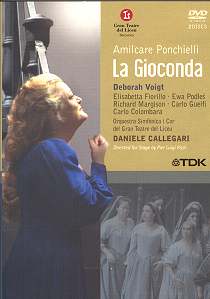
there is some first rate singing. Deborah
Voigt as La Gioconda, in bright blue
dress, has all the requisite power and
sings with feeling but she can also
be rather squally. She grows through
the performance however and in Suicidio!
in the last act she stands out for the
great dramatic soprano she is. She is
at times affected by what I believe
is unfavourable placing of the microphones.
As soon as singers move upstage they
lose focus. A pity. Barnaba is very
much the Iago of this opera and Carlo
Guelfi has the sinister tone and appearance
to suit the role, but he is dry-voiced
and unsteady. The second act aria
Pescator, affonda l’esca is however
done with a suitable swagger.
Quite the best singing
comes from Richard Margison, who besides
finding a lot of nuance in his part
has a still brilliant voice; the top
notes ring out impressively. His reading
of Cielo e mar may not be the
subtlest we have heard but he starts
it softly and the rest of the aria is
really thrilling. He is even better
in the ensuing duet with Laura with
some fine lyrical singing. Unfortunately
Elisabetta Fiorillo’s Laura is wobbly
and strained though undoubtedly dramatic.
Her set piece Stella del marinar
is powerful but a steady tone eludes
her, making most of the aria a liability.
As her husband Carlo Colombara, whom
I first heard on Morandi’s Naxos recording
of Verdi’s Requiem and was deeply
impressed, is a bit woolly in the first
act but comes into his his own in the
third where he cuts an imposing Alvise
and sings the recitative and aria that
open the act with dark steady tone.
Ewa Podles as La Gioconda’s
blind mother La Cieca, gets the audience’s
sympathy after the cruel treatment she
is subjected to and the aria Voce
di donna is sung with innate feeling.
Is this a recommendable
set? It depends on your priorities.
The sets are beautiful and evocative,
the direction and the acting under-nourished,
the crowd scenes impressive, the sound
full and atmospheric but the voices
are too often unfavourably balanced.
The Dance of the Hours is a must-see.
While the singing is variable the production
has a good Gioconda, a fine Alvise and
a thrilling and nuanced Enzo. I don’t
think I will return too often to it
as a whole, but with 55 cue points it
is easy to pick and choose among the
goodies and avoid the baddies.
Göran Forsling



 for
details
for
details Orquestra Simfònica I Cor Gran Teatre
del Liceu/Daniele Callegari
Orquestra Simfònica I Cor Gran Teatre
del Liceu/Daniele Callegari  TDK
DVWW-OPGIOC [2 DVDs: 174:00]
TDK
DVWW-OPGIOC [2 DVDs: 174:00] 











