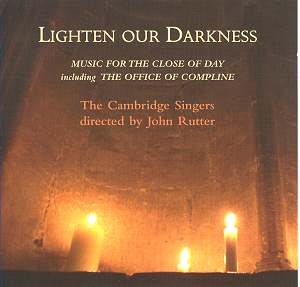
This new collection
in which John Rutter directs his Cambridge Singers finds Rutter
back at what I believe is his favourite location for recording
a cappella music, the lovely Lady Chapel at Ely Cathedral.
Over the years I’ve bought and enjoyed most of Rutter’s recordings
with the Cambridge Singers, including several featuring his
own music. However his best recordings of all have been the
anthologies of a cappella liturgical music, such as
this. This latest example is the finest of them all.
Rutter has had
the happy idea of marrying a recital of music for the close
of day with a complete Office of Compline. This is such a
good idea that I’m surprised no one – to the best of my knowledge
- has done it before. It does mean that the album requires
two CDs, one of them with a short running time. However, the
set is being sold, I believe, at the same price as one full-price
CD.
The choral music
on the first disc is well chosen and marvellously executed.
First we hear a group of seven pieces that are settings of
prayers associated with the evening liturgy. John Sheppard’s
sublime In pace makes a wonderful opening. It is sung
quite beautifully. At once the listener is aware of the choir’s
control of line and phrasing and their fine, even tone. These
are to be constant features of the performances on this disc.
Also one is conscious of the warm but not over-resonant acoustic
of Ely’s Lady Chapel. This lovely acoustic is to play an important
role in the success of this whole programme.
The Sheppard piece
that follows, the slow-moving seven-part Libera
nos, salva nos, is just as memorable. In his notes Rutter
refers to a description of Sheppard’s music as “a musical
counterpart to English Perpendicular architecture”. This particular
piece and the fine performance it receives, shows how apt
is that description. I also enjoyed very much Jacob Handl’s
Pater noster. This is for double choir, placed antiphonally.
However, rather unusually one choir comprises high voices
(SSAA), while its companion consists of lower voices (TTBB).
The separation is effective here. The extended, flowing ‘Amen’,
with the music passing back and forth from one choir to the
other is particularly to be noted.
Byrd’s Visita,
quaesumus Domine, from the 1605 Gradualia, is airily
scored for SSAT. This scoring gives the piece, in Rutter’s
words, “a texture of magical transparency”. It’s an absolutely
gorgeous little gem. The Rheinberger piece may seem to sit
a little oddly at the end of this group of sixteenth-century
polyphonic pieces. However, the chaste beauty of this seven-part
setting more than earns it its place.
The group of three
evening hymns that follows includes O gladsome light
by Louis Bourgeois. However, this isn’t quite what
it seems. It is, in fact, a metrical, rhymed translation,
by Robert Bridges, of the original Greek hymn which was included
in The English Hymnal of 1906. Rutter suggests that it may
have been Vaughan Williams himself who, as editor, married
the text to Bourgeois’s psalm-tune.
The crux of the
recital is the section devoted to Motets of the Virgin Mary,
a section dominated by Victoria’s settings of the four Marian
antiphons, which in their plainchant form were sung, according
to season, at Compline. All four of these settings are scored
for two four-part choirs. In three of the pieces that means
two groups of SATB but Regina caeli laetare
differs in calling for SSAT and SATB. The motets contrast
with each other very nicely. I love the short lilting section
at the words ‘Gaude, gaude, gloriosa’ in Ave Regina
caelorum and Regina caeli laetare positively
skips along – who said Victoria’s music was always austere?
The most extended and ambitious of the set is the concluding
Salve Regina. The piece is luxuriantly laid out for
double choir and the Cambridge Singers perform it quite beautifully.
I’m bound to say that the offering by Rachmaninov seems an
odd bedfellow in a group otherwise consisting of Iberian polyphony.
This lovely piece is always welcome, of course, but I wonder
if, to accommodate it, the contents of this group should have
been more mixed?
Finally we hear
two settings of In manus tuas. The one by Byrd is,
again, from the 1605 Gradualia. John Sheppard’s version
is even more tranquil and easeful. Since the music harks back
to that of the opening In pace, it makes a particularly
apposite and satisfying way to end the recital.
The second disc
is given over to the Office of Compline as presented in the
1928 revision of the 1662 Book of Common Prayer. Here one
of the tenors of the Cambridge Singers, John Harte, reads
the words of the celebrant in the spoken passages of the liturgy
while his tenor colleague, Simon Wall, sings the passages
allotted to the Precentor. Both discharge their roles commendably.
The plainchant passages, such as Psalm 91 and the office hymn,
Before the ending of the day, are delivered clearly
and in a well-measured manner. Purists might object that the
chant should be reserved to the male voices but I have no
problem whatsoever with the ladies of the choir taking their
part. I like the calm, measured way that the spoken passages
are delivered, both by John Harte and by the rest of the singers
in response. The whole is a completely believable rendering
of a lovely, pacific end-of-day liturgy and the essential
simplicity and intimacy of the service is properly conveyed.
And, of course, the language is wonderful.
The engineers
have captured both the singers and the acoustic of the building
most atmospherically. The singing is superb from start to
finish, mixing radiance and clarity to perfection. The documentation
accompanying the disc includes succinct but informative notes
and all the texts with English translations. This is a lovingly
performed and deeply satisfying pair of discs that should
be self-recommending to all lovers of the music of the English
church.
John Quinn
Collegium
Records



 for
details
for
details
 John Harte (Reader)/Simon
Wall (Precentor)
John Harte (Reader)/Simon
Wall (Precentor) 











