This is the third new
recording of the symphony to come my
way in the last few months and since
there is hardly any shortage of good
versions a clear first choice is not
easy to pick. Newcomers to the symphony
are advised to read the review of the
Wigglesworth (BIS) and Kofman (Dabringhaus
und Grimm) (http://www.musicweb-international.com/classrev/2006/Sept06/Shostakovich13_BISSACD1543_MDG93712056.htm)
recordings to find the pros and cons
of them as well as background information
about the work itself.
There could be a historical
reason to record Babi Yar in
Liverpool, since it was here that the
first performance in Western Europe
was given on 14 September 1971 with
the RLPO under Sir Charles Groves and
with John Shirley-Quirk as the bass
soloist. I can’t believe there were
many, if any, musicians from that performance
still playing in 2003, but that is of
no great importance. What matters is
that the RLPO has retained its excellence
and under its then principal conductor
Gerard Schwarz, who took over in 2001,
seems to be in very good shape in all
departments. They certainly produce
a homogenous sound and lots of power.
At the other end of the dynamic scale,
their hushed pianissimo, so important
in this symphony, is just as impressive;
listen to the softly intense playing
of the final pages. The production team
have ensured that the orchestra is expertly
recorded with wide-ranging dynamics.
Listeners should be warned that the
bass drum makes its mark ca.10.00 into
the first movement with such thundering
realism that those who are unprepared
will be literally lifted from the chair.
With an excellent contribution from
the male voices of the Royal Liverpool
Philharmonic Choir, Schwarz has the
best possible conditions for making
something memorable of this dark masterpiece
and on the whole he manages this with
flying colours. The only problem – and
the only reason for not giving a straightforward
recommendation – is that there are so
many other splendid versions available.
Even if I reduce the competition to
the ones mentioned above, there are
swings and roundabouts.
The other two are in
SACD, which of course can be a deciding
factor for those with multi-channel
equipment, while the present one is
in normal digital. Making some comparisons,
mainly with the Wigglesworth version,
which in the end was my recommendation,
Schwarz goes for sharper contrasts in
tempo. While the differences in the
first movement are marginal, Schwarz
gains a full minute in the Allegretto
second movement, which he loses plus
another 20 seconds in the Adagio
and a further good half-minute in the
Largo. In the final movement
they are again more even.
Taken on its own Schwarz’s
reading is fully valid with admirable
dynamic gradations and pin-point precision.
His second movement dances along with
a lightness and forward thrust that
is absolutely compelling. I can’t remember
hearing it played with such verve and
this movement alone makes the recording
highly desirable. The rest of the symphony
is not quite on the same level, the
marginally slower speeds in the Adagio
and Largo movements imply
a certain loss of tension as compared
to Wigglesworth. But make no mistake:
we are speaking of subtle differences
now. Without the direct comparisons
I would have been fully satisfied with
Schwarz. Moreover he has a real trump
card in his soloist. I greatly admired
Jan-Hendrik Rootering on the Wigglesworth
recording, and still do. He sings with
power, expressiveness and involvement
but Gidon Saks has an even greater intensity
and he has the finer voice. Rootering’s
is slightly worn and drier of tone while
Saks is rounder, warmer, more beautiful
and he has a far wider range of tonal
colours. There is also an inborn quality
in his voice which, for want of a better
expression, could be termed Russian
"sentiment". As opposed to
"sentimentality" this is,
in my vocabulary, a downright positive
denomination and it is very aptly demonstrated
ca. 7 minutes into the first movement
where he scales down his impressive
voice to ravishing lyrical beauty. In
the second movement he adjusts himself
to the lightness of Schwarz’s reading
and adopts an almost tenor-like tone.
All through the symphony he sings with
such tangible involvement and soaring
beauty that one time and again nods
and says: "This can’t be bettered".
There are so many memorable moments,
but just to pick one: in the bleak fourth
movement, Fears, where Yevtushenko
lists the many fears that surrounded
the Russian people, "the fear of
speaking to foreigners … even to
your own wife!", Saks’ voice
is so charged with emotion that he could
be speaking out of personal experience.
That movement - indeed
the whole symphony - is music that grows
on you with every hearing. Readers who
have not yet made the acquaintance of
Babi Yar are advised to attend
to this deficiency without delay. Even
if in the last resort I still have a
slight predilection for Wigglesworth
thanks to the overall greater intensity
and the fabulous playing of the Netherlands
Radio PO, any of the three versions
mentioned here is a worthy intermediary
of Yevtushenko’s and Shostakovich’s
touching message. For the deeply felt
singing of Gidon Saks the present version
should be heard and savoured by anyone
with a liking for this symphony, irrespective
of how many other recordings one already
has.
As with the other two
versions the documentation is splendid
as are the liner notes by David Fanning
and the anonymous ones about the poet
and the artists. Full texts, transliterated
and translated by Andrew Huth are also
included. A model of presentation, but
why did we have to wait more than three
years for its release?
Göran Forsling



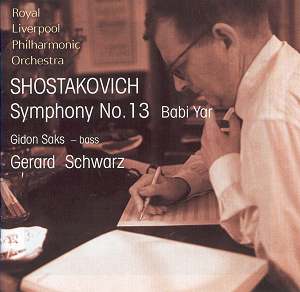
 Gidon Saks (bass)











