Leslie Howard’s Hyperion
recording of all the Tchaikovsky works
that could be labeled "sonatas"
first appeared in the mid-nineties and
has now been re-released in the lower-priced
Helios line. The fact that it took a
comparatively short amount of time for
this disc to make the jump to Helios
may have more to do with Hyperion’s
current woes than with the popularity
of the disc, which has always been extremely
well-received. In any case this recording
remains the standard for the second
sonata and indeed the only one of the
first.
Before going further,
we should attend to the numbering of
the sonatas, especially as most people
only know "the Tchaikovsky sonata".
The first is actually 172 bars of an
incomplete first movement that Leslie
Howard has extended to nearly twice
its length to complete. The second was
written a year after the first and gained
its late opus number when Taneyev published
various unknown works after the composer’s
death. It is a complete four movement
work with a few surprises. The Grand
Sonata has always been known as the
major work in the composer’s pianistic
output.
The F minor sonata
gets off to an interesting start that
is soon clouded with Schumannesque harmonies.
Howard plays it for all it’s worth,
his forceful pianism almost hiding the
place in the development section where
the original material breaks off. In
spite of the influence of Schumann,
this fragment shows that Tchaikovsky
has produced a work which distinctly
foreshadows those to come.
As we said above, the
sonata Op. 80 was written only a year
after the F minor work. But the composer
had grown a lot in that year. The harmony
is more individual and the writing seems
better suited to the piano; pace
those who feel that Tchaikovsky
couldn’t write for the instrument. The
main theme of the allegro may remind
one of Beethoven and Schubert, but the
material is handled in an individualistic
way, especially the contrast between
the themes. The andante is an early
example of the composer in his "None
but the Lonely Heart" mode, with
a Schumann twinge added. Formally, it
is an alternation between this sentimental
material and various mazurka-like passages.
Here Howard does his best to differentiate
between the various sections without
losing sight of the overall movement.
He handles the development of the first
theme at 5:04 extremely well. In the
short scherzo that follows I felt that
Howard’s ability to differentiate failed
him, but this was my only major complaint
with his playing of the sonata. The
trio of this movement is the one that
was later transposed a half step and
slightly altered to become the trio
in the scherzo of Symphony No.1, but
it is quite moving in its original form.
The fourth movement follows without
a break and begins with a not too exciting
display of rhetoric, with more influences
of Schumann. However, Tchaikovsky develops
his material in an increasingly interesting
fashion until it becomes a noble finale
that avoids bombast. Leslie Howard handles
the development of the movement with
both the strength and childlike whimsy
that were to be two of the composer’s
hallmarks.
The Grand Sonata has
been recorded many times and really
needs no introduction. I have always
preferred the versions made by Sviatoslav
Richter in 1954 and 1956. His combination
of power and poignancy (see above) produced
extremely well-balanced performances.
Leslie Howard has a somewhat similar
approach, although I think he leans
more to the poignancy. But there is
plenty of strength in his performance
and as in the second sonata he shows
a great ability to develop individual
sections of a movement while not losing
sight of the whole. Although he’s best
known for his titanic Liszt cycle, this
disc would have to count as one of his
best and also put him in the top rank
of Tchaikovsky interpreters. The transfer
from the original Hyperion disc is fine
and the pianist contributes some interesting
thoughts in the program notes. If only
for the Op. 80 sonata, this is a record
to have.
William Kreindler



 Leslie Howard (piano)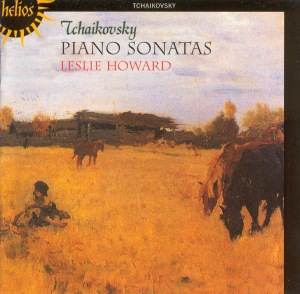
 for
details
for
details











