The
virile recording quality secured by Chris Hazell is the first
thing that hits you about this disc. But there’s more to it
than that.
Ole Schmidt is best known as a conductor who has
made far too few recordings. I had cause quite recently to
recommend strongly his Sibelius
and Borodin
collections on Regis. His early 1970s recording of the six
Nielsen
symphonies made history and remains the most life-enhancing
and vivid in the catalogue (Regis again).
Schmidt is a composer whose tutelage was served
with Vagn Holmboe, Finn Høffding, Jörgen Jersild and Niels
Viggo Bentzon. He was born in Copenhagen in 1928. After the
war he became a jazz pianist and continued this career while
studying at the Royal Danish Academy of Music. His conducting
lessons were learnt at the hands of Albert Wolff, Kubelik
and Celibidache.
His Piano Concerto of 1954 was broadcast on the
radio and made an early success. At about the same time he
wrote the score Bag Tæppet (Behind the Curtain)
for the Royal Danish Ballet. In fact there are a number of
ballet scores,. He also became music director of the company
in 1957 an appointment that continued until 1965. His ballet
experience is reflected in the airborne fantasy of the two
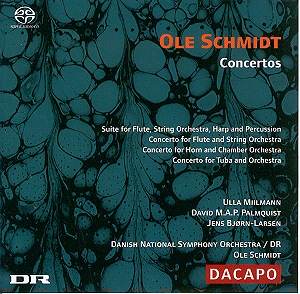
flute concertos recorded here. The writing in both cases has
the flightiness of the Nielsen concerto but without its wilder
anarchic element. The Horn Concerto is in two movements. It
shows Schmidt’s engagement with the ripeness of the romantic
schools - in itself extraordinary for 1966 - but its accenting
is contemporary. The golden cantilena at 1:52 in the
Largo recalls Malcolm Arnold while the moderately gritty
aspects link with the horn writing in Britten’s Serenade.
The work also struggles with nightmare visions (4:33). The
writing here is of a searing pressure. The Allegro giusto
has a bold striding metropolitan confidence and street-wise
heroism - at times redolent of Arnold. For sampling try the
ticking, ear-tickling syncopation of 4:20 onwards in the Allegro
giusto. This is a splendid display piece; all the stronger
because it has no vapid moments. The Tuba Concerto is in three
movements. It too reflects the romantic strain especially
in the ruminative and singing second movement although one
occasionally is aware of the ungainliness of the instrument.
In the brief final allegro there are some extraordinary
moments such as the rapid rolling sprouting figures for the
soloist at 2:20. It’s not as strong a piece as the Horn Concerto
but it will repay repeat hearings.
The Horn Concerto is a remarkable odyssey of a
work - surely one of the most masterful of the twentieth century’s
concertos for the instrument - and stands out in this company
for its sustained oxymoronic toughness and romance. The wonderfully
provocative writing is deeply harnessed to romantic models
but breathes a wholly contemporary ozone.
Rob
Barnett
BUY NOW
AmazonUK
AmazonUS




 [68:50]











