Unknown Mozart? Certainly it was to me, even though a few of the
compositions are well-known – but not in these settings. Clarinettist
Dieter Klöcker, who contributes the lion’s share of the obbligato
playing, explains in the liner notes that “it was by pure chance
that I was fortunate enough ... to stumble on the arias ... presented
here, while browsing through various collections – mainly in Eastern
Europe – of arias in which the voice is partnered by an obbligato
instrument - The quality of these rediscovered works was extraordinarily
high, particularly in the case of the arias with clarinet, probably
on account of the novelty of the sound of this, then, recently
invented instrument.” Further on he also admits that the authenticity
of some of the works is not fully confirmed – and probably never
will be. Never mind, whether Mozart or not it is still attractive
music, and there is always room for attractive music.
All of these arias
are settings of religious Latin texts, apart from the last of
them which is in German and could possibly be called quasi-religious.
The virtuosity required from both soprano and clarinettist hints
that it was probably conceived for concert purposes, but there
also exists a Latin text. Moreover all the other arias are to
greater or lesser extent virtuoso pieces. In 1987 little or
nothing seems to have been known about performances.
That Mozart loved
the clarinet is well-known and especially when played by his
friend, the “Bohemian wonder” Anton Stadler. He wrote two of
his most beautiful works for him, the clarinet quintet and the
clarinet concerto. He also used an obbligato clarinet - in one
case rather the basset horn - in two arias from La clemenza
di Tito, and one of them, Parto, parto ma tu ben mio
is heard here with the text Jesu dulcis memoria (track
5). Likewise the opening number Cor Sincerum, is an arrangement
of the E flat major aria Non temer, amato bene (K. 505)
composed originally to replace an aria from Idomeneo.
Alfred Einstein states that the aria was a declaration of love
to Nancy Storace, who is also the dedicatee. He had already
written an aria to the same text half a year earlier (K. 490)
for a private performance of the opera by Prince Karl Auersperg.
There he used a solo violin as obbligato instrument; with the
Latin text Domine Deus salutis meae, recorded here (track
7) he utilized the clarinet.
Generally speaking
the obbligato parts are challenges to even great virtuosos,
but the three we have here execute their solos with the utmost
elegance and confidence. In Helen Donath we have a Mozart singer
who encompasses even the heaviest demands the composer puts
upon her. Texan by birth she came to Europe at a very early
age and her break-through was as Pamina, a role she first sang
at Hannover. I first came across her, still young, as a lovely
Sophie in the now legendary Decca recording of Der Rosenkavalier
under Georg Solti. That was issued in autumn 1969 and has ever
since been my benchmark version. On the present disc she retains
much of her youthful timbre and lightness and beauty of tone,
even though she can’t hide that the years have passed. The tone
has hardened slightly, the vibrato widened ever so little but
her phrasing is so right and her technique, not least her coloratura
singing, is admirable.
The Suk Chamber
Orchestra play well, as was expected, under the direction of
the soprano’s husband. The sound, an original digital recording
remastered 24 bit/96 KHz, is worthy of the occasion. Dieter
Klöcker’s notes are personal and perspective building. The sung
texts are printed, although without translations. This may not
be an indispensable disc but with such high-quality singing
and playing it is well worth acquaintance – not perhaps for
continuous listening very often but for dipping into one or
two arias at a time. Don’t let the anaemic cover picture deter
you; the singing is full-blooded!
Göran Forsling
AVAILABILITY
Arts



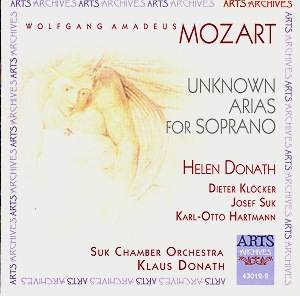
 Helen Donath (soprano),
Dieter Klöcker (clarinet) (tracks 1, 3, 5, 7, 9), Josef Suk (violin)
(tracks 2, 6), Karl-Otto Hartmann (bassoon) (tracks 4, 8)
Helen Donath (soprano),
Dieter Klöcker (clarinet) (tracks 1, 3, 5, 7, 9), Josef Suk (violin)
(tracks 2, 6), Karl-Otto Hartmann (bassoon) (tracks 4, 8)











