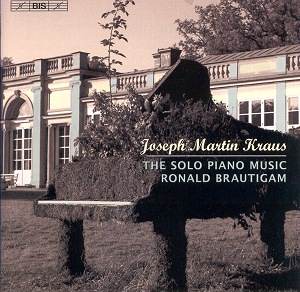
I have recently spent
some enjoyable time with Brautigam’s
fortepiano recordings of Mozart’s solo
complete piano music. I have now been
delighted to see that these performances
are played on another instrument by
Paul McNulty, this time based on an
early 1800s example by Walther &
Sohn. The sound is a little brighter
than the instrument used for the Mozart,
slightly more silvery, but with an equally
attractive colour and depth. Listeners
who may have been put off by creaky
old recordings of fortepianos in the
past will be reassured to hear such
beautifully made and tuned modern reproductions.
These are the sounds of the past brought
into the present as richly and accurately
as those which issue so beguilingly
from period music boxes, unchanged in
many generations.
Joseph Kraus is a name
which to me stands for the highest quality
in both imagination and craftsmanship.
This collection of his surviving piano
music is quite up to the expected standard.
Kraus has been describes as ‘the Swedish
Mozart’, and listening superficially
one can hear what is meant by such a
glib comparison. Lovers of Mozart will
certainly find the works on this disc
to their taste, but they will also find
themselves asking the question: ‘what
is it that makes Kraus different?’ Detailed
analysis no doubt reveals numerous variations
between the two composer’s fingerprints
when it comes to their piano writing.
Mozart was an opera composer, and so
many of his melodies could so easily
become arias. Kraus has something more
in common with Haydn and C.P.E. Bach,
with often less outspokenly lyrical
themes, occasionally a more quirky approach
to tonalities, major-minor relationships,
cadence formation, moments of counterpoint
and variety in his use of the left hand.
In the end, you find yourself asking
‘what would Mozart have done?’ and almost
invariably coming up with something
tangibly different to Kraus – making
Kraus Kraus, and not merely a pale imitation
of Mozart.
Taking the Scherzo
con variazioni as an introduction
we get all of the expected virtuoso
fireworks which might have appeared
in an improvisation over such a theme.
There are witty pauses and flights in
unexpected directions, conversations
between left and right hands, expressiveness
in the minor key and plenty of idiosyncratic
piano writing; a description of which
could easily apply to a far later composer
– but still existing within the strictures
of the classical idiom. The same is
true of the Rondo in F, which
gives more of a sense of the relationship
and influence of C.P.E. Bach, while
at the same time being a showpiece for
Kraus as a virtuoso communicator – keeping
the crowds happy with a grin and a wink
from behind his keyboard.
The two Sonatas are
works of substance and great intrinsic
interest. The CD opens with the slightly
later Sonata in E which stakes
its claim to be at the top of the heap
of late 18th century keyboard
sonatas in terms if its intricacy and
technical intensity. Just taking the
first minute or so of the second Adagio
movement the mind is sent on a journey
which is hard to grapple with on first
hearing. A deceptive, simple opening
theme is almost immediately challenged
by rising figures, followed with dissonances
and resolutions which seem to pop out
of nowhere. 30 seconds in and the opening
theme is already being subjected to
Brahmsian minor key torture in the lower
register, answered in the higher, and
tailing off with a plangent descent
which could end anywhere, and indeed
introduces a hefty remoteness of key
which has the brain grasping for straws
of familiarity – immediately granted
with further variations and diversions
on and around the opening theme (in
the new key). There is plenty of advanced
musical thinking going on here, reaching
deeply into Beethovenesque territory.
The marginally earlier
Sonata in E-flat posses an innocence
and openness of character, characterised
by largely two-part piano writing and
much elegance and lyricism. The central
Andante con variazioni has the
most adventurous and romantic character
of the three movements, reminding me
a little of Chopin’s variations on Rossini.
It almost goes without
saying that Brautigam revels in the
effectiveness of this music on such
a marvellous instrument. His effortless
technique brings out all of the charm
and, where necessary, the Sturm und
Drang passion to Kraus’s sometimes
remarkably adventurous piano writing.
The recording is placed in a Church
acoustic with a generous reverberation.
This helps the atmosphere, without detracting
from the all-important detail in this
music. I congratulate Bis’s engineer
Ingo Petry on the sound of this recording:
one has the feeling one is being given
a one-to-one private recital, seated
a comfortable distance from the piano,
but still able to see every bead of
sweat on the player’s forehead. I find
myself increasingly drawn to the fortepiano
sound, and be warned - modern instruments
can end up sounding quite flat and dull
by comparison.
Dominy Clements



 Ronald Brautigam (fortepiano)