Music
is a language without words. The equivocal nature of Mahler’s
Seventh Symphony makes performers respond in an individual way.
It is as if Mahler is setting a challenge that will separate
the creative from the conformists. In the same way, it is a
challenge for listeners. Can they follow the interpretation?
Can they feel what the performer is trying to express? There
are no “right” answers: the challenge is in the process. As
E.M. Forster said, “Only connect”. Sometimes when I listen to
this symphony I think of Mahler with his uncompromising intellect
and originality, looking at us, with a grin, whispering “Only
connect”.
What
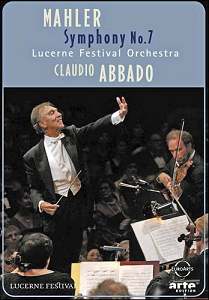
then is Abbado expressing? This version has the conductor working
with the Lucerne Festival Orchestra, an orchestra hand-picked
from among the finest musicians in Europe. The great names are here - Kolja Blacher, Antonello
Manacorda, Albrecht Mayer, Sabine Meyer and her Bläserensemble,
members of the Hagen and Alban Berg Quartets, members of the
Mahler Chamber Orchestra. Abbado has worked with them individually
and collectively many times, and they know each other well.
Coming together to play is an exhilarating experience, all the
more stimulating because it is a seasonal event, rather than
a regular fixture. This gives the performance a wonderful blend
of precision and spontaneity: these are musicians at the peak,
technically, playing for the sheer enjoyment of being together
and sharing their love of the music. This means Abbado can create
an unusually acute, chamber-like performance.
It
is the refinement and sensitivity of this interpretation that
is refreshing. Abbado recorded this in May 2001 with the Berlin
Philharmonic, when he was their chief conductor. That performance
was assured and expansive, making the most of the Berliners’
feel for the grand scale. Although many of the Berlin players
are on the Lucerne Orchestra too, Abbado has chosen a very different,
more sophisticated approach. The famed figure on posthorn that
signals the opening asserts itself, but leads naturally into
the ensemble, without overly dominating. This chamber approach
enhances details like the flurries in the exposition, warning,
perhaps, of “night winds” to come. What is even more striking,
though is the expert precision with which these players respond
to the conductor. They switch from the march theme to strings
as if they were a single organism. Playing of this calibre is
exciting, particularly when you appreciate just how many players
are involved. Abbado takes the march theme not as a rigid militarist
march but as something crisper, and faster paced. It is less
tied to 19th century reality, and becomes more abstract,
more timeless. In the first Nachtmusik, the horns are
exquisite, expressly like alpine horns ushering in nightfall.
The movement has a duality like that between night and day,
darkness and light. Yet, as in the first movement, the music
moves forward to the scurrying sounds of clarinets and pizzicato
strings. The swirling motifs in the Scherzo cut off with breathtaking
suddenness. They deliberately unsettle any complacency. This
same unsentimentality illuminates the second Nachtmusik.
Serenading mandolins and guitars are typical Romantic cliché.
Yet again, this orchestra lifts the movement out of the 19th
century with its clean, modern sound. Lush, resonantly mysterious
playing is a given, but then Abbado puts finger to mouth, indicating
gradual silence. The music softens into a strange, but convincing
combination of understated yet precise playing.
In
contrast, the Rondo Finale is even more electric. In his notes
to the recording, Donald Mitchell states: “The violent, unprepared
contrast is akin to parting the curtains in a dark room and
finding oneself dazzled by brilliant sunlight”. It’s an ambiguous,
contradictory movement, but what stands out is its powerful
sense of energy. This is where a crack orchestra like this proves
its worth. The precise, vivid commitment of this playing carries
all with it. This is its excitement. There’s no place here for
sloppy blurred playing. There is no need for the composer to
resolve the ambiguities of the night, which are part of nature.
Mahler throws himself into the light as if in an act of faith.
The Lucerne Orchestra explodes with sheer exhilaration. It’s
glorious. Abbado shines with happiness and clutches his chest
– an unconscious gesture, but one which for me was incredibly
poignant. Life is fragile, but Mahler lived it fully and passionately.
He wrote the equivocal Nachtmusiks before the rest of
the symphony. Perhaps then the Finale is, like Urlicht in
the Second Symphony, or the Finale in the Eighth, a statement
of faith in life itself? I don’t know. But this performance
certainly had me thinking on new lines, the sign of a truly
original and thought-provoking interpretation. One day, perhaps,
when audiences become more attuned to modern approaches to Mahler,
the Lucerne Festival concerts will be appreciated for their
role in developing Mahler performance practice.
Anne Ozorio
BUY NOW
AmazonUK
AmazonUS




 [78:00]











