I
had quite a salutary lesson while listening to this. On
the whole, I keep a score open while listening to discs
for review - where I’ve got one, obviously. There are many
artists who can provide us with real revelations as to
what the composer actually wrote. There are others who
are such a law unto themselves that it’s best to keep a
check on what they’re up to.
I
listened to the Mozart feeling that this was full of beautiful
things, even while it was all wrong in principle. Rests
are pedalled through, staccatos are made legato, legato
is made staccato, dynamics are ignored or reversed, accents
are ignored, others are put where none are written. Yet
what a gracious spirit lay behind it all.
Early
on in the Schubert something prompted me to lift my eyes
from the score – and I never looked at it again. Without
that impediment, I became aware of the grandeur and the
beauty of what I was hearing. It’s one thing to witness
how Kempff prepares for Schubert’s many modulations, when
you’ve got the score in front of you and can see the modulation
coming. But close your eyes and just listen, let him relate
this modulation to you in his way, in his own time, in
his own sound.
Bryce
Morrison’s wise notes point out that, while Furtwängler
may have called Géza Anda a “troubadour of the keyboard”, “the
description is even more ideally suited to Wilhelm Kempff”.
This, I think, is the hub of the matter. Although in reality
Kempff may not depart all that flagrantly from the score,
his spirit is nevertheless completely untrammelled by it,
and the score will only get in the way of our understanding
of what he has to tell. And, like a troubadour, he essentially relates,
the music, sings it. Just listen to the myriad of
delicate imaginings he finds in the Beethoven where so
many others find only severity and asperity. His “Vivace
alla Marcia” may not be note-perfect (but it is not the
garbled mess Schnabel left us) yet it is so full of joy,
and unlike that of Richter – who could physically play
it much better – it convinces us that Beethoven was writing
real and beautiful piano music. In the first of the Brahms
pieces he gives us a more flowing tempo than usual – at
last, I thought – while he shows the C major intermezzo – often
made to sound inconsequential – to have a wider range of
expression than we thought.
For
most of this programme I was just dying to sit down at
the piano at the end and try to play that Schubert sonata
with something – just a tiny little something – of
Kempff’s freedom and poetry. But I knew it was impossible.
I sat down and played some other Schubert – it seemed safer.
Don’t
be discouraged by the fact that the sound is limited -
it’s from a private source not an original BBC taping -
or that you may have recordings of Kempff playing at least
the Schubert and Beethoven in the studio. A Kempff recital
would often take wing in ways of its own, and this CD gives
you a fair idea of what it must have been like to attend
one. Just a query: surely it can’t have been played in
this order? The Mozart and Beethoven must have made the
first half, the Schubert the second, with the Brahms as
encores.
Christopher
Howell
BUY NOW
AmazonUK AmazonUS



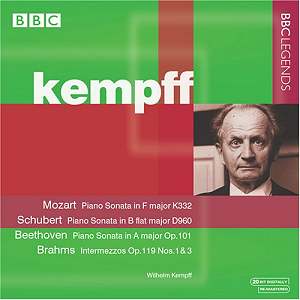
 Wilhelm
Kempff (piano)
Wilhelm
Kempff (piano) 











